Mid-Century Lounge Chair Restoration in Fort Collins: Scissor Legs Refinished, Frames Brought Back, and a Collaboration Worth Seeing
There are projects that come out of the shop and make everyone stop walking.
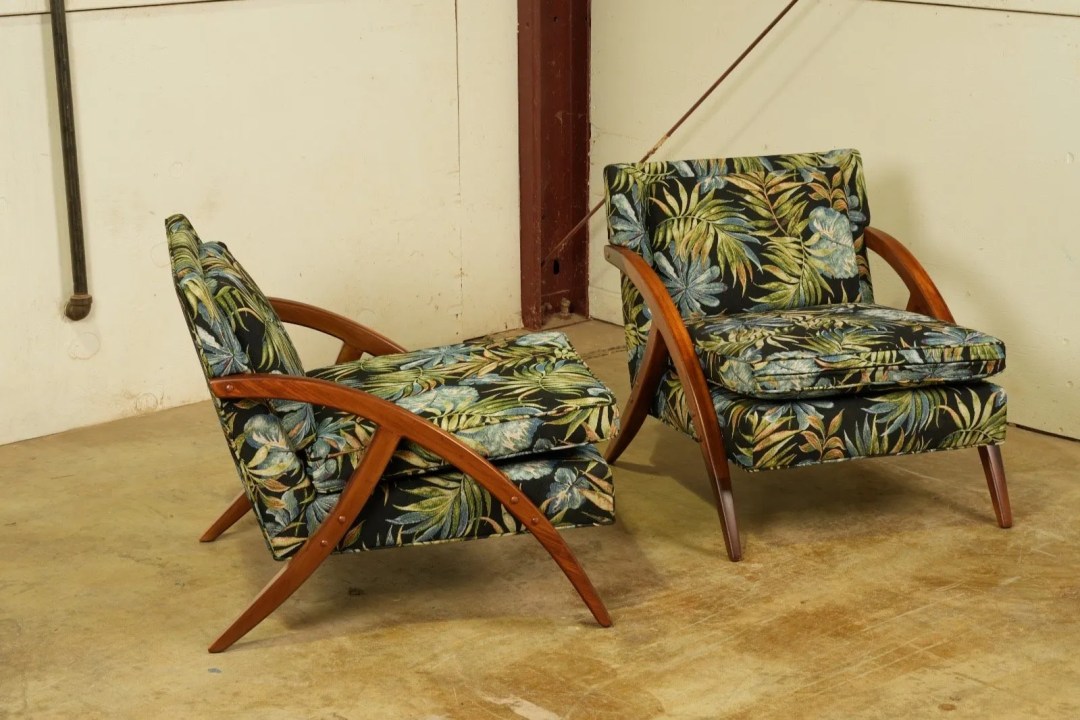
These two mid-century lounge chairs were that kind of project. The scissor-style curved legs are the kind of design detail that mid-century furniture does better than anything made before or since: dramatic without being loud, sculptural without sacrificing function, and built with a confidence in the form that contemporary furniture rarely matches. When a pair of chairs like this comes in needing work, you treat the assignment seriously.
This project was also something a little different from the usual workflow at our shop. The wood refinishing on the frames and legs came through us. The reupholstery went to our partners at Sparrow House of Design here in Fort Collins. The two trades landed on the same piece at the same time, and the result is the kind of thing that happens when two shops who care about the craft work toward a shared outcome rather than just completing their own portion and handing it off.
Project Overview
-
Full assessment of the frame and leg condition on both chairs before refinishing work began
-
Wood refinishing on the scissor-style curved legs and frames, developing a warm, even walnut tone throughout
-
Grain enhancement and surface consistency confirmed across all curved leg and frame surfaces on both chairs
-
Coordination with Sparrow House of Design on the reupholstery scope, fabric selection, and sequencing of the two trades
-
Final review of both chairs together as a matched pair before delivery
The Chairs: What Makes Scissor-Leg Mid-Century Design Worth This Level of Attention
The scissor leg, sometimes called an X-base or cross-leg configuration, is one of the more architecturally ambitious design moves in the mid-century modern furniture vocabulary. It requires the leg structure to do two things simultaneously: provide stable support for the chair and serve as a visual focal point that carries as much design weight as the upholstered seat and back above it.
Getting that geometry right in solid wood is not straightforward. The curved scissor legs on these chairs sweep outward from the base and inward toward the seat in a continuous arc that has to be consistent across all contact surfaces. The wood grain has to read correctly through the curves. The finish has to be even across transitions that face different directions and catch light differently depending on where you are standing relative to the chair.
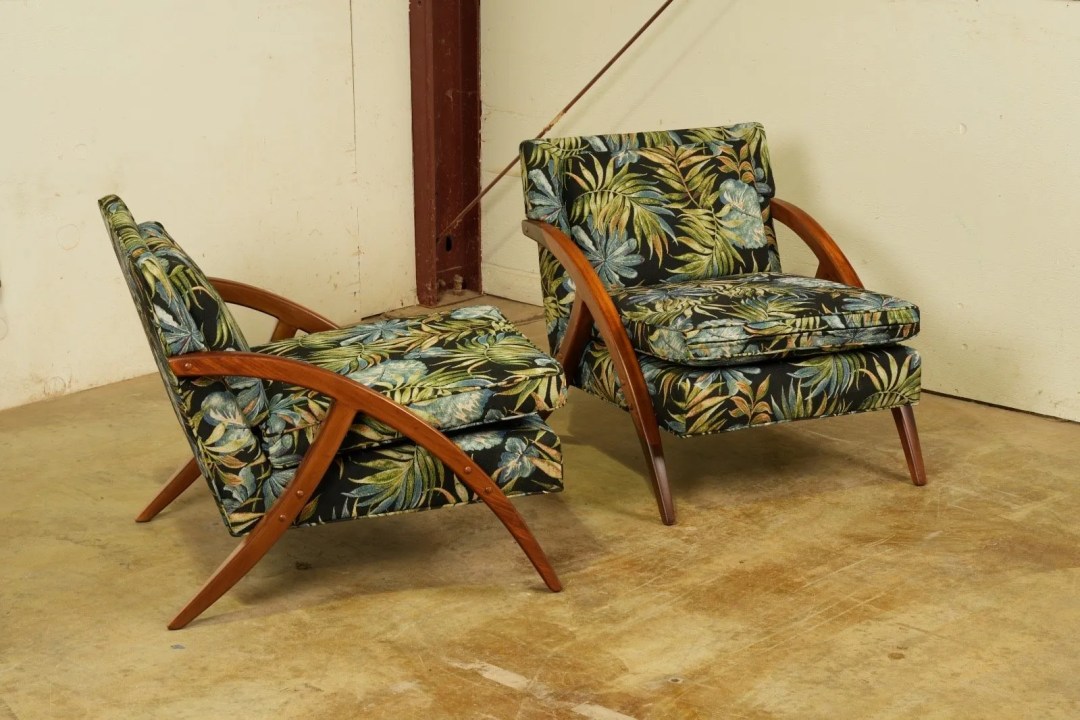
These chairs do all of that correctly. The scissor legs have a confident, clean sweep to them that reads from across a room and holds up to close inspection. The walnut used in the frames has genuine grain character that the refinishing process was designed to bring forward rather than flatten. And the proportions of the seat and back in relation to the leg structure are balanced in a way that lets the visual drama of the base exist without overwhelming the overall form of the chair.
Mid-century modern furniture of this quality is increasingly recognized as significant American design, and the Denver Art Museum’s decorative arts and design collection includes important examples of the postwar American furniture design movement that produced chairs with exactly this kind of structural and visual ambition. Restoring pieces like these correctly keeps them in use and in homes rather than in storage or lost entirely.
The Wood Refinishing: Walnut Frames and the Challenge of Curved Geometry
The refinishing scope on these chairs was focused on the legs and frames: the walnut structural elements that define the visual character of the piece and carry the entire design concept.
Both chairs came in with frame finish that had dulled and worn unevenly, with the curved leg surfaces showing the most deterioration. This is typical for mid-century lounge chairs that have been in active use: the legs take contact from shoes, furniture legs, and general handling that the upholstered sections do not, and the finish on curved wooden legs tends to wear at the transition points where the geometry changes direction.
The assessment confirmed that the existing finish could not be successfully restored through touch-up work. The deterioration was too uneven across the curves to produce a consistent result without a complete strip and refinish. Starting from bare wood on both sets of frames was the right approach.
Surface preparation on curved scissor legs requires patience and appropriate tools. There are no flat reference surfaces. The geometry changes continuously from the base through the crossing point and up to the seat connection. Sanding and preparation that does not follow the curve of the wood will produce flat spots and transitions that read in the finished surface. Hand preparation throughout, following the actual geometry of each leg, is what allows the refinished surface to flow correctly through the full arc of the form.
The color direction was a warm walnut tone: rich and brown with enough red-orange warmth to complement the grain character of the wood without reading as orange or cherry. Getting that tone consistent across both chairs and across all the varied surfaces of the curved frames, inside curves, outside curves, the flat seat connection plates, required evaluating the color at multiple stages and under different lighting conditions before proceeding to the finish coats.
This kind of careful color and surface work on curved mid-century frames is part of the broader furniture repair and antique furniture restoration work we do every day in the shop.
The Collaboration: What Sparrow House of Design Brought to This Project
Reupholstery and wood refinishing are separate trades, and on a project like this one they have to work together rather than sequentially and independently.
The fabric choice on these chairs, a bold tropical botanical print on a dark background with greens, blues, and warm amber tones in the leaf pattern, is exactly the kind of selection that either works completely or fails completely against a warm walnut frame. There is no middle ground with a combination this specific. The Sparrow House of Design team made the call correctly. The dark ground of the fabric lets the warm walnut of the frames read clearly against it rather than competing with the upholstery. The leaf colors in the print pick up the amber and warm brown tones in the walnut wood. The result is a chair where the wood and the fabric feel like they were always meant to be together.
Coordinating the sequencing of two trades on the same piece matters more than it might seem. The wood refinishing has to be complete and fully cured before the upholstered sections are installed, because any contact between uncured finish and fabric can transfer. The upholstery has to be installed with the finished frames already in their final state so the fabric sits correctly against the wood at all contact and transition points. Getting that sequencing right, and communicating clearly between the two shops throughout the process, is what produces a finished chair where every element looks intentional rather than assembled.
For clients in Fort Collins, Old Town, and the surrounding areas who need both wood frame restoration and reupholstery on a chair, sofa, or other piece, we coordinate regularly with upholstery partners and can discuss sequencing and scope at the point of estimate. Our upholstery repair page has more on how we approach projects that involve both trades.
The Finished Pair: Two Chairs, Two Trades, One Cohesive Result
Both chairs left the shop as a matched pair. The walnut tone is consistent across all frame and leg surfaces on both chairs. The scissor legs read with the warmth and grain depth the wood always had, now visible through a finish that protects without flattening. The upholstery by Sparrow House of Design sits correctly against the finished frames at every contact point.
The combination works. The drama of the scissor leg geometry is still the first thing you see. The warm walnut tone and the bold tropical fabric are the second and third things, and they reinforce each other rather than competing. These are chairs that belong in a room where they can be seen and used, not in storage.
Mid-century furniture built with this kind of structural ambition was designed to last. It has, and these two chairs will continue to.
Services Included in This Mid-Century Lounge Chair Project
Complete condition assessment of both chair frames and legs before refinishing Full strip and surface preparation on all curved scissor legs and frame elements Custom warm walnut tone developed and applied consistently across both chairs Multi-coat protective finish system applied and leveled on all frame surfaces Trade coordination with Sparrow House of Design on reupholstery sequencing and fabric installation Final paired review of both chairs before delivery
Have Mid-Century Chairs, Wood Frames, or Lounge Furniture That Needs Refinishing?
If you have mid-century lounge chairs, a sofa frame, dining chairs, or any wood furniture with worn or damaged finish on the frames or structural elements, we would be glad to assess what the refinishing work involves. We handle wood frame restoration on upholstered pieces regularly, and we work with upholstery partners when a project involves both trades.
We serve clients throughout Fort Collins, including Old Town, Midtown, and the surrounding neighborhoods, as well as Loveland, Windsor, Boulder, Longmont, Denver, and the greater Denver metro area. Pickup and delivery are available throughout our service area.
Send photos to shop@gmrestores.com or call us at 970-493-8737. Free estimates on all projects.
113 Hickory Street, Fort Collins, Colorado 80524 | (970) 493-8737 | shop@gmrestores.com
Frequently Asked Questions: Mid-Century Chair Wood Frame Restoration in Fort Collins
Can the wood frames on upholstered mid-century lounge chairs be refinished without removing the upholstery?
In most cases, the upholstery needs to come off or be carefully protected during the refinishing process. Chemical stripping materials and finish products are not compatible with fabric, and spray or brush application of finish in close proximity to upholstery risks transfer and damage to the fabric. On a project where the upholstery is being replaced as part of the same restoration, the sequencing is straightforward: strip and refinish the frames first, cure fully, then have the new upholstery installed. On a project where the existing upholstery is being preserved, the scope and protection approach is discussed at the point of assessment.
How do you get consistent finish on curved scissor legs across a matched pair of chairs?
Consistency across a matched pair requires evaluating both chairs together throughout the finishing process rather than completing one and then matching it. Color tone and sheen level are evaluated on both frames simultaneously at each stage, and adjustments are made to keep both chairs developing in the same direction. The curved geometry of scissor legs also requires hand preparation and application rather than flat-block sanding, which is what allows the finish to flow correctly through the full arc of each leg rather than producing flat spots at the transition points.
Do you work with upholstery shops on projects that need both wood refinishing and reupholstery?
Yes. We coordinate with upholstery partners on projects that involve both trades, and we manage the sequencing to ensure the wood refinishing is complete and fully cured before upholstered sections are installed. For clients who need both services, we can discuss the full project scope at the point of estimate and coordinate directly with the upholstery partner so the client is not managing the handoff between two separate shops.
Where can I get mid-century chair frames refinished near Fort Collins or Denver?
Michaels Restoration has been handling wood furniture refinishing and restoration from our Fort Collins shop since 1985. We serve clients throughout the greater Denver metro area including Boulder, Longmont, Loveland, Arvada, Lakewood, Aurora, Windsor, and Denver proper, as well as neighborhoods throughout Fort Collins including Old Town and Midtown. Free estimates are available on all projects, and we offer pickup and delivery throughout our service area. Send photos to shop@gmrestores.com or call 970-493-8737 to get started.
Located in the historic city of Fort Collins, Colorado, G. Michaels Restoration is an experienced furniture repair and antique furniture restoration shop serving Fort Collins, Loveland, Windsor, Boulder, Longmont, Denver, and the greater Denver metro area.
113 Hickory Street, Fort Collins, Colorado 80524 | (970) 493-8737 | shop@gmrestores.com
Located in the historic city of Fort Collins, Colorado. G. Michael’s is an esteemed furniture repair and antique furniture restoration wood shop.