Heywood-Wakefield Coffee Table Restoration in Fort Collins: Bringing a Mid-Century Icon Back to Life
There are pieces that come through the shop and pieces that arrive. This Heywood-Wakefield coffee table arrived.
Anyone who knows American mid-century modern furniture knows the name. Heywood-Wakefield produced some of the most recognizable domestic furniture of the postwar period: clean, sculptural, built from solid birch, and finished in those signature warm tones that defined a certain version of the American living room in the 1950s. The company’s pieces were designed by serious designers and made with genuine craft attention. They were not mass-market throwaway furniture. They were built to last, and the ones that have been properly cared for across seven decades prove it.
This coffee table had the bones of a great piece. The sculpted splayed legs, the softly rounded top, the proportions that make Heywood-Wakefield furniture so immediately recognizable were all there. What it needed was a full restoration to get it back to the standard the piece was built to. We were glad to do it.
Project Overview
Complete disassembly of the coffee table before any restoration work began Full strip of all existing finish down to bare wood across all components Surface preparation and repair on all table surfaces and leg elements Custom finish application rebuilt to match the signature Heywood-Wakefield warm honey tone Full reassembly and final inspection before the piece was returned
The Piece: Why Heywood-Wakefield Furniture Deserves This Level of Care
Before the process, the piece deserves its own moment.
Heywood-Wakefield as a furniture manufacturer has a history stretching back to the nineteenth century, but the pieces that collectors and design enthusiasts pursue today are primarily from the company’s mid-century modern period, roughly 1936 through the mid-1960s. During this period the company produced furniture that was genuinely innovative for its time: solid birch construction, organic curved forms, and a finishing approach that became so distinctive it is essentially the definition of the style.
The warm tones Heywood-Wakefield used, the honey and wheat finishes that appeared across their catalog, were not arbitrary color choices. They were developed to work with the natural character of birch and to produce a surface that reads warm and welcoming under the artificial lighting that defined postwar American interiors. Those finishes are part of what the furniture is. Restoration that does not respect the original color intent produces something that looks like a Heywood-Wakefield piece without actually being one.
This coffee table shows the hallmarks of the brand’s best work from the period: the splayed leg geometry that lifts the form visually off the ground, the rounded top that softens an otherwise spare silhouette, and proportions that are exactly right for the scale of a mid-century American living room. It is a designed object, not just a piece of furniture, and it was treated accordingly throughout the restoration process.
The Colorado Preservation organization has documented the significance of mid-century modern objects and interiors as a meaningful part of Colorado’s domestic design heritage, noting that well-preserved and well-restored examples from this period are increasingly recognized as important artifacts of twentieth-century material culture. Heywood-Wakefield pieces sit squarely within that tradition. They were made to be lived with, and restoring them correctly is how they continue to be.
The Assessment: What the Table Needed Before Any Work Began
When a piece with this kind of significance comes into the shop, the first step is a thorough assessment before anything is touched. Restoration decisions made without a complete understanding of the piece’s condition will produce a result that does not hold up.
The assessment on this table covered several areas. The condition of the existing finish across all surfaces, including the top, the apron, and all four leg elements, was evaluated for depth of wear, adhesion failure, and any areas where previous repairs or touch-up work might affect the approach. The structural integrity of the joints connecting the legs and apron was confirmed. The birch substrate across all components was checked for any surface damage, staining, or lifting that would require attention before finishing could begin.
The conclusion from the assessment was clear: this piece needed a complete strip and refinish rather than targeted touch-up work. The existing finish had deteriorated past the point where surface restoration would produce a consistent result. Getting the piece back to the standard it deserved meant starting from bare wood.
That is the honest answer on a lot of pieces that come to us presenting as candidates for touch-up. It is not the easiest answer to give, because a full restoration is more work than a surface treatment, but it is the right one when the finish has reached a point where building on top of it will only transfer the problem rather than solve it.
Our antique furniture restoration process always begins with this kind of complete assessment. The work that follows is only as good as the understanding that precedes it.
Disassembly: Why We Take the Table Apart Before Starting
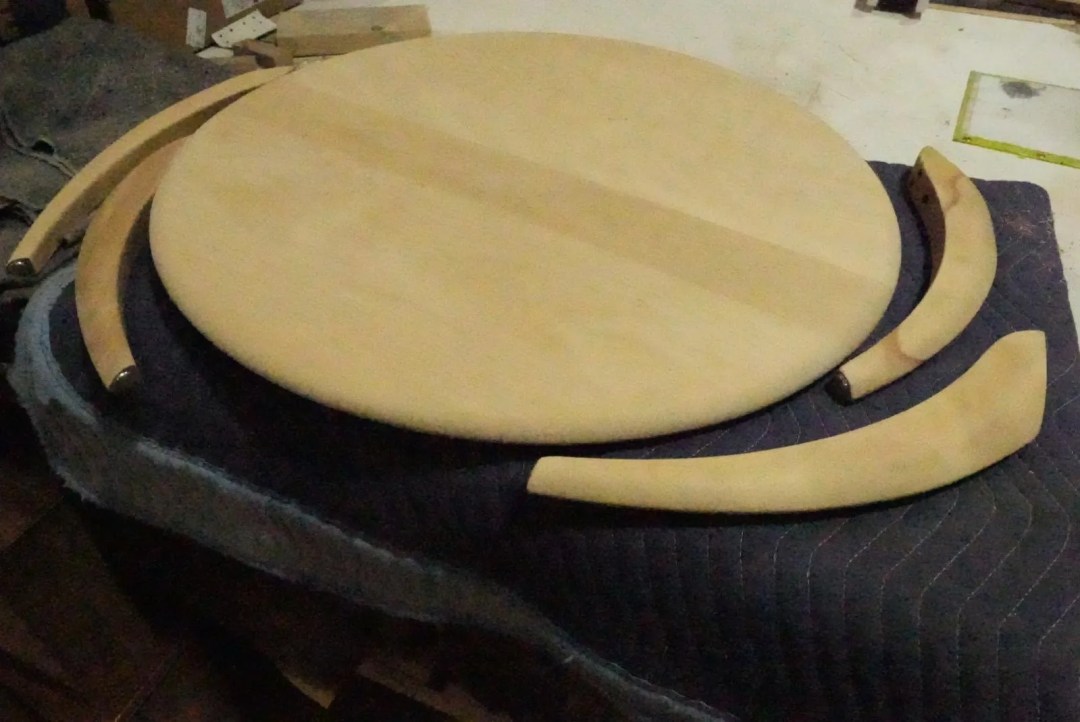
The first physical step in this restoration was complete disassembly of the coffee table.
This is not the approach every shop takes on a piece like this, and it is worth explaining why we do it. Working on assembled furniture creates constraints. Interior surfaces at joints are inaccessible. Cleaning and stripping solutions can pool in areas that are difficult to flush and monitor. Finish application on leg elements that are still attached to the apron will produce buildup and inconsistency at the joint transitions. And when the piece is reassembled after the finish is complete, the joint surfaces are coated rather than bare wood to bare wood, which can compromise adhesion and long-term stability.
Disassembly before restoration removes all of those constraints. Every surface of every component can be accessed, prepared, finished, and inspected individually. The result is a piece where the finish is complete and consistent from every angle, including the areas that are not visible once the table is assembled, and where the structural joints are clean and tight.
For a Heywood-Wakefield piece, disassembly is also a useful diagnostic step. The joint construction on furniture of this era tells you a lot about what the piece has been through: previous repairs, replacement components, and structural issues that are not visible from the outside are much easier to identify with the piece apart than with it assembled.
Stripping to Bare Wood: Removing What Was There to Get Back to What Matters
With the table disassembled, every component went through a complete strip process to remove all existing finish down to bare birch.
Stripping a piece like this is not a shortcut operation. Heywood-Wakefield furniture from this period was finished with care, and the original finish, even in a degraded state, can bond tenaciously to the birch surface. Working too aggressively risks raising grain or damaging the surface underneath. Working too gently leaves finish residue that will interfere with the new finish system.
Our furniture stripping process on pieces with period finishes is controlled and staged. Materials are selected for compatibility with the substrate, applied to dwell correctly, and removed completely before the next step begins. After the chemical strip, all surfaces were neutralized and lightly abraded to bring the birch to a consistent, clean, ready-to-finish condition.
The birch under the old finish looked exactly as it should: pale, even-grained, and ready to receive stain and finish evenly across all surfaces. Good material does not lie. Seventy-year-old birch that has been protected by even a deteriorated finish is often in excellent condition, and this table was no exception.
Rebuilding the Finish: Matching the Heywood-Wakefield Tone
Finishing a Heywood-Wakefield piece is a color problem before it is a technical one.
The signature warm honey tone that defines the brand is a specific target, and it is not one that can be hit by selecting a standard stain from a rack and applying it once. The tone Heywood-Wakefield achieved is warm but not orange, golden but not yellow, and it has a depth that comes from a finish system applied in a way that lets the birch grain show through rather than sitting behind it. Matching it requires evaluating the color at each stage of the process and adjusting until the result is right.
We built the color in layers, evaluating the tone under different lighting conditions at each stage to confirm the direction before proceeding. Birch has a relatively closed grain compared to oak, which means it absorbs stain more evenly but also means that color depth has to be developed more deliberately through the finishing layers rather than through the grain variation of the wood itself. Getting the warmth and glow that makes a Heywood-Wakefield piece look the way it is supposed to look requires attention to how the color is building across the full surface rather than evaluating it from a single angle under a single light source.
Once the color was confirmed, the protective finish system was applied in stages with proper dry time and light leveling between coats. The final surface across all components is smooth, even in sheen, and consistent in tone from the top surface through the apron and down all four leg elements.
This kind of careful color and finish work on mid-century pieces is part of the broader table refinishing and restoration and furniture repair work we do every day at G. Michaels Restoration.
Reassembly and Final Inspection
With all components finished, dry, and confirmed individually, the table was reassembled with the same attention to fit and alignment that went into every earlier step.
Reassembly after a complete restoration is not the same as putting furniture back together after moving it. The joints come together on freshly finished components, and the alignment of the leg geometry has to be confirmed and adjusted while the assembly is still workable. Heywood-Wakefield’s splayed leg design is part of what makes the form visually distinctive, and the angles have to be right for the finished piece to look the way it is supposed to look.
After reassembly, the complete piece was evaluated under multiple lighting conditions for finish consistency, color accuracy against the target tone, structural stability, and overall appearance. The result cleared every part of that evaluation before the table left the shop.
The Finished Piece: What It Looks Like When the Work Is Done Right
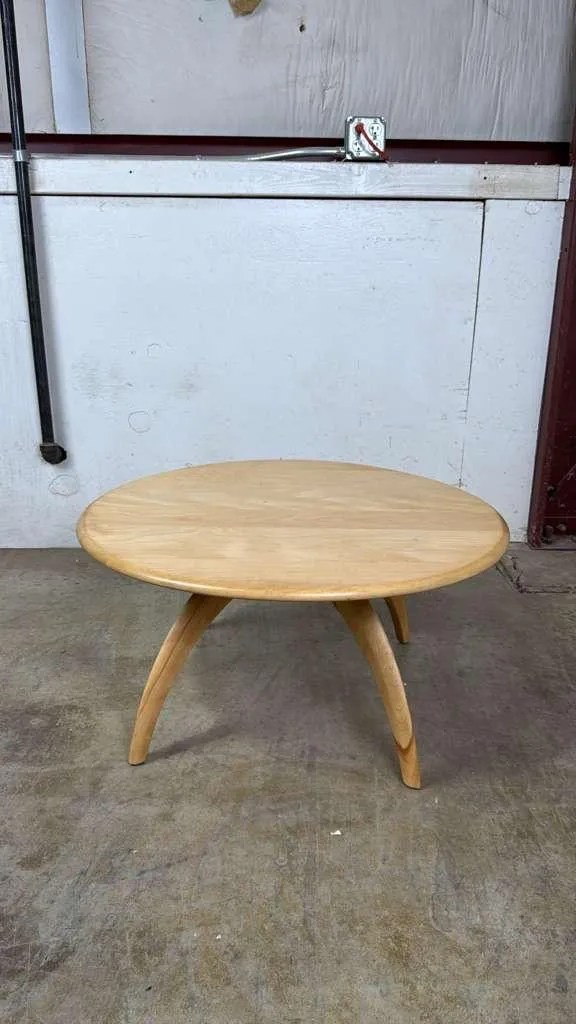
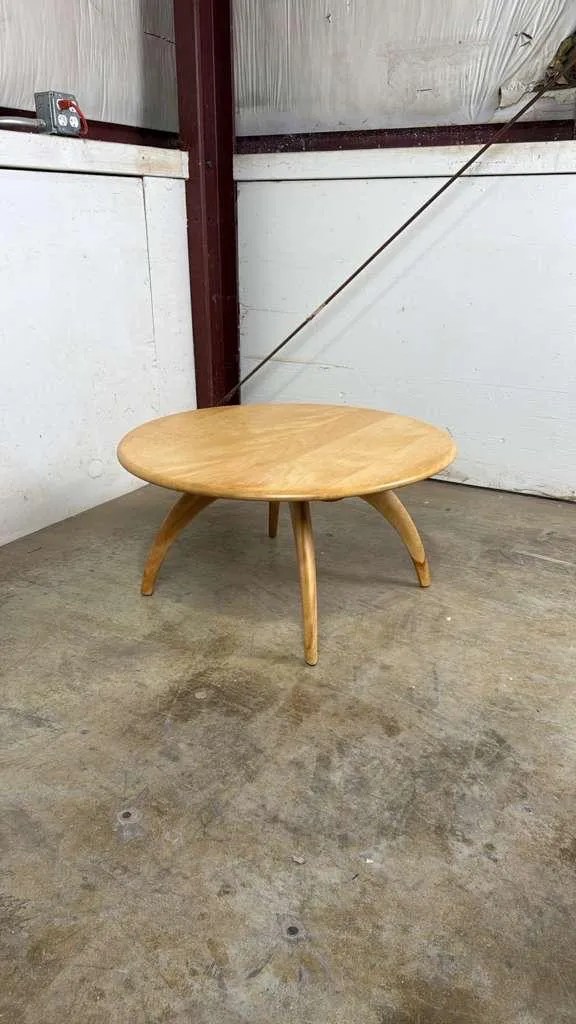
The finished coffee table looks like it just came out of a 1950s showroom. That is not an exaggeration and it is not marketing language. It is the honest description of what happens when a well-built piece receives a restoration process that respects what it is.
The warm honey tone is back. The birch grain reads clearly through the finish with the depth and warmth that made these pieces so well-regarded. The splayed legs and rounded top read the way they were designed to read. The surface is even and smooth from every angle.
This table was made to be in a living room, used, looked at, and enjoyed. It is back where it belongs.
Services Included in This Heywood-Wakefield Restoration
Complete disassembly of the coffee table before restoration work began Full chemical strip of all existing finish to bare birch on all components Staged surface preparation and inspection on all table surfaces and leg elements Multi-layer custom finish application matched to the original Heywood-Wakefield warm honey tone Structural reassembly with leg geometry confirmed and aligned Final quality inspection under multiple lighting conditions
Have a Heywood-Wakefield Piece or Mid-Century Modern Furniture Waiting for Restoration?
If you have a Heywood-Wakefield coffee table, dining set, dresser, or any other piece sitting in storage because it has seen better days, do not let it sit another season. These pieces were built to be used, and a proper restoration will get them back into a home where they belong.
We handle mid-century modern furniture restoration with the same care and process attention we apply to antique pieces. Color matching to original manufacturer tones, complete strip and refinish, structural repair and reassembly: all of it is within scope.
We serve clients throughout Fort Collins, Loveland, Windsor, Boulder, Longmont, Denver, and the greater Denver metro area. Pickup and delivery are available throughout our service area.
Send photos to shop@gmrestores.com or call us at 970-493-8737. Free estimates are available on all projects.
113 Hickory Street, Fort Collins, Colorado 80524 | (970) 493-8737 | shop@gmrestores.com
Frequently Asked Questions: Heywood-Wakefield Furniture Restoration in Fort Collins
Can the original Heywood-Wakefield honey or wheat finish tone be accurately matched during restoration?
Yes, though it requires a deliberate, staged approach rather than a standard single-stain application. The warm tones that define Heywood-Wakefield furniture are a specific color target that has to be built in layers and evaluated under multiple lighting conditions throughout the finishing process. Birch, the wood used in Heywood-Wakefield production furniture, has a closed grain that absorbs color evenly, which means depth and warmth in the finish have to be developed through the finishing layers rather than through grain variation. When the process is done correctly, the result matches the original color intent closely enough that the piece reads as authentic rather than refinished.
Is it worth fully restoring a Heywood-Wakefield piece rather than trying to touch it up?
For pieces where the existing finish has deteriorated significantly, a full restoration almost always produces a better and more durable result than surface-level touch-up work. Touch-up on a degraded finish can produce an inconsistent surface where the repaired areas read differently than the surrounding original finish, particularly on a flat top surface where the light hits evenly. A complete strip and refinish removes the variable entirely and allows the new finish to be developed consistently across the full piece. For collectors and design enthusiasts who want a Heywood-Wakefield piece to look and perform correctly, full restoration is the right call when the finish has reached a significant level of deterioration.
Should Heywood-Wakefield furniture be disassembled before refinishing?
We disassemble pieces like this before restoration work begins whenever the construction allows it, and most Heywood-Wakefield coffee tables and case pieces are good candidates for disassembly. The reasons are practical: disassembly allows complete access to all surfaces including joint areas, makes stripping and finishing more controlled and consistent, and allows structural inspection of joint conditions that are not visible on an assembled piece. Reassembly after finishing also produces cleaner joints than trying to work around assembled components. The extra steps are worth it in the quality of the result.
Do you restore mid-century modern furniture beyond Heywood-Wakefield?
Yes. We work on mid-century modern pieces from a range of American and European manufacturers, as well as custom and unmarked furniture from the period that shares the design and construction characteristics of the era. The approach on mid-century pieces is the same as on antique furniture: assess the piece honestly, determine what it needs, and execute the work at a standard that respects the quality of what was originally built. If you have a mid-century modern piece in any condition, send photos and we will give you an honest assessment.
Where can I get Heywood-Wakefield furniture restored near Denver or Fort Collins?
Michaels Restoration has been working on furniture of this quality from our Fort Collins shop since 1985. We serve clients throughout the greater Denver metro area including Boulder, Longmont, Loveland, Arvada, Lakewood, Aurora, Windsor, and Denver proper. Free estimates are available on all furniture restoration projects, and we offer pickup and delivery throughout our service area. Send photos to shop@gmrestores.com or call us at 970-493-8737 to get started.
Located in the historic city of Fort Collins, Colorado, G. Michaels Restoration is an experienced furniture repair and antique furniture restoration shop serving Fort Collins, Loveland, Windsor, Boulder, Longmont, Denver, and the greater Denver metro area.
113 Hickory Street, Fort Collins, Colorado 80524 | (970) 493-8737 | shop@gmrestores.com
Located in the historic city of Fort Collins, Colorado. G. Michael’s is an esteemed furniture repair and antique furniture restoration wood shop.