Antique French Oak Buffet Cabinet Restoration in Fort Collins: Split Top Repair, Full Refinish, and Hand-Carved Detail Preserved
Some projects stop you in your tracks before the work even begins.
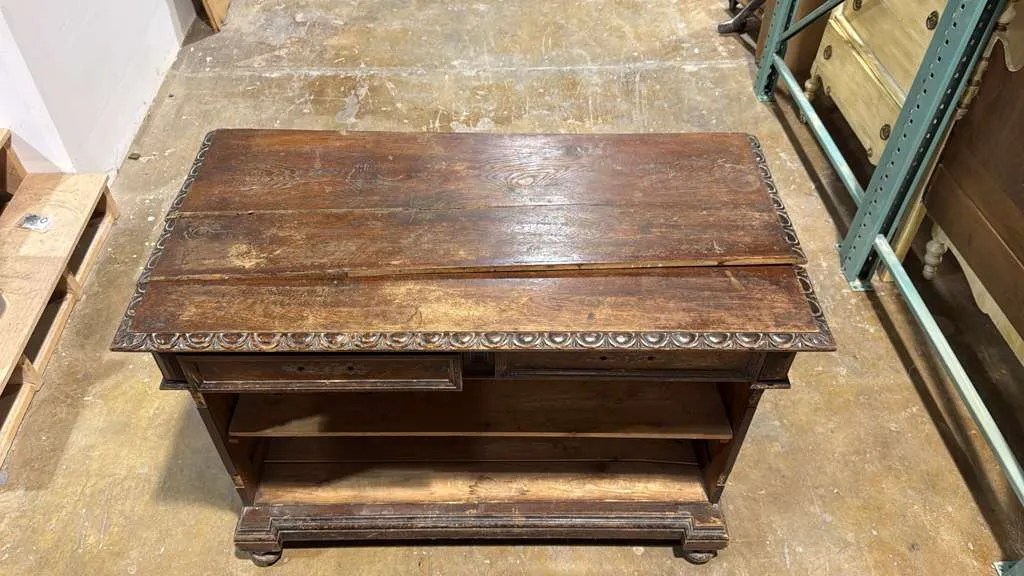
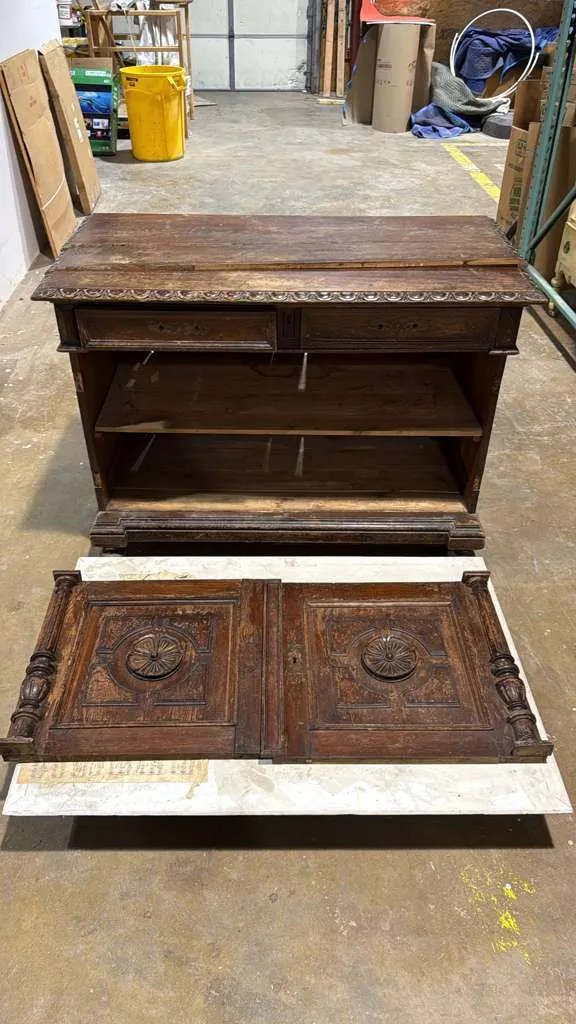
This antique French oak buffet cabinet was one of them. It came to our Fort Collins shop in pieces, literally disassembled, with a split and damaged top surface, decades of grime layered over a finish that had long since given up, and structural components that needed proper assessment before anything else could happen. On paper, it was a significant undertaking. In person, standing next to it in the shop and looking at the hand carving on those cabinet doors, the egg-and-dart molding running the full perimeter of the top edge, the turned column supports flanking the front, and the ornate brass hardware buried under tarnish and age, there was never a question about whether it was worth doing.
Pieces like this are not made anymore. The hand work alone represents a level of craft investment that has no real equivalent in contemporary furniture production. Our job was to honor what the original makers put into it.
Project Overview
- Structural assessment of all components following disassembly on arrival
- Split top surface repair, stabilization, and full preparation before refinishing
- Complete surface refinishing in a rich, deep smoky oak tone across the entire piece
- Careful finish work around all hand-carved details to preserve and reveal carving definition
- Cleaning and preservation of original ornate brass hardware throughout
- Full reassembly with all components properly fitted and aligned
The Cabinet: What Makes This Piece Significant
Before the process, the piece deserves to be understood.
This is a French oak buffet cabinet in the Henri II style, a design tradition rooted in the French Renaissance of the sixteenth century that enjoyed significant revival production during the nineteenth century. Henri II style furniture is characterized by heavy solid oak construction, architectural proportions, and highly ornate carved decoration applied across every available surface. Turned column supports, carved rosette medallions, egg-and-dart molding, and raised panel door construction are all markers of the style, and this cabinet has every one of them executed at a high level.
The rosette medallions carved into the cabinet doors are particularly notable. Each one is a fully realized relief carving with petal definition, surrounding geometric framing, and a depth of cut that takes real skill and time to produce. These are not stamped or routed decorations. They are hand work, done with chisels, by someone who knew what they were doing. The egg-and-dart molding running the full perimeter of the top edge shows the same level of attention: consistent depth, clean transitions between the egg and dart elements, and a rhythm that holds across the full length of the piece.
Furniture in this tradition was built to last across generations, and the solid oak construction of a piece like this means the material itself is not the limiting factor in its lifespan. The limiting factor is always whether someone is willing to do the restoration work when the piece needs it. That is where we come in.
The Poudre Landmarks Foundation, which works to preserve historic objects and structures throughout the Fort Collins region, has noted that European antique furniture brought to Colorado during the settlement and early statehood periods represents a meaningful part of the area’s material cultural heritage. A French oak buffet cabinet of this age and quality is exactly the kind of object that record reflects. Restoring it correctly keeps it in circulation for another generation rather than allowing it to deteriorate past the point of recovery.
Assessing the Damage: What the Cabinet Needed Before Anything Else
When a piece arrives disassembled, the first step is a complete condition assessment of every component before any restoration work begins. You cannot make good decisions about a piece you have not fully evaluated.
The top surface presented the most significant structural challenge. The solid oak top had split along a grain line, a failure mode common in old furniture as seasonal wood movement over many decades eventually overcomes the glue and fasteners holding a wide board or panel together. A split like this has to be properly repaired before any refinishing work begins, because applying finish over an unrepaired split will make the failure more visible rather than less, and it will not address the underlying structural issue.
The existing finish across all surfaces had deteriorated past the point where surface restoration was a viable option. The grime and residue that had accumulated over decades had bonded to the finish in a way that could not be removed without stripping the finish itself. The condition of the carving beneath the accumulated surface contamination was not fully visible until the stripping process was underway, which is one of the genuinely interesting moments in a project like this: watching the actual quality of the hand work emerge as the old material comes away.
The brass hardware was original and intact. Replacing period hardware on a piece like this with reproduction fittings is the wrong call whenever the originals can be preserved, and these could be. They needed cleaning and attention, not replacement.
Repairing the Split Top: Structural Work Before Surface Work
The split top repair was the first physical work on the piece, and it had to be right before anything downstream could proceed.
Repairing a split in a solid wood top requires opening the joint enough to introduce fresh adhesive, clamping the split closed with even pressure across the full length of the failure, and allowing full cure time before the repair is loaded in any way. On a wide antique oak top, the split typically runs with the grain for some or all of its length, which means the repair line can be very long relative to the width of the damage. Getting even clamping pressure across a long, narrow split in old wood requires attention to clamping placement and pressure distribution so the repair closes cleanly without introducing a bow or twist into the panel.
After the repair was cured and confirmed stable, the top surface was prepared for refinishing. This involved leveling the repaired area flush with the surrounding surface, addressing any additional surface damage across the top, and bringing the full panel to a consistent condition that would accept the new finish system evenly. The carved egg-and-dart molding around the top perimeter required careful hand work during surface preparation to clean out accumulated material from the carved recesses without damaging the definition of the carving itself.
This kind of structural and surface repair work on antique pieces is a core part of what our furniture repair process covers, and it is the work that has to happen correctly before any finishing can begin.
Stripping and Surface Preparation: Getting Down to What Matters
With the top repaired and stable, the full stripping and surface preparation process proceeded across all components of the cabinet.
Stripping a piece with this level of carved detail requires a different approach than stripping a flat-surfaced piece. Chemical stripping materials have to be worked into carved recesses and then removed completely from the same areas, which requires careful technique and appropriate tools to avoid leaving residue in the carving detail or damaging the wood in areas where access is constrained. Carved transitions, inside corners on the raised panel doors, and the recesses of the egg-and-dart molding all require individual attention during both the stripping and the neutralizing steps.
Our furniture stripping process on carved antique pieces is controlled and staged. Materials are selected for compatibility with old oak, applied correctly, and removed completely before the next step begins. What came off the surface during stripping confirmed what the initial assessment suggested: the underlying wood and carving were in significantly better condition than the exterior had indicated. The oak itself was sound and consistent. The carving detail was fully intact under the accumulated finish and grime. The piece had been worth saving from the moment it arrived, and the stripping process made that undeniably clear.
The Finish: A Smoky Oak Tone That Unifies the Piece and Serves the Carving
Finishing a carved antique piece requires thinking about the relationship between the finish and the carving from the beginning of the color development process, not as an afterthought.
Hand carving creates depth variation across the surface of a piece. The raised elements sit forward. The recessed areas sit back. A finish that applies color and sheen uniformly across both will flatten that depth variation visually, making the carving read as less defined than it actually is. A finish developed with the carving in mind uses that depth variation, allowing slightly more color to settle into the recesses while the raised surfaces read with the primary tone, which is exactly how a period finish on a piece like this would have worked originally.
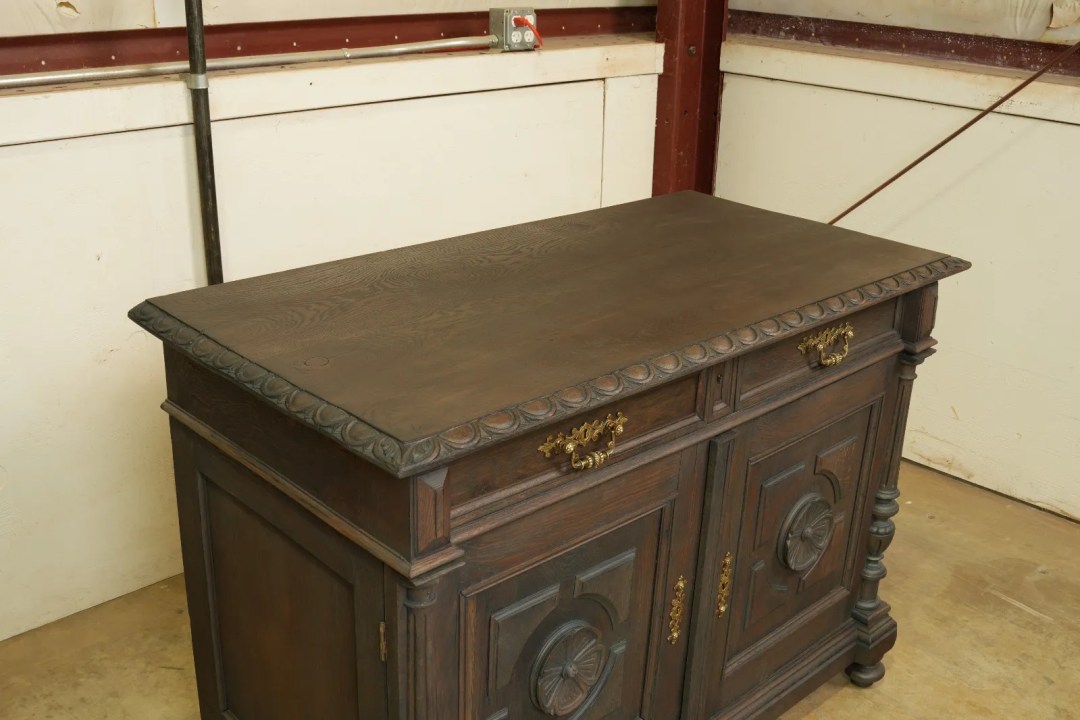
The color direction on this cabinet was a rich, deep, smoky oak tone: darker and more complex than a simple brown, with enough cool undertone to read as aged and substantial without going gray. This is a finish that suits the Henri II style, which is a formal, architecturally conceived design tradition. A warm, light finish on a piece with this kind of heavy carved ornament would read as inconsistent with the piece’s character. The smoky oak tone suits it correctly.
Color was built in layers and evaluated throughout the process, with particular attention to how the tone was reading across the carved door panels and the egg-and-dart molding. The goal was a surface where the carving definition was fully visible and the depth of the relief work read clearly from across a room.
For our complete approach to surface color work and finish development on antique pieces, see our antique furniture restoration and refinishing service pages.
Hardware: Preserving What Was Original
The ornate brass hardware on this cabinet, the bail pulls on the drawers and the escutcheons on the doors and keyhole surrounds, was original to the piece and intact throughout.
Period hardware on a French antique of this quality is not interchangeable with reproduction fittings. The casting weight, the patina, the specific design vocabulary of the hardware is part of the piece’s authenticity and visual coherence. Replacing original hardware with reproductions, even high-quality ones, changes the piece in ways that are visible to anyone who looks carefully.
The hardware was cleaned and treated to bring back the surface quality while preserving the natural patina that comes from genuine age. Against the finished deep smoky oak surface, the brass reads exactly as it should: warm, substantial, and clearly original.
Reassembly: Putting the Piece Back Together Correctly
With all surfaces finished and the hardware addressed, the cabinet was reassembled with attention to fit, alignment, and structural integrity throughout.
Reassembly of a disassembled antique piece is not simply putting components back in their original positions. Old joinery has to be evaluated at every connection point. Joints that were sound before disassembly may need fresh adhesive. Components that have moved dimensionally over decades of seasonal cycling may need minor fitting work to come back together correctly without forcing. The turned column supports flanking the front of this cabinet required careful fitting to seat properly against the case body and read as plumb and vertical in the finished piece.
Final inspection after reassembly covered structural stability, finish consistency across all surfaces, hardware alignment and function, and overall appearance under multiple lighting conditions. The piece cleared every part of that evaluation before it left the shop.
The Finished Cabinet: What It Looks Like When the Work Is Done Right
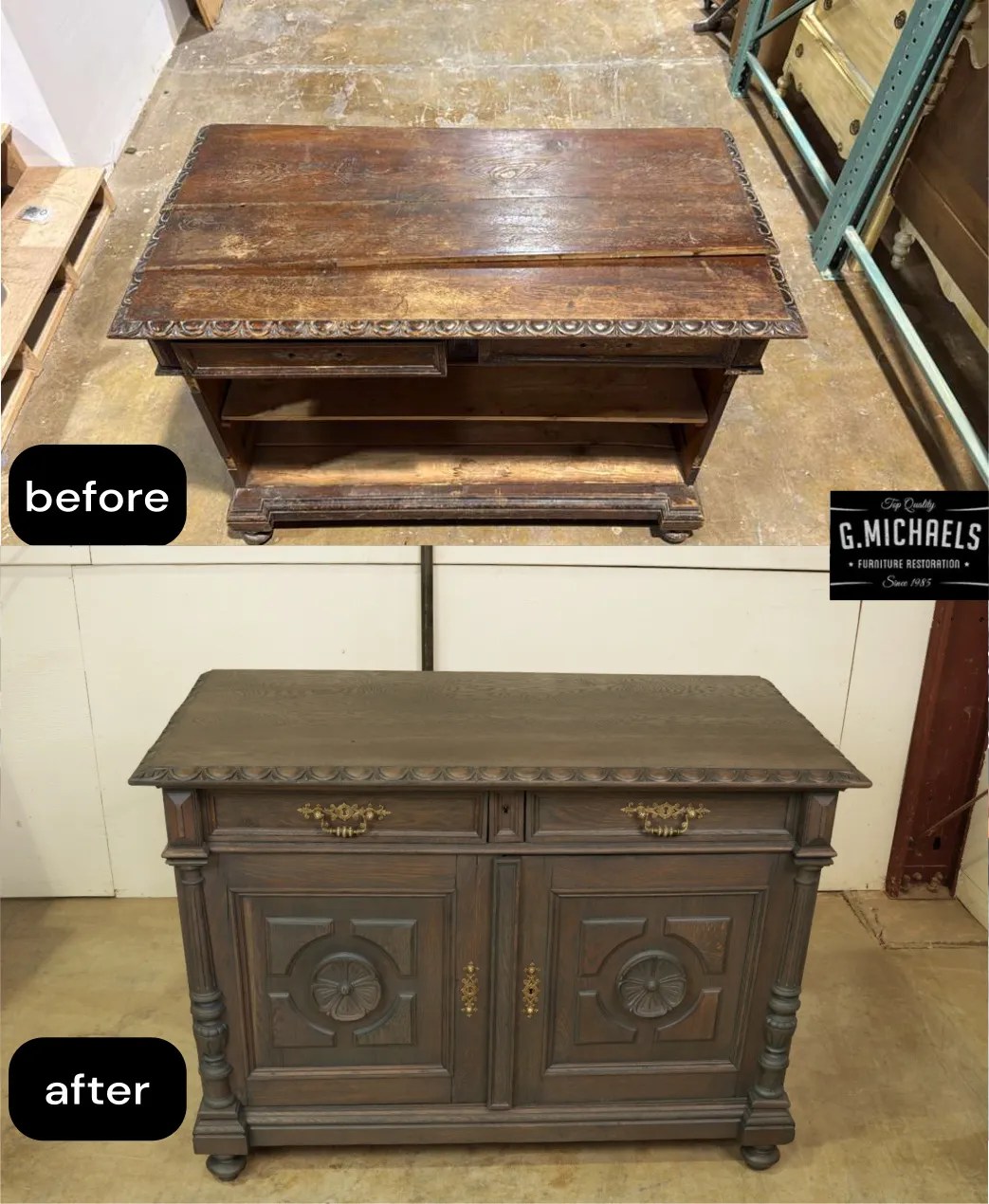
The before and after on this project is as significant as any we have produced. What arrived as a disassembled, damaged, grime-covered piece with a failing finish left as a fully restored antique French oak buffet cabinet with carving definition that stops people in their tracks, a finish that respects the age and character of the piece, and hardware that looks exactly as it should.
The rosette medallions read clearly from across a room. The egg-and-dart molding around the top perimeter shows every element with full definition. The turned columns are consistent and true. The top surface shows no evidence of the split repair. The smoky oak finish unifies every surface of the piece while allowing the natural oak grain to remain visible through it.
This cabinet was made to last, and it will.
Services Included in This Antique French Oak Cabinet Restoration
Structural assessment of all disassembled components on arrival Split top repair, stabilization, and surface preparation Complete stripping of all existing finish across all components Full surface preparation including carved detail cleaning and leveling Multi-layer finish development in a custom smoky oak tone Careful finish work preserving and revealing all hand-carved detail Original brass hardware cleaning and preservation Full structural reassembly with fitting and alignment throughout
Have an Antique Piece That Looks Too Far Gone to Save?
If you have a carved antique cabinet, sideboard, buffet, or any other piece sitting in storage because it looks too damaged or too deteriorated to be worth the effort, please send us a photo before you make that decision. The pieces that arrive looking the most hopeless are often the ones with the best material underneath.
We handle the full range of antique furniture restoration work: structural repair, split and damaged top surfaces, complete stripping and refinishing, color development on carved and figured pieces, and hardware preservation. If you are in Fort Collins, Loveland, Windsor, Boulder, Longmont, Denver, or the greater Denver metro area, we would be glad to take a look.
Send photos to shop@gmrestores.com or call us at 970-493-8737. Free estimates are available on all projects, and we offer pickup and delivery throughout our service area.
113 Hickory Street, Fort Collins, Colorado 80524 | (970) 493-8737 | shop@gmrestores.com
Frequently Asked Questions: Antique French Oak Cabinet Restoration in Fort Collins
Can a split solid wood top on an antique cabinet be repaired to an invisible result?
In most cases, yes. A split along the grain in a solid wood top can be repaired by introducing fresh adhesive into the joint, clamping the split closed with even pressure across its full length, and allowing complete cure before any surface work proceeds. Once the repair is cured and the surface has been prepared and finished, the repair line on a well-executed split repair is typically not visible in the finished piece. The key variables are the condition of the wood at the split, whether the split is clean or has developed secondary checking, and the quality of the surface preparation before finishing. We assess all of these at the point of evaluation and give an honest estimate of the expected outcome before any work begins.
How do you refinish a carved antique piece without losing the carving definition?
Finishing around carved detail requires a deliberate approach at every stage of the process: stripping without leaving residue in carved recesses, surface preparation that cleans carved areas without softening their edges, and finish application that allows color to settle naturally into the depth variation the carving creates rather than coating everything uniformly. Done correctly, a finish developed with the carving in mind will actually enhance the visual definition of the carved detail by creating natural shadow in the recesses and allowing the raised surfaces to read clearly against them. Done poorly, heavy or uniform finish application will fill carved recesses and reduce definition. We treat carving preservation as a non-negotiable constraint on every project where carved detail is present.
Should original hardware on a French antique be preserved or replaced?
Preserved whenever possible. Original period hardware on a French antique buffet or cabinet is part of the piece’s authenticity, and the casting weight, patina, and design vocabulary of original fittings is not replicated accurately by reproduction hardware regardless of quality. Cleaning and preserving original hardware is almost always the right approach. Replacement should only be considered when original hardware is missing, structurally failed, or damaged beyond recovery, and in those cases period-appropriate reproduction or salvaged matching hardware is preferable to generic modern fittings.
How do you restore a piece that arrives completely disassembled?
The first step is always a thorough assessment of every component individually. Disassembly, whether intentional or the result of failed joinery, actually creates an opportunity to evaluate the piece more completely than would be possible assembled: joint conditions, interior surfaces, and structural details that are not visible on a complete piece can all be assessed and addressed before reassembly. The restoration work then proceeds on individual components, with reassembly as the final step after all surfaces are finished and all structural issues have been addressed.
Where can I get an antique French cabinet or European antique furniture restored near Fort Collins or Denver?
Michaels Restoration has been working on antique and European furniture from our Fort Collins shop since 1985. We serve clients throughout the greater Denver metro area including Boulder, Longmont, Loveland, Arvada, Lakewood, Aurora, Windsor, and Denver proper. Free estimates are available on all projects, and we offer pickup and delivery throughout our service area. Send photos to shop@gmrestores.com or call us at 970-493-8737 to get started.
Located in the historic city of Fort Collins, Colorado, G. Michaels Restoration is an experienced furniture repair and antique furniture restoration shop serving Fort Collins, Loveland, Windsor, Boulder, Longmont, Denver, and the greater Denver metro area.
113 Hickory Street, Fort Collins, Colorado 80524 | (970) 493-8737 | shop@gmrestores.com
Located in the historic city of Fort Collins, Colorado. G. Michael’s is an esteemed furniture repair and antique furniture restoration wood shop.