Queen Anne Dining Table Refinishing in Fort Collins: Cabriole Legs, Scalloped Apron, and a Complete Dark Brown Refinish
There is a particular kind of furniture that does not need to announce itself. It just sits in a room and looks exactly right. Queen Anne style dining tables are that kind of furniture, and the one that came through our Fort Collins shop recently is a good example of why the style has stayed in circulation for nearly three hundred years.
Cabriole legs with pad feet. A softly rounded top with a scalloped apron. Proportions that feel generous without being heavy. The Queen Anne vocabulary is one of the most cohesive design languages in the history of American furniture, and a well-built piece in that tradition ages in a way that contemporary furniture simply does not. The bones on this table were exactly right. The finish was not keeping pace with the quality of what was underneath it, and that is what brought it to us.
Project Overview
-
Complete strip of the existing finish across all surfaces, including the top, apron, all four cabriole legs, and pad feet
-
Full surface preparation bringing all components to an even, consistent condition
-
Custom dark brown finish developed and applied in stages across the complete piece
-
Careful finish work on the curved cabriole legs and scalloped apron detail to achieve consistent color and sheen through the contoured geometry
-
Final inspection confirming even tone and sheen from the top surface down to the pad feet
The Table: Understanding What Queen Anne Style Actually Is
Before the process, the piece deserves its own attention.
Queen Anne furniture emerged in early eighteenth century England and reached its fullest American expression in the colonial and post-colonial periods, roughly 1725 through 1760, though revival production continued well into the twentieth century. The defining characteristics of the style are organic and curve-based: the cabriole leg, which transitions from a knee that curves outward to a lower leg that curves inward before terminating in a pad, ball, or claw foot, is the most recognizable element. The scalloped or shaped apron, the softly rounded table top, and the overall absence of straight lines or right-angle transitions are equally characteristic.
What makes Queen Anne furniture hold up visually across centuries is the internal logic of the curved forms. Every curve on a well-designed Queen Anne piece relates to the others. The sweep of the cabriole leg echoes the profile of the apron. The rounded corners of the top repeat the soft geometry of the legs below. Nothing about the form feels arbitrary, which is why it reads as correct and satisfying rather than fussy or dated.
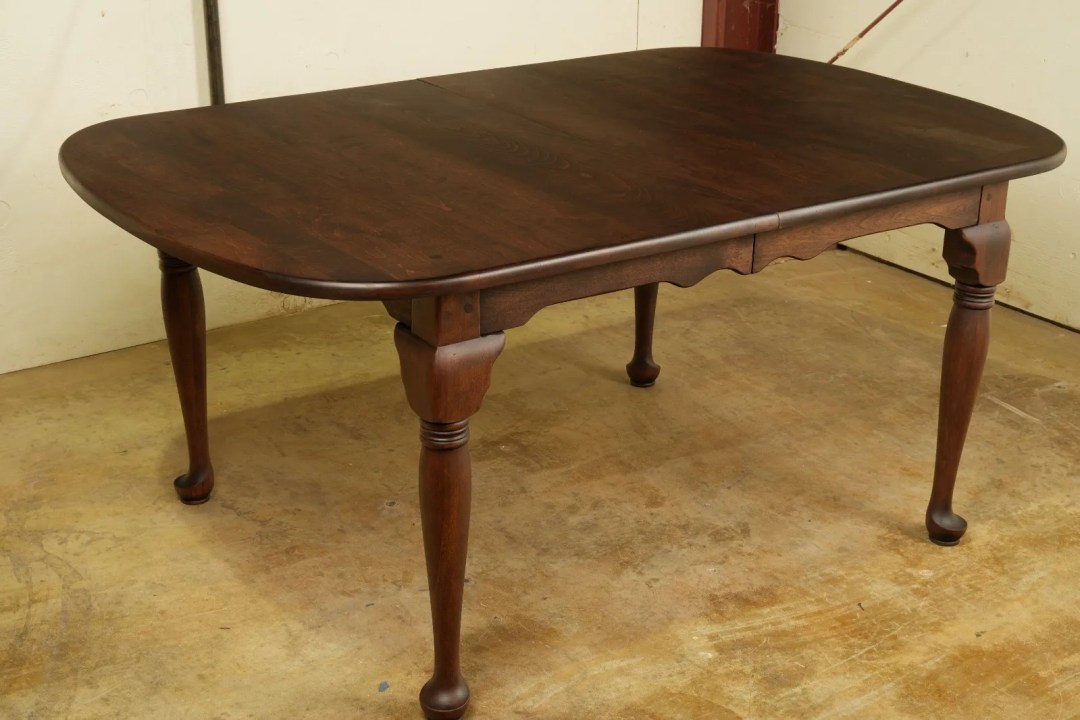
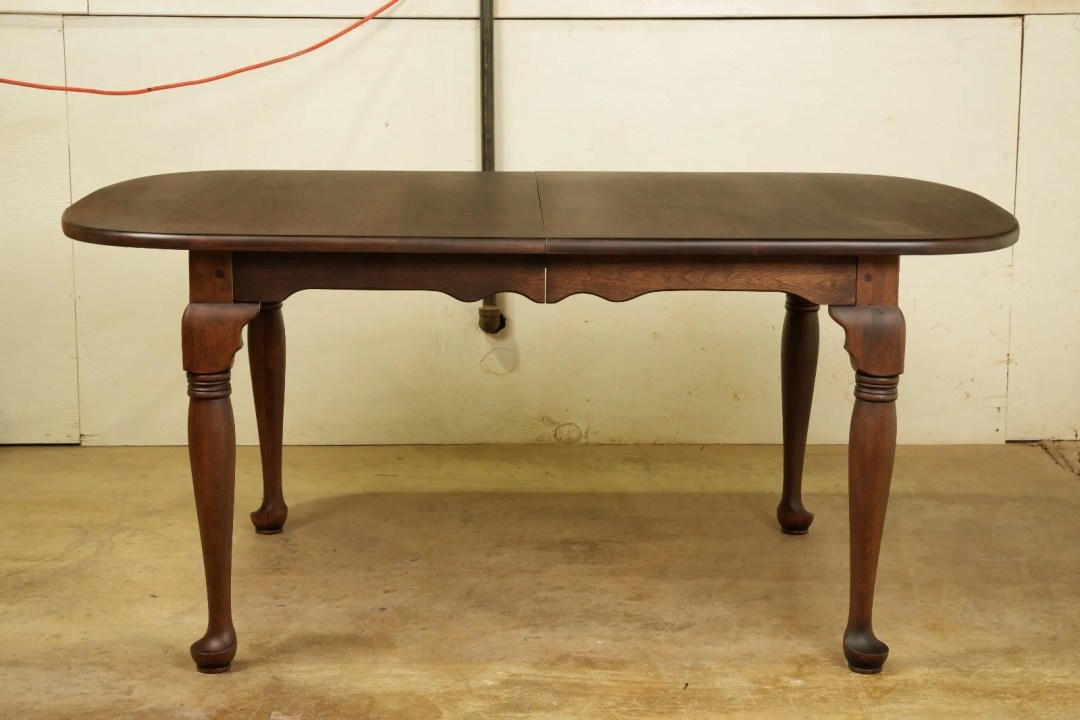
This table has those relationships working correctly. The cabriole legs are well-proportioned, with a knee that transitions smoothly into the apron and a lower leg that tapers cleanly to the pad feet. The scalloped apron profile is consistent and crisp. The top is appropriately rounded at the corners and sized correctly for the base below it. It is a good piece, built to a standard worth honoring with an equally good refinish.
History Colorado’s collections include significant examples of period American furniture documenting how design traditions like Queen Anne were adopted and adapted across the country from the colonial period onward. A dining table like this one sits within that longer story of American domestic furniture, and restoring it correctly keeps it in use rather than allowing it to leave circulation.
Why a Complete Refinish Was the Right Call
Not every piece that comes to us needs a complete refinish. Part of the assessment process on any project is determining whether targeted touch-up and finish restoration will produce a satisfactory result, or whether the existing finish has deteriorated past the point where building on top of it makes sense.
On this table, the finish had worn unevenly across the top surface and showed significant variation in sheen and tone between the horizontal top panels and the vertical surfaces of the apron and legs. Touch-up work in those conditions produces results that are visible as repair work rather than as a unified surface. The better outcome, and the honest one, was a complete strip and refinish that would allow the new finish to be developed consistently across every surface of the piece from the beginning.
This is the kind of assessment we apply to every project that comes through our furniture repair and restoration process. The right answer is determined by the actual condition of the piece, not by what is faster or simpler.
Surface Preparation on Curved Geometry: Where the Work Gets Specific
Stripping and preparing a Queen Anne dining table is more involved than the same work on a table with straight legs and a flat apron, and that difference is worth explaining.
The cabriole leg presents a continuous curved surface with no flat reference planes. Stripping has to cover the full geometry of each leg, from the knee transition at the top through the outward curve of the upper leg, the inward curve of the lower leg, and the pad foot at the base, without leaving residue in the areas where the curve transitions are tightest. Surface preparation after stripping has to follow the same geometry, with sanding that works with the curves rather than flattening them.
The scalloped apron presents a similar challenge on a smaller scale. The scalloped profile creates inside curves and outside curves in close succession, and surface preparation in those transitions requires hand work with appropriately shaped tools rather than flat sanding blocks. Any preparation shortcut on a scalloped apron shows immediately once finish is applied, because the scallop profile sits at eye level and any inconsistency in preparation reads as inconsistency in the finished surface.
We take the time to do this preparation correctly on every curved piece that comes through the shop. It is not the fastest part of the process, but it is what makes the rest of the finish work hold up. For our full approach to table refinishing and restoration, including curved and period pieces, see our service page.
Developing the Finish: Dark Brown Tone Across a Complete Piece
The color direction on this table was a deep, rich dark brown: substantial and formal, appropriate to the Queen Anne style and to the scale of a dining table that is meant to anchor a room.
Dark brown on oak reads differently than dark brown on walnut or cherry, and the finish development process has to account for how the specific wood species absorbs and interacts with pigment. Oak’s open grain structure means that a dark stain will emphasize the grain lines strongly, creating a surface with real visual depth when the finish is developed correctly. The goal was a color that was deep and consistent without obscuring the natural grain character of the wood, which is part of what gives a refinished antique piece its visual interest.
Color was built in stages and evaluated throughout the process, with particular attention to how the tone was reading across the transition from the horizontal top surface to the vertical apron faces and down through the curved cabriole legs. Getting consistent color across geometries that face different directions and receive stain differently requires evaluating the piece as a whole rather than surface by surface, and adjusting the application accordingly.
The protective finish system was applied over the developed stain color in multiple coats with proper leveling between each. The final surface is smooth and consistent in sheen from the top panels through the apron, down all four cabriole legs, and across the pad feet. That consistency is the standard the project was held to, and it is the standard every project we complete is held to.
For our approach to color development and finish systems on solid wood pieces, see our antique furniture restoration and refinishing service pages.
The Finished Table: What Consistent Work Looks Like
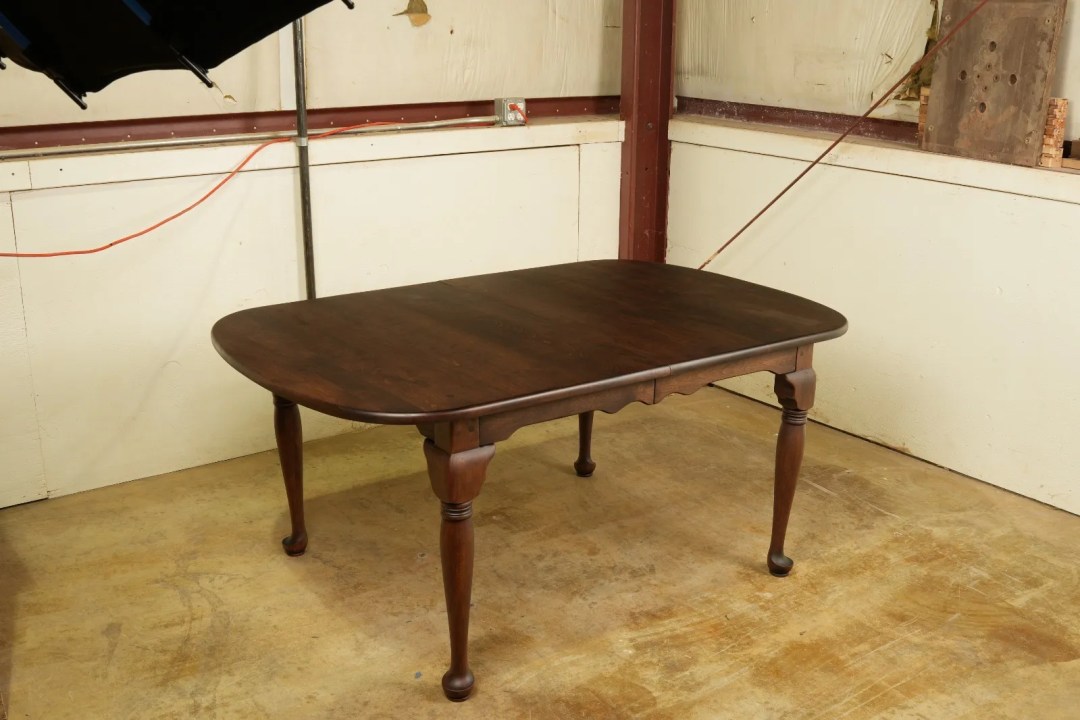
The finished table reads exactly as a well-refinished Queen Anne dining table should. The dark brown tone is even across every surface. The cabriole legs and pad feet show consistent color and sheen through all the curves. The scalloped apron profile is fully visible and clearly defined. The top surface has the depth and smoothness that comes from a properly built finish on well-prepared solid wood.
Nothing about the finished piece looks repaired or corrected. It looks like a Queen Anne dining table that has been refinished to a high standard, which is exactly what it is.
This table will go back into a dining room and stay there. The form will not go out of style. The wood will not wear out. The finish, maintained correctly, will protect the surface for years before it needs any attention.
Services Included in This Queen Anne Dining Table Refinishing
Complete strip of all existing finish across the top, apron, cabriole legs, and pad feet Full surface preparation including careful hand work on curved apron and leg geometry Multi-stage dark brown finish development evaluated for consistency across all surfaces Protective topcoat system applied in multiple leveled coats throughout Final inspection confirming even color and sheen from top surface to pad feet
Have a Dining Table or Wood Piece That Needs a Full Refinish?
If you have a dining table, an antique, or any wood piece where the finish has worn past the point where touch-up will produce a clean result, we would be glad to assess it. We handle the full range of refinishing work from targeted surface restoration to complete strip and refinish on pieces of any style and age.
We serve clients throughout Fort Collins, Loveland, Windsor, Boulder, Longmont, Denver, and the greater Denver metro area. Pickup and delivery are available throughout our service area. Free estimates on all projects.
Send photos to shop@gmrestores.com or call us at 970-493-8737 to get started.
113 Hickory Street, Fort Collins, Colorado 80524 | (970) 493-8737 | shop@gmrestores.com
Frequently Asked Questions: Queen Anne Dining Table Refinishing in Fort Collins
What makes Queen Anne dining tables worth refinishing rather than replacing?
Queen Anne furniture is built from solid hardwood using joinery and construction methods that are simply not found in contemporary furniture at comparable price points. The cabriole leg on a period or quality revival Queen Anne table is turned and shaped from solid stock, a time-intensive process that has no equivalent in modern production furniture. A well-built Queen Anne dining table, properly refinished, will outlast and outperform any new furniture purchased to replace it, and it will do so with the visual character that comes from solid wood, genuine curves, and a design tradition that has proven itself across three centuries.
How long does a complete dining table refinish take at your Fort Collins shop?
Timeline depends on the condition of the piece and the shop’s current queue. A complete strip and refinish on a dining table of this type typically runs two to four weeks from drop-off to completion. Proper surface preparation, adequate dry time between finish coats, and careful color evaluation throughout the process all take time that cannot be compressed without affecting the quality of the result. We give honest timeline estimates at the point of assessment and update clients if anything changes.
Is it difficult to get a consistent finish on curved cabriole legs?
It requires more care than finishing a straight leg, yes. The curved geometry of a cabriole leg presents surfaces that face multiple directions, transition continuously rather than at defined angles, and absorb stain and finish somewhat differently at the knee, the lower leg, and the pad foot. Getting consistent color and sheen through those transitions requires deliberate application technique and evaluation of the leg as a complete curved form rather than as a series of flat sections. It is one of the reasons Queen Anne pieces benefit from experienced hands rather than a first refinishing attempt.
Do you refinish Queen Anne dining tables in the Denver area?
Yes. We serve clients throughout the greater Denver metro area in addition to our Fort Collins base, including Boulder, Longmont, Loveland, Arvada, Lakewood, Aurora, Windsor, and Denver proper. Pickup and delivery are available throughout the service area. Send photos to shop@gmrestores.com or call 970-493-8737 to get started with a free estimate.
Located in the historic city of Fort Collins, Colorado, G. Michaels Restoration is an experienced furniture repair and antique furniture restoration shop serving Fort Collins, Loveland, Windsor, Boulder, Longmont, Denver, and the greater Denver metro area.
113 Hickory Street, Fort Collins, Colorado 80524 | (970) 493-8737 | shop@gmrestores.com
Located in the historic city of Fort Collins, Colorado. G. Michael’s is an esteemed furniture repair and antique furniture restoration wood shop.