Antique Dresser Restoration in Fort Collins: A Hidden Compartment, a Full Strip, and a Natural Finish That Lets the Wood Breathe
Every once in a while a piece comes through the shop that makes you stop and look more carefully than you planned to.
This antique dresser did that. Not because the condition was dramatic, though it was, but because of what happened when the lid on top was lifted. There is a hidden compartment built into the upper section of this piece, concealed beneath a hinged top panel that sits flush with the surface and gives no indication from the outside that anything is there. Lift it and there is a full-width interior storage space, lined and fitted, where the original owner kept whatever they needed kept private. Jewelry, letters, documents, things worth protecting. We will never know exactly what. But it was designed with intention and built to conceal it completely.
That kind of detail is not an afterthought. It is evidence of a maker who thought carefully about what this piece needed to do and built it accordingly.
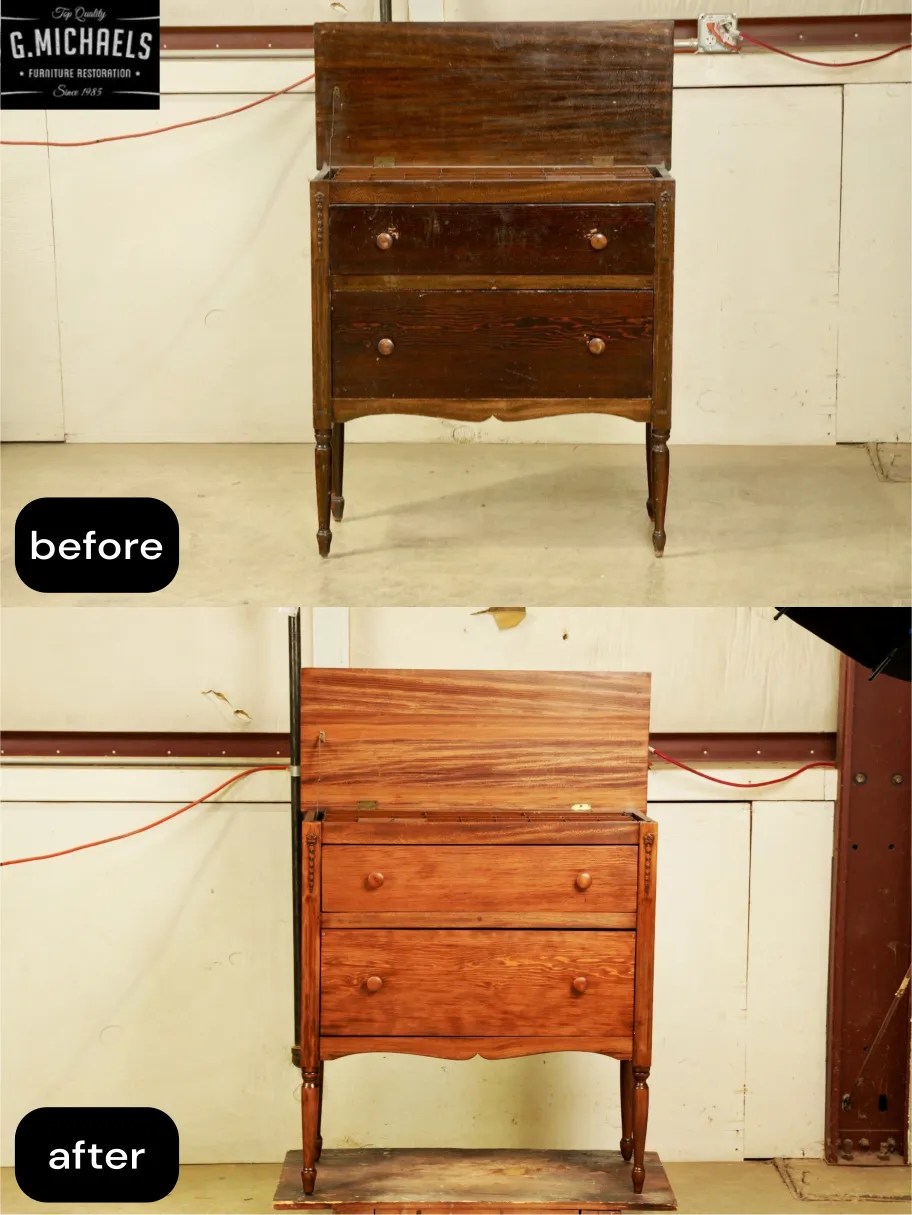
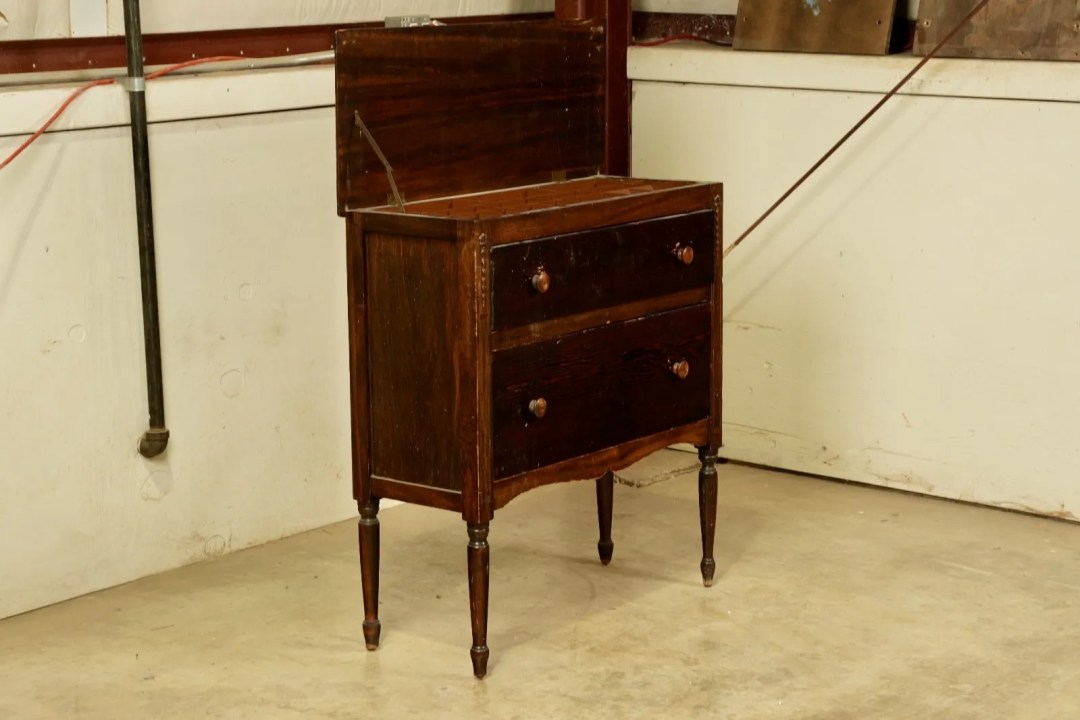
What the piece also needed, by the time it came to us, was a serious restoration. The finish had gone almost completely dark over years of accumulated grime and oxidation, layered up to the point where reading the wood species underneath required guessing. The drawer fronts, the turned and carved leg details, the scalloped apron, all of it buried under decades of neglect that had turned what was clearly a quality piece of antique furniture into something that read as worn-out and forgettable.
It was neither. The strip process made that clear within the first hour of work.
.
Project Overview
This project covered the complete dresser from the hidden compartment interior through to the turned leg feet:
- Full assessment of the existing finish condition, grime accumulation, and wood substrate condition across all surfaces
- Complete strip of all existing finish and accumulated surface contamination down to bare wood on all components
- Surface preparation bringing the wood to an even, consistent condition across the lid, case top, drawer fronts, case sides, scalloped apron, and turned legs
- Natural warm finish developed and applied to enhance the wood’s own color and grain without imposing a stain color over it
- Hidden compartment interior addressed as part of the complete restoration scope
- Final inspection under multiple lighting conditions before delivery
The Dresser: What This Piece Actually Is
Before the process, the piece deserves proper attention.
Looking at the before photographs, this dresser follows a form associated with early twentieth century American bedroom furniture production, likely from the 1910s through the 1930s based on the combination of design elements visible on the piece. The two-drawer configuration with a lift-top upper section was a practical storage form common in bedroom and dressing furniture of the period, allowing the owner to access a concealed storage area without disturbing the primary drawer organization below. The turned and carved corner details flanking the drawer section, the scalloped apron between the turned legs, and the turned leg profiles themselves all point to production from a period when American furniture manufacturers were still applying genuine decorative detail to mid-range bedroom pieces rather than reducing them to purely utilitarian form.
The hidden compartment is the most interesting element of the piece from a historical standpoint. Built into the upper section with a hinged lid that sits completely flush when closed, it was clearly part of the original design rather than a modification. Furniture with concealed interior storage compartments has a long history in American domestic furniture, reflecting both the practical need for secure storage in a period before modern security options and a broader cultural appreciation for the craft element of hidden or surprise features in quality furniture.
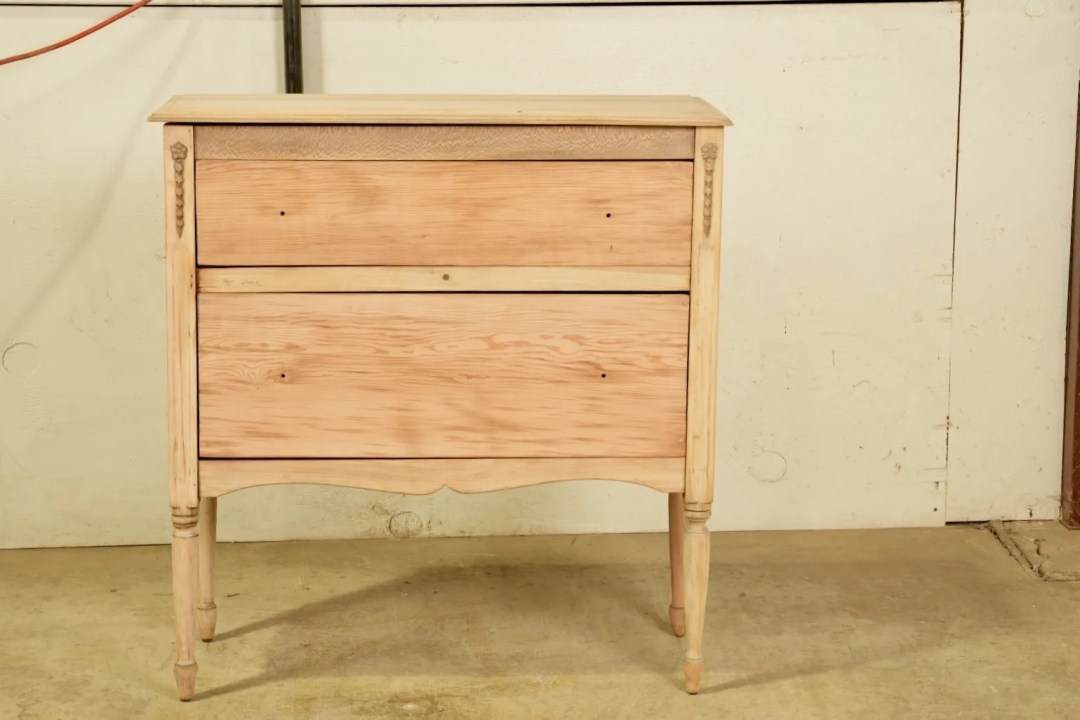
The process photograph showing the piece stripped to bare wood is particularly revealing: the wood visible across the drawer fronts and case shows strong, active grain with the kind of character that develops in old-growth timber from the early twentieth century. This is not veneered particleboard. It is solid wood that was worth stripping back to and worth finishing correctly.
History Colorado’s collections document American domestic furniture from the territorial and early statehood periods through the mid-twentieth century, including the kind of bedroom and dressing furniture that Colorado families used and passed down across generations. A piece like this dresser sits within that documented tradition of well-built American furniture that outlasts the assumptions people make about its condition.
What the Strip Process Revealed
Stripping an old piece that has accumulated this level of surface contamination is one of the more revealing steps in any restoration process, because you genuinely do not know what is under the surface until the stripping begins.
On this dresser, the strip process revealed exactly what the before photographs had obscured: clean, sound, characterful wood in good condition underneath the decades of grime and oxidized finish. The drawer fronts showed strong grain with natural color variation. The case sides and top showed the same quality of material. The turned leg sections, which can be the hardest to assess under a dark build-up, came clean with full turning detail intact and the wood in good condition throughout.
The hidden compartment interior required its own attention during the strip process. Interior spaces on antique pieces accumulate differently than exterior surfaces, and the compartment interior on this dresser needed careful work to remove accumulated material without damaging the fitted interior structure. Getting the interior surfaces to a consistent, clean condition was part of treating the piece as a complete restoration rather than addressing only the visible exterior surfaces.
The process photograph taken at the bare wood stage shows the result of that stripping work: pale, even, clean wood across all surfaces of the dresser, ready to receive a finish that would develop the natural character of the material rather than cover it.
Our furniture stripping process on pieces with this level of accumulated surface buildup is controlled and staged throughout, with each surface evaluated individually before the next step begins.
The Finish: Natural and Warm, Not Dark and Heavy
The color direction on this dresser was the opposite of what it arrived in. Instead of a dark, heavy tone that suppressed the wood’s natural character, the finish was developed toward the warm natural end of the spectrum: a tone that enhances the wood’s own color rather than imposing something over it.
Looking at the after photograph, the finished surface reads as warm, clear, and honest about what the wood actually is. The grain on the drawer fronts is visible and active. The turned leg sections show the wood’s natural color through a finish that protects without obscuring. The scalloped apron and the corner detail elements read clearly rather than disappearing into a uniform dark surface.
Getting to that outcome on a piece that had been as dark as this one arrived requires stripping completely to bare wood, because any residual old finish or stain left on the surface will continue to influence the color of the new finish regardless of what is applied over it. A partial strip on a piece like this produces a result where the new finish reads inconsistently across the surface, lighter in areas that were fully stripped and darker in areas where old material remained. Starting from bare wood gives the new finish a consistent foundation across every surface of the piece.
The warm natural finish built up in controlled stages, with each coat evaluated for consistency and sheen before the next was applied. The result across all surfaces of the dresser, including the hidden compartment interior, is a finish that reads as appropriate to the age and character of the piece without looking artificially aged or artificially new.
For our approach to finish development on antique and period pieces where the natural wood character is the primary visual goal, see our antique furniture restoration and furniture refinishing service pages.
The Hidden Compartment: Part of What Makes This Piece Worth Keeping
It is worth coming back to the hidden compartment, because it is the detail that makes this dresser more than just a two-drawer chest with turned legs.
The lift-top mechanism is original to the piece and functions correctly. The hinges that hold the lid panel are period hardware, cleaned and operating properly as part of the restoration. The interior of the compartment is finished as part of the complete restoration scope, so the full piece, including the concealed storage space, presents consistently.
Furniture with this kind of built-in feature was made with care and intention. The maker who designed and built this dresser wanted the hidden compartment to work correctly, to be genuinely concealed when closed, and to provide real, usable storage for the owner. That intention is still present in the piece more than a century later, and the restoration honors it by treating the compartment as an integral part of the piece rather than an incidental detail.
This is the kind of thing that gets lost when people decide a piece is too far gone to save. The story goes with it. So does the craftsmanship. And in the case of this dresser, so does the hiding spot.
The Finished Dresser: A Piece With Another Generation Ahead of It
The finished dresser reads as what it always was: a well-built antique with genuine character, a warm natural finish that lets the wood do the work, and a hidden compartment that will continue to surprise whoever discovers it next.
The turning detail on the legs reads clearly. The scalloped apron is visible and well-defined. The drawer fronts show active grain under a finish that develops it properly. The lid opens cleanly to reveal the compartment interior, finished consistently with the exterior surfaces of the piece.
This dresser is going back into a home in Fort Collins or somewhere in the greater Denver metro area, and the next person who sits down at it may or may not know the compartment is there. That is exactly how it was designed.
Services Included in This Antique Dresser Restoration
Full assessment of finish condition, surface contamination, and wood substrate condition on all surfaces
Complete strip to bare wood across the lid, case top, drawer fronts, case sides, scalloped apron, and turned legs
Hidden compartment interior addressed and finished as part of the complete restoration scope
Warm natural finish developed and applied in stages across all exterior and interior surfaces
Finish consistency confirmed across turned leg sections, flat drawer faces, and carved corner detail elements
Final inspection under multiple lighting conditions before delivery
Have an Antique Dresser, Chest, or Bedroom Piece That Needs Restoration?
If you have an antique dresser, chest of drawers, or any solid wood bedroom piece where the finish has gone dark and tired from years of use and neglect, the material underneath is almost always better than the surface suggests. Stripping a piece like this back to bare wood and developing a fresh finish from there produces results that consistently surprise people who have been looking at the dark version for years.
We handle the full range of antique case piece restoration work from our shop on Hickory Street in Fort Collins, serving clients throughout the Old Town, Midtown, and surrounding neighborhoods as well as Loveland, Windsor, Boulder, Longmont, Denver, and the greater Denver metro area. Pickup and delivery are available throughout our service area.
Send photos to shop@gmrestores.com or call us at 970-493-8737. Free estimates on all projects.
113 Hickory Street, Fort Collins, Colorado 80524 | (970) 493-8737 | shop@gmrestores.com
Frequently Asked Questions: Antique Dresser Restoration in Fort Collins
Can an antique dresser with very dark, grime-covered finish be restored to a natural wood appearance?
Yes, provided the wood substrate beneath the accumulated finish and grime is in sound condition. A complete strip to bare wood removes all existing finish, stain, and surface contamination, revealing the natural material underneath. If the wood is in good condition, which is frequently the case on solid wood antique pieces even when the surface looks severely neglected, a natural or lightly toned finish applied to the clean bare wood will produce a result that shows the wood’s natural grain and color clearly. The key step is the assessment before stripping begins, which determines whether the underlying wood is sound enough to support a quality refinish.
How do you restore a piece with a hidden compartment or interior storage areas?
Interior spaces require the same attention as exterior surfaces during a complete restoration, though the techniques and tools differ somewhat due to access constraints. The hidden compartment on this dresser was stripped, prepared, and finished as part of the complete project scope rather than being treated as a secondary area. Getting the interior surfaces to a consistent condition and applying a finish that matches the exterior tone ensures the piece reads as a unified whole rather than as an exterior that has been refinished over an untouched interior.
Is it worth restoring an antique dresser rather than replacing it with new furniture?
For a solid wood antique dresser with sound structure and good underlying material, restoration almost always produces a more durable and more visually interesting result than any new furniture available at a comparable price point. Solid wood antique bedroom furniture from the early twentieth century was built from old-growth timber with construction quality and material character that new production cannot replicate. A restored antique dresser will outlast new furniture, look better in a room, and carry the kind of history and detail that new pieces simply do not have.
Do you restore antique dressers and bedroom furniture near Denver?
Yes. We serve clients throughout the greater Denver metro area from our Fort Collins shop, including Boulder, Longmont, Loveland, Windsor, Arvada, Lakewood, Aurora, Centennial, and Denver proper. Free estimates are available on all projects and we offer pickup and delivery throughout our service area. Send photos to shop@gmrestores.com or call 970-493-8737 to get started.
Located in the historic city of Fort Collins, Colorado, G. Michaels Restoration is an experienced furniture repair and antique furniture restoration shop serving Fort Collins, Loveland, Windsor, Boulder, Longmont, Centennial, Lakewood, Aurora, Denver, and the greater Denver metro area.
113 Hickory Street, Fort Collins, Colorado 80524 | (970) 493-8737 | shop@gmrestores.com
Located in the historic city of Fort Collins, Colorado. G. Michael’s is an esteemed furniture repair and antique furniture restoration wood shop.