Oak Table Refinished and fully restored

Antique Round Oak Pedestal Table Refinishing in Fort Collins: Claw-and-Ball Feet, Quarter-Sawn Grain, and a Full Dark Refinish

There is a particular category of antique furniture that earns a second look every time someone walks past it. Not because it is trying to get attention, but because the craft that went into making it is genuinely difficult to ignore once you notice it.

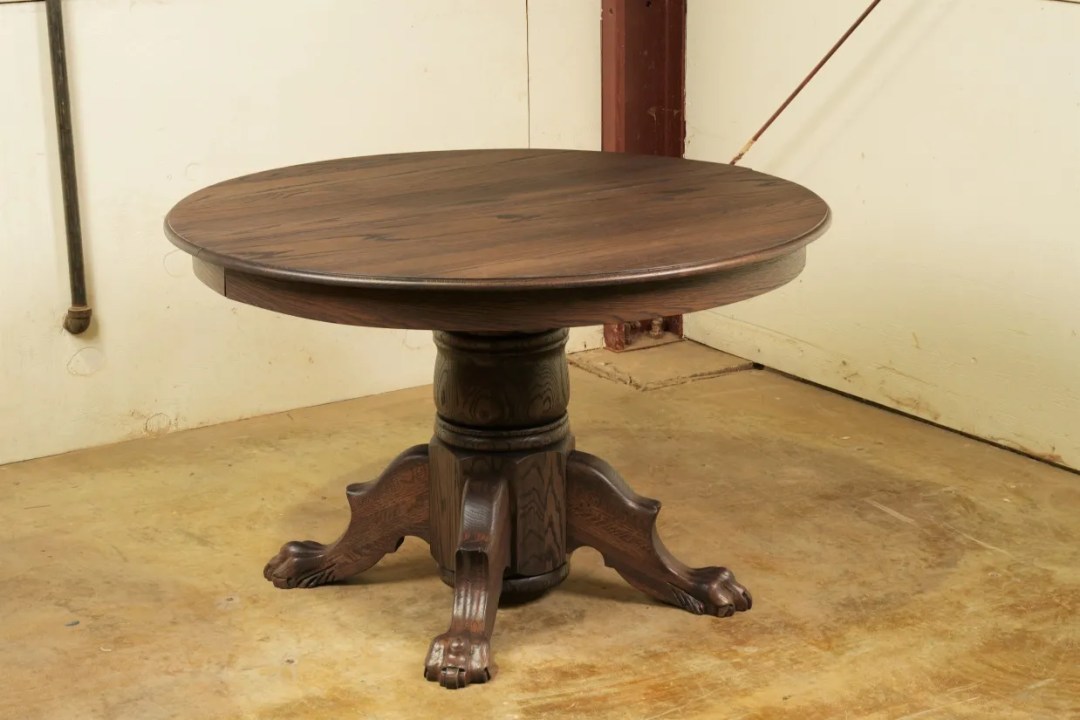
This antique round oak pedestal table is that kind of piece. It came through our Fort Collins shop for a complete refinish, top and base, and from the moment it was in position on the shop floor the carved claw-and-ball feet were stopping people mid-step. Four of them, one at the end of each leg sweeping out from the central column base, each one carved with the kind of detail and consistency that American furniture makers at the turn of the twentieth century were producing at a standard rarely matched since.

The refinish on this piece had to honor all of that. A deep, rich dark brown tone that would bring every carved surface forward and let the exceptional quarter-sawn oak grain read clearly through the finish. That is what we delivered.

Oak Round Table Restoration in Fort Collins

Project Overview


This project focused on the table top surface:

  • Full assessment of the existing finish condition across the round top, the apron, the turned column, the four carved leg sections, and the claw-and-ball feet
  • Complete strip of all existing finish on all surfaces
  • Surface preparation accounting for the varied geometry of the carved base elements and the flat round top
  • Rich dark brown finish developed and applied consistently from the top surface through every carved surface of the base
  • Carved claw-and-ball feet and column detail finished with particular attention to bringing carved definition forward
  • Final inspection confirming even color and sheen across all surfaces before delivery

The Table: What Claw-and-Ball Pedestal Oak Tables Actually Represent

Before the process, the piece deserves proper context.

The round oak pedestal dining table with claw-and-ball feet is one of the most recognizable forms in American late Victorian and Eastlake-influenced furniture production. The period from roughly 1880 through 1910 produced these tables in significant numbers, built from solid quarter-sawn white oak with turned pedestal columns, carved quadruped bases, and the ball-and-claw foot detail that had roots in much earlier European furniture traditions. American manufacturers, particularly those operating out of Grand Rapids, Michigan during this period, brought the form to a wide market while maintaining construction standards that have allowed the best examples to survive in usable condition well over a century later.

What distinguishes quality examples of this form, and what this table has clearly, is the combination of exceptional material and genuine craft attention in the carved elements. Quarter-sawn oak, produced by cutting the log at a specific angle relative to the growth rings, exposes the medullary ray structure of the wood as a pattern of reflective fleck across the face of each board. On quality late Victorian oak furniture, this ray figure is visible across every surface of the piece and gives the wood a visual depth and liveliness that plain-sawn oak simply cannot produce.

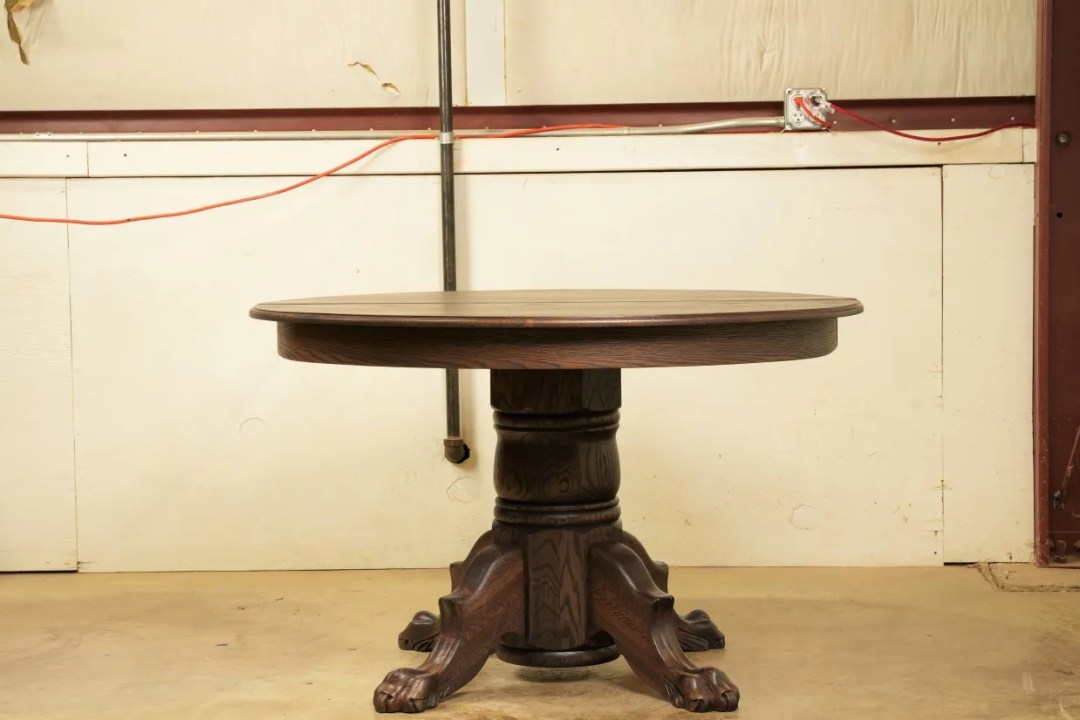
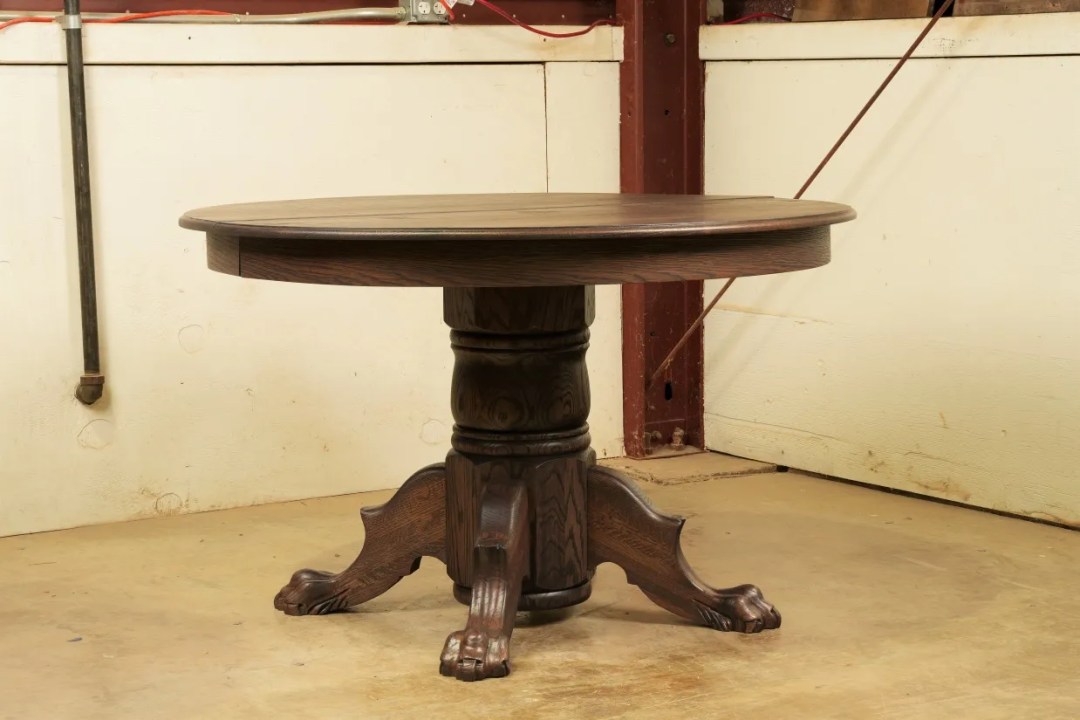
Looking at the finished photographs from multiple angles, the column and base of this table show strong ray figure running through the turned sections, and the top surface shows the characteristic ray pattern of quarter-sawn oak across the full circular panel. The carved claw-and-ball feet show the same figure in the leg sections above each foot, with the carving detail itself crisp and consistent across all four feet.

The City of Fort Collins Historic Preservation program has documented the presence of late Victorian and turn-of-century furniture in many of the city’s historic homes in the Old Town and Eastside neighborhoods, reflecting the period when Fort Collins was growing rapidly and residents were furnishing homes with the quality American production furniture of the era. A table like this one is a direct material artifact of that history, and restoring it correctly keeps it in use rather than in storage or lost to deterioration.

Why a Complete Refinish Was the Right Approach

Assessment before committing to a complete strip and refinish is not a formality. The right answer on any refinishing project is determined by what the piece actually needs, not by what is easier or faster.

On this table, the existing finish had deteriorated past the point where surface restoration would produce a satisfactory result. The condition was particularly evident on the carved surfaces of the base, where the finish had worn unevenly across the carved claw-and-ball feet and the transitions of the turned column. Touch-up work on carved surfaces that have worn unevenly creates visible repair areas where the restored sections read differently than the surrounding original finish, particularly on dark-toned oak where tonal inconsistency is immediately apparent.

Starting from bare wood on all surfaces, both the top and the complete base assembly, was the approach that would allow the new finish to be developed consistently from the first stage through the final coat. A complete refinish is more work. It is also the only approach that produces a result where every surface of the piece reads as unified rather than as a combination of restored and original areas.

This kind of honest assessment is built into our furniture repair process on every project, regardless of whether the answer favors a targeted treatment or a complete refinish.

Stripping and Preparing Carved Surfaces: Where Patience Matters

Stripping a round pedestal table with carved claw-and-ball feet is not the same process as stripping a table with straight legs and a flat apron. The geometry is more complex at every level, and the preparation work has to account for that complexity throughout.

The claw-and-ball feet present the most demanding preparation challenge on a piece like this. The ball element of each foot is a carved three-dimensional form with no flat reference surfaces. The claw elements surrounding the ball are individual carved details that require careful work in the recesses between each claw to remove old finish completely without softening the edges of the carving itself. The transitions from the carved leg sections above into the claw-and-ball element below require the same attention: the existing finish has to come off completely in those transition areas or it will show as residue in the finished surface.

The turned column presents a different set of challenges. The ring moldings and turned profiles of the column create a series of inside curves and outside curves running along the full height of the base. Stripping and preparation in those inside curves requires appropriate tools and technique to get the old finish out without leaving residue in the recesses that will appear as color inconsistency once the new finish is applied.

The round top is the most straightforward surface on this piece, but straightforward preparation on a large quarter-sawn oak panel still requires care to bring the ray figure forward without creating cross-grain scratching that would show under a dark finish.

Our furniture stripping process on carved and turned antique pieces is controlled and staged throughout, with each step evaluated before the next begins.

The Finish: Dark Brown Tone That Serves the Carving and the Grain

The color direction on this table was a rich, deep dark brown: formal, substantial, and appropriate to the Victorian character of the piece and the quality of the quarter-sawn oak throughout.

Dark tones on quarter-sawn oak produce a particular effect that lighter finishes cannot match. The ray figure of the oak, already visible in lighter finishes, reads with even greater contrast under a dark tone because the reflective ray surfaces catch light differently than the surrounding grain. Under a deep dark brown finish, the quarter-sawn figure across the top panel and column sections of this table reads as a shifting, almost luminous pattern that changes character depending on the angle of the light and the viewer. It is one of the reasons dark-finished quarter-sawn oak furniture from this period has remained so visually compelling over more than a century.

Getting that effect requires a finish that is dark enough to provide the necessary contrast for the ray figure while still transparent enough to allow the figure to read through it rather than being obscured by pigment density. Building the color in layers, evaluating the developing tone at each stage under raking light, and adjusting the application to develop the color evenly across surfaces with varying porosity is what produces a result where the finish depth is consistent and the ray figure is fully visible throughout.

The carved claw-and-ball feet received particular attention during the color development and finish application stages. The dark tone is exactly what makes carved detail on a piece like this read from across a room: the color that settles into the carved recesses creates shadow that makes the relief of the carving visually apparent, while the raised surfaces of the carving read with the primary tone of the finish. Done correctly, a dark refinish on carved Victorian oak furniture reveals the quality of the carving more clearly than the original finish did. This table is a good example of that outcome.

For our full approach to color development and finish systems on antique and period pieces, see our antique furniture restoration and table refinishing and restoration service pages.

Consistency Across Top and Base: The Standard the Project Was Held To

A complete refinish on a pedestal table is evaluated as a unified piece, not as a top and a base finished separately and assembled afterward.

The color and sheen of the round top have to match the column, the carved leg sections, and the claw-and-ball feet when the table is assembled and viewed under normal room lighting. Achieving that consistency across surfaces with such different geometry requires evaluating the developing color on all components together at each stage rather than completing one section and then trying to match it on the others.

The finished table, looking at it assembled from any angle in the photographs, shows consistent color from the top surface through the apron, down the column, across the leg sections, and through the carved detail of the claw-and-ball feet. That consistency is not accidental. It is the result of treating the refinish as a complete project rather than a collection of individual surfaces.

Services Included in This Antique Oak Pedestal Table Refinishing

Complete condition assessment of all surfaces before any refinishing work began
Full strip of all existing finish from the round top, apron, column, leg sections, and claw-and-ball feet
Careful surface preparation on all carved and turned base elements accounting for geometry and detail
Multi-stage dark brown finish development evaluated for consistency across top and base
Protective topcoat system applied and leveled across all surfaces
Final inspection of assembled table under multiple lighting conditions

Have an Antique Pedestal Table, Carved Oak Furniture, or Victorian Piece That Needs Refinishing?

If you have a round pedestal dining table, an antique oak piece with carved detail, or any Victorian-era furniture where the finish has worn past the point of surface restoration, we would be glad to assess what the refinishing work involves. Carved and turned antique pieces respond particularly well to a proper complete refinish, and the results on dark-finished quarter-sawn oak are among the most dramatic transformations we produce.

We serve clients throughout Fort Collins, including the Old Town, Eastside, and Midtown neighborhoods, as well as Loveland, Windsor, Boulder, Longmont, Centennial, Lakewood, Aurora, Denver, and the greater Denver metro area. Pickup and delivery are available throughout our service area.

Send photos to shop@gmrestores.com or call us at 970-493-8737. Free estimates on all projects.

113 Hickory Street, Fort Collins, Colorado 80524 | (970) 493-8737 | shop@gmrestores.com

Frequently Asked Questions: Antique Oak Pedestal Table Refinishing in Fort Collins

Can the carved claw-and-ball feet on an antique pedestal table be refinished without losing carving detail?

Yes, and a proper refinish actually enhances the visual definition of carved detail rather than reducing it. The key is controlled stripping that removes the old finish completely from the carved recesses without softening the edges of the carving, and a finish developed in a tone dark enough to create natural shadow in the recesses while the raised surfaces read with the primary finish color. That shadow is what makes carved relief visible from across a room. Rushing the stripping process or applying a finish too heavily in carved areas are the two ways that refinishing reduces carving definition, and both are avoidable with proper technique and attention.

What makes quarter-sawn oak so visually distinctive under a dark finish?

Quarter-sawn oak is produced by cutting the log at a specific angle relative to the growth rings, which exposes the medullary ray structure of the wood as a reflective fleck pattern across the face of each board. Under a dark finish, this ray figure reads with strong contrast because the reflective ray surfaces catch light at different angles than the surrounding grain, producing a visual movement in the surface that changes character as the viewing angle changes. Dark-finished quarter-sawn oak has been visually compelling since the Victorian period for exactly this reason, and the effect is most pronounced on pieces where the ray figure is particularly strong.

Is it worth doing a complete refinish on an antique Victorian pedestal table rather than targeted touch-up?

On a piece with significant finish deterioration, particularly one with carved and turned elements where uneven wear is concentrated in the most visible areas, a complete refinish almost always produces a better result than targeted touch-up work. Touch-up on worn carved surfaces creates visible repair areas where the restored sections read differently than the surrounding finish. A complete refinish, developed consistently from bare wood across all surfaces, produces a result where every surface of the piece reads as unified and the quality of the underlying material is fully visible throughout.

Do you refinish antique pedestal tables and Victorian furniture near Denver?

Yes. We serve clients throughout the greater Denver metro area from our Fort Collins shop, including Boulder, Longmont, Centennial, Lakewood, Aurora, Loveland, Windsor, Arvada, and Denver proper. Free estimates are available on all projects and we offer pickup and delivery throughout our service area. Send photos to shop@gmrestores.com or call 970-493-8737 to get started.

Located in the historic city of Fort Collins, Colorado, G. Michaels Restoration is an experienced furniture repair and antique furniture restoration shop serving Fort Collins, Loveland, Windsor, Boulder, Longmont, Centennial, Lakewood, Aurora, Denver, and the greater Denver metro area.

113 Hickory Street, Fort Collins, Colorado 80524 | (970) 493-8737 | shop@gmrestores.com

G. Michael's Wood Table Refinishing

Located in the historic city of Fort Collins, Colorado. G. Michael’s is an esteemed furniture repair and antique furniture restoration wood shop.

Furniture repair & restoration expert

Danish Skovby SM-32 Dining Table

This Danish Skovby SM32 dining table arrived with a shattered base, broken extension mechanism, and a damaged cherry top after taking a tumble down eight stairs during a move. We rebuilt the pedestal base piece by piece, realigned the internal mechanism so it glides open like new, and fully refinished the cherry top. It might just look better than the day it left the factory in Denmark.

Antique Front Door Restoration

This 120-year-old front door in Old Town Fort Collins arrived with peeling finish, weathered wood, and a sticky lock. We took it through 12 to 15 steps: stripping, our 9-step wood prep, lock restoration, and a new mechanism. ML Campbell Poly 2K finish protects it for 20 to 30 years.

Solid Pine Closet Restoration

Built by our customer's grandfather, this 7 by 9 foot solid pine closet arrived covered in a bold Southwestern mural. We stripped every inch of paint, refinished it in a rich warm tone, and cleaned up the original hardware. Same bones, whole new soul.

Antique Oak Dresser Restoration

This antique oak piece arrived at our shop missing its entire bottom drawer, with the top drawers reduced to just front panels. We custom-built a new bottom drawer and fresh boxes for the upper panels, then hand-blended stains until the raw wood disappeared seamlessly into the original. A traditional French polish and high-end wax finish brought back that silky, antique glow.

Windsor Armchairs Restoration

These two Windsor armchairs came in with failing finish on the arms and spindles, the areas that take the most wear over the years. A thorough cleaning and careful touch-up brought the finish back to life across both chairs. Sometimes furniture doesn't need a full overhaul, just the right hands.

Table With Carved Base Restoration

This antique carved table base arrived covered in lion heads, grotesque faces, acanthus leaves, and ornate scrollwork. Beautiful craftsmanship, but no top. We fabricated a brand new solid walnut top to match its scale and presence, then finished it with ML Campbell conversion varnish for decades of protection. Old world base, new world craftsmanship.

Oval Mahogany Table Repair and Refinishing

A moving company broke the lip trim off this oval table and couldn't return the missing piece. We made a mold of the original profile, fabricated a new lip from scratch, then matched the stain and sheen against the table's banded inlay edge. Every grain direction and tone lined up: you'd never know it happened.

Heywood-Wakefield Dresser Restoration

This Heywood-Wakefield dresser arrived with a tired, scratched-up finish, especially across the top. We took it through a full refinish from top to bottom, restoring the warm, even blonde tone that makes this signature birch so iconic. Clean grain, smooth finish, exactly the way it left the factory.

Heywood-Wakefield Chairs

These vintage Heywood Wakefield chairs arrived hidden under a heavy dark stain and dated floral fabric. We carefully stripped the non-original finish, refinished the wood to reveal that famous blonde grain, and replaced the upholstery with a clean modern blue fabric. Iconic mid-century design, back to its original glory.

Mid-Century Cabinet Restoration

This mid-century walnut cabinet arrived with a faded, cloudy finish hiding the natural beauty of the wood. We stripped the old finish, then carefully sanded and refinished the walnut veneer to bring back its deep, warm tones. The sharp contrast with the black accent doors is back, exactly the way mid-century modern was meant to look.

Antique Dining Set Repair and Refinishing

This antique dining set came into the shop ready for a second life. The table leaves got a full refinish that brought out the natural grain, while the matching side chairs received a careful finish restoration without touching a single thread of the original needlepoint seats. The warmth is back in the wood, the history is still in the fabric, and the whole set looks ready for the next generation of dinners.

Mission Style Dining Table Restoration

This Mission-style trestle dining table came to us completely unfinished: bare, pale oak with beautiful natural grain and clean slat detailing on the base. We took it through a full staining and finishing process, building up a rich, deep warm tone that makes the oak grain absolutely sing. From raw wood to a table built to last generations.

Heywood-Wakefield Coffee Table Restoration

Heywood-Wakefield coffee table arrived needing a full restoration, from its sculpted splayed legs to the perfectly rounded top. We took it completely apart, stripped everything down to bare wood, and brought every surface back to life before the finish went on. That signature 1950s honey tone is back, exactly the way collectors love it.

French Oak Buffet Cabinet Repair and Refinishing

This antique French oak buffet cabinet arrived disassembled, with a split top, worn finish, and decades of grime hiding incredible hand carving: rosette medallions, egg-and-dart molding, turned columns, and ornate brass hardware. We repaired and refinished the top, then treated the whole piece to a rich, deep, smoky oak finish that unifies every surface while letting each carved detail pop. Pieces like this are irreplaceable, and this is exactly why we do what we do.

Queen Anne Style Dining Table

This Queen Anne style dining table came through our shop for a complete refinish, from the cabriole legs and pad feet to the scalloped apron and every curve in between. The whole piece was finished in a deep, rich dark brown tone that gives it exactly the presence it deserves. Smooth, even, and consistent from the top all the way down: the way it was always meant to look.

Ethan Allen Pine Desk

This Ethan Allen pine desk arrived buried under decades of dark stain and years of scratches. We stripped it back, brought out that warm honey pine grain, and gave it a clean professional finish that shows off every knot and ring. Same desk, same solid pine, completely different life.

Mid-Century Lounge Chairs Restoration

These mid-century lounge chairs left the shop with their curved scissor-style legs telling the whole story. We refinished the walnut frames to a warm, even tone that lets the grain and the sculptural shape do the talking, while our partners at Sparrow House of Design handled the bold tropical upholstery. Two shops, two trades, one result worth staring at.

Hexagonal Gun Cabinet Repair and Refinishing

This 1960s hexagonal gun cabinet arrived locked, scratched up, and fitted with original 1/16 inch glass fragile enough to shatter from a single touch. We picked the lock and had a brand new key cut by Red Rocks Locksmith, swapped the original glass for 3/16 tempered panels from Black's Glass, replaced the old fluorescent tubes with color-changing COB LED strips, relined the interior in fresh wool felt, and gave the whole piece a full pine refinish from top to base.

Multi-Species Dining Table Project

This multi-species butcher-block dining table came through our shop and the wood alone stopped everyone in their tracks.This multi-species butcher-block dining table came through our shop and the wood alone stopped everyone in their tracks. Alternating strips of dark and light species sit side by side, creating a pattern that looks almost like a piece of art as much as a table. A surface this dramatic deserves to be seen.

Antique Round Oak Pedestal Table

This antique round oak pedestal table just left the shop after a full refinish, and those carved claw-and-ball feet under the turned column base are something else. Quarter-sawn oak grain runs through the column and base, with strong ray patterns across the top, all finished in a rich deep brown that makes every carved detail pop. Antique tables like this deserve to be used, not stored.

Antique Furniture Restoration

Check how we restore wonderful pieces of antique furniture to its new glory. If you would like to have your valuable piece of furniture restored, simply contact us! We cover Fort Collins and all Denver metro from Downtown Denver, Boulder, Arvada, Lakewood, Evergreen and more.

Antique Oak Sideboard

This antique oak sideboard came to us with years of water damage across the entire top surface and a finish that had long since given up. We completed a full refinish in a warm reddish-brown tone that brought every surface back to life, and those bookmatched burl panels now show the depth and figure they were always hiding.

Inquires:

  • Office
    shop@gmrestores.com
  • (970) 493-8737
  • Estimate
    shop@gmrestores.com
Address:
113 Hickory Street
Fort Collins, Colorado 80524


Hours:
8a – 5p M-F

Portfolio