01One piece. One clear restoration story.
Some restoration projects are straightforward in scope but demanding in execution. This Heywood-Wakefield dresser was one of them.
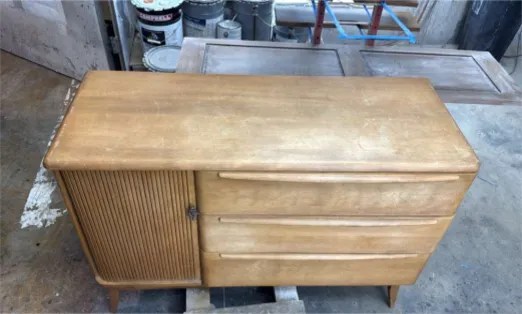
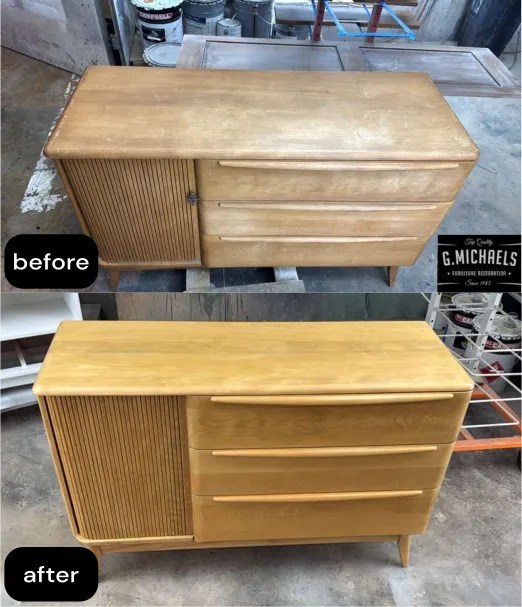
The piece is a classic example of Heywood-Wakefield’s mid-century American furniture design: solid birch construction, a tambour sliding door panel on the left cabinet section, three drawers on the right, integrated sculpted drawer pulls, and the brand’s characteristic tapered legs. The overall form is clean, low, and horizontal in the way that defines the period. It is also a piece that punishes careless refinishing. Get the tone wrong, or sand too aggressively through the veneer, and you lose what makes a Heywood-Wakefield worth restoring in the first place.
Understanding Heywood-Wakefield Before Touching It
Heywood-Wakefield furniture requires a restorer who understands what they are working with before the preparation process begins. This is not a generic mid-century piece that can be sanded and refinished like any other hardwood project.
The brand used solid birch throughout its furniture line, which is a relatively light-toned, fine-grained wood that responds well to the blonde and wheat finish tones the company became known for. The original factory finishes were applied to achieve a specific warm, consistent tone across the entire piece, and that tone is tied directly to the natural character of the birch beneath it. Any refinishing process that disrupts the surface too aggressively risks changing the way the wood accepts new finish, which changes the final color even before stain or toner is applied.
Surface Preparation
All surfaces were stripped and sanded through a process appropriate to the birch construction and the original finish system. The goal at this stage was to remove the degraded finish cleanly and bring the surfaces to a consistent, even condition ready for refinishing, without cutting into veneer or altering the grain character of the wood beneath.
The top panel, which showed the most significant finish wear and scratch accumulation, received the most attention at this stage. Surface scratches that read through a finish tend to read even more clearly after new finish is applied if the underlying wood surface has not been properly prepared. Getting the top panel to a flat, clean condition before any finish was applied was a prerequisite for the final result reading correctly.