Antique Dining Set Restoration in Fort Collins: Table Leaf Refinishing and Chair Finish Restoration
Some projects arrive in the shop already telling you what they need. This antique dining set was one of them. After proper antique dining set restoration in Fort Collins was done – this wonderful piece of history was revived.
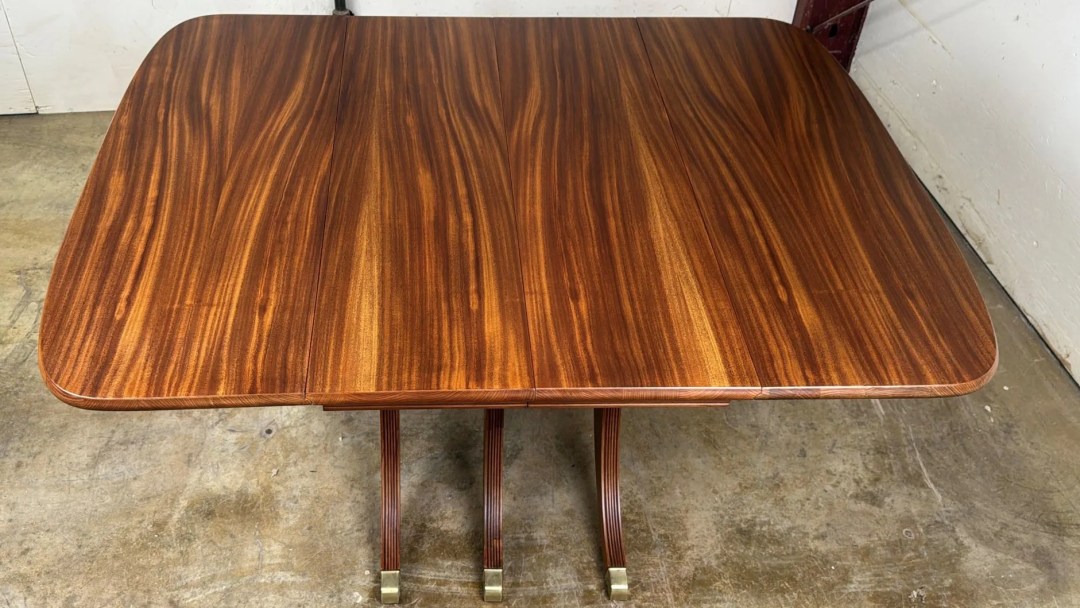
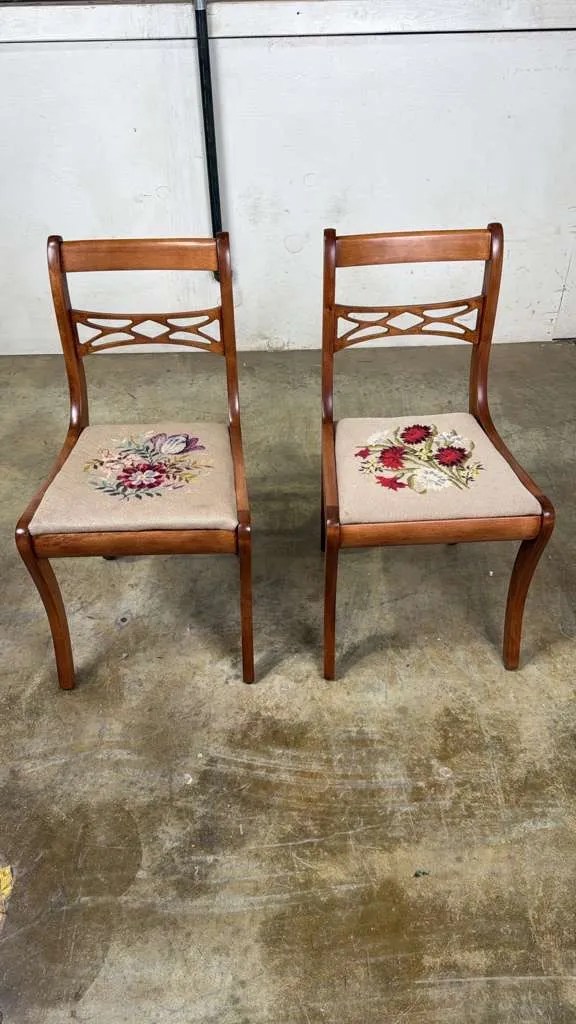
The table leaves came in with a natural grain so striking it was almost frustrating that it had been sitting under a worn finish for as long as it had. The chairs were a matched set with pierced splat backs, saber legs, and original needlepoint seat cushions, each one hand-worked with its own floral design in reds, purples, and greens. The bones of this dining set were exceptional. The finish was not keeping pace with the quality of what was underneath it.
The scope of work split cleanly across two objectives. The table leaves needed a full refinish, worked by hand to bring the natural grain forward and apply a finish that would protect the surface without sitting on top of the wood like a plastic coating. The chair frames needed careful finish restoration, enough to bring warmth and depth back to the wood, without a single thread of the original needlepoint touched in the process.
Both objectives were met. The dining set that left this shop looks like it belongs in a magazine and will hold up in a home even better.
Project Overview
This project included:
- Full refinish of the table leaves, hand worked to develop and protect the natural grain
- Careful finish restoration of the chair frames throughout the set
- Color and sheen matched consistently across all table and chair surfaces
- Original needlepoint seat cushions fully preserved on all chairs
- Complete dining set returned as a cohesive, matched unit
The Dining Set: What Makes It Worth This Level of Care
Before the process, the piece deserves some attention on its own terms.
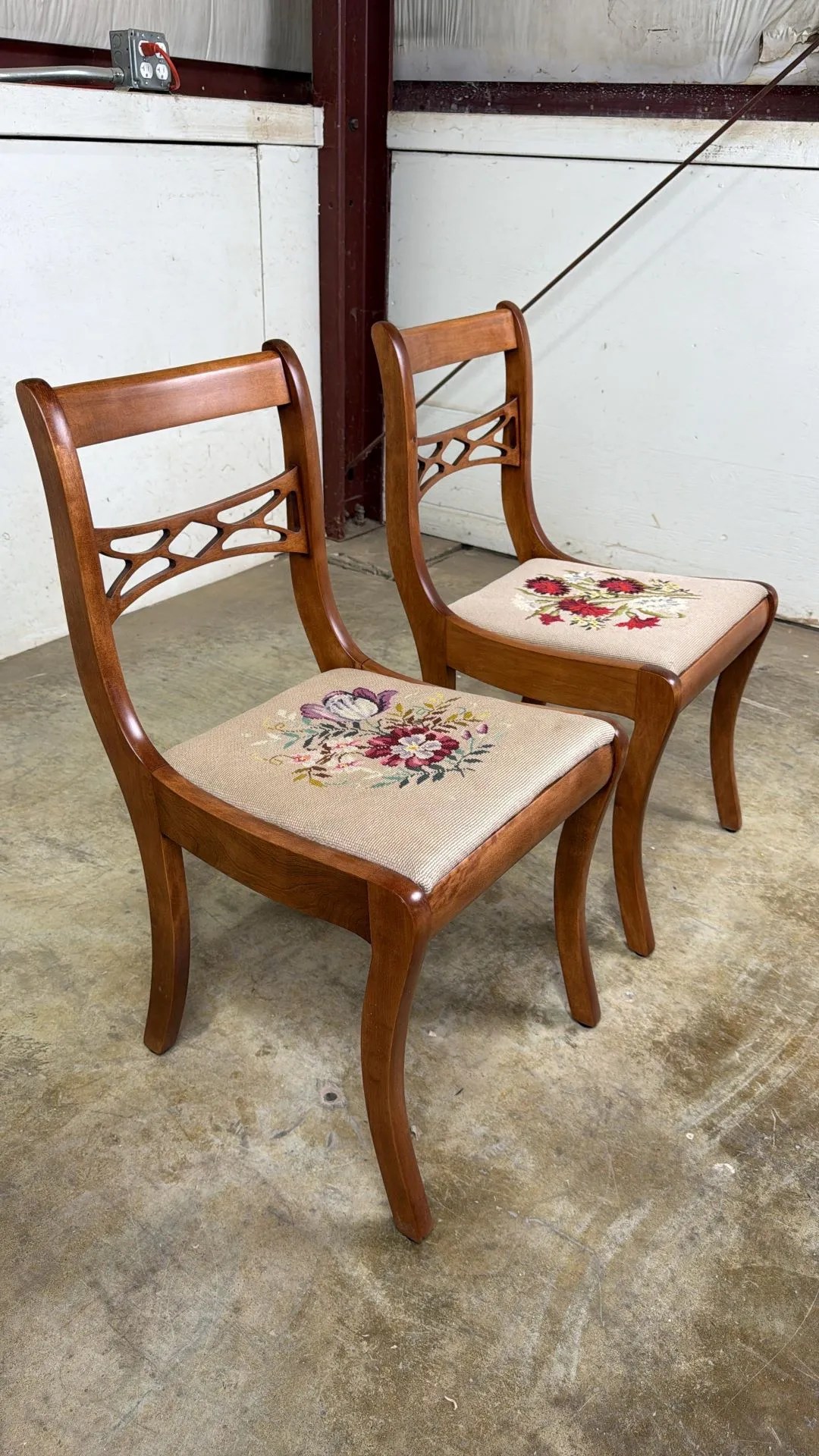
The chairs are a classic American antique design with curved crest rails, pierced splat backs featuring an open geometric pattern, shaped seat rails, and outward-curved saber legs front and rear. The form is associated with early nineteenth-century American furniture design, a period when the influence of Regency and Federal style elements produced chairs with this kind of elegant, restrained line. The saber leg in particular is a marker of the period: a graceful outward curve that lifts the chair visually off the ground and distributes the weight of a seated person with surprising efficiency.
The needlepoint seat cushions are individually worked. Each chair has a different floral arrangement in its center, with colors coordinated across the set but not identical. This is hand work, done by someone with skill and time, and it represents an investment of care that the chairs themselves were clearly designed to receive. Recovering these seats with modern fabric would be faster and cheaper than what we did. It would also be wrong.
The table leaves show a warm, figured grain with strong contrast between the lighter field and the darker grain lines running through it. Under a proper finish, this kind of grain movement reads with real depth. Under a worn or degraded finish, it looks flat and tired. The difference between the two is entirely a function of how well the surface has been prepared and what finish system sits on top of it.
History Colorado’s Art and Design collection holds over 70,000 artifacts including furniture and decorative arts primarily from Colorado homes, documenting how style, craft, and taste evolved across generations. Directoryone Antique dining sets like this one are a direct part of that story, objects that were made to last, used for decades, and passed down because they were worth keeping. Restoring them correctly is how they stay in circulation rather than ending up in an estate sale or a landfill.
Refinishing the Table Leaves
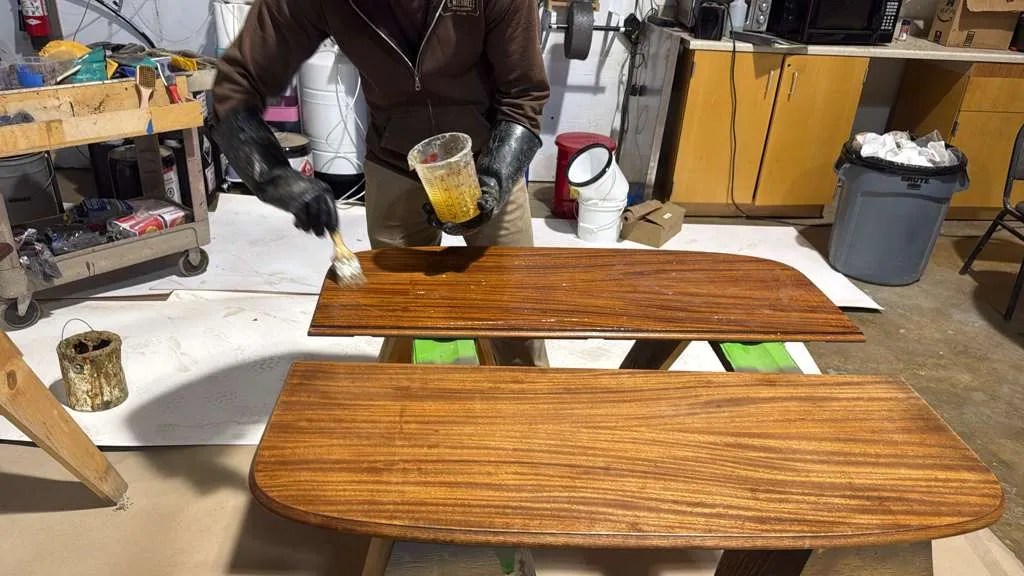
The table leaves were refinished by hand from preparation through final topcoat.
Hand-worked refinishing on figured wood is slower than spray application and gives the restorer more control over how the finish develops across surfaces with grain variation. The goal on a leaf like this is a finish that reads as part of the wood rather than as a coating sitting on top of it. That outcome requires working in stages, evaluating the surface under raking light at each step, and adjusting the build and sheen as the finish develops.
Surface preparation began with careful stripping and sanding to remove the existing finish and bring the wood to a clean, even condition. Figured grain can present uneven porosity across a single panel, and surface preparation that does not account for this will produce a finish that looks blotchy or inconsistent even when the color is correct. Taking the time to get the preparation right is what allows the grain to read clearly through the finished surface.
The color and sheen were matched to be consistent with the chair frames so the complete dining set would read as a unified whole rather than as a table and a set of chairs that happened to be in the same room.
This kind of careful, surface-specific work is a consistent part of our table refinishing and restoration process on pieces with figured grain or significant natural character.
Restoring the Chair Frames Without Touching the Needlepoint
The chairs required a different kind of attention.
Finish restoration on a chair with original period upholstery is a constrained process by definition. The needlepoint seats on these chairs are irreplaceable. They cannot be cleaned the way wood can be cleaned, they cannot tolerate the chemicals used in stripping, and they cannot be protected well enough from overspray to allow any kind of spray finish application with the cushions in place. Every step of the finish restoration on these frames had to be executed with the needlepoint present and untouched.
The seat cushions were carefully protected throughout the process. Finish restoration was applied to the frames by hand, working around the cushion perimeters and across the saber legs, crest rails, and pierced splat backs with tools and technique suited to the constraint.
The goal was not to make these chairs look freshly refinished in the way a fully stripped and refinished piece looks. It was to bring the warmth and depth back to the existing wood surface, close the gaps where the finish had worn through or dulled, and produce a result where the chair frames and the table leaves would read as a matched set. That is a more difficult standard to hit than a standard refinish because it requires matching to something specific rather than developing a new finish on a clean surface.
Our antique furniture restoration process on chairs and frames with original upholstery always treats preservation of the existing textile as a non-negotiable constraint. The woodwork serves the piece. The piece includes everything on it.
Color and Sheen Consistency Across the Set
A dining set is evaluated as a unit. Individual pieces that look good on their own but do not read as a matched set fail as a dining room.
Once the table leaves were refinished and the chair frames were restored, we evaluated the complete set together under multiple lighting conditions before considering the project finished. The warm tone of the wood needed to be consistent across the table surfaces and all chair frames. The sheen level needed to be the same across all pieces. The grain on the leaves needed to read with depth and clarity at the same level as the chair frames.
These adjustments are iterative and require looking at the full set rather than individual pieces. A chair that looks slightly orange next to a table that reads warm brown is a problem that is invisible when you are looking at the chair alone and immediately visible when the set is assembled. Getting the set right means working toward a unified result from the beginning, not finishing individual pieces and hoping they match.
For more on our approach to color work and surface finishing, see our furniture refinishing service page.
The Finished Dining Set
The complete dining set left our shop as a cohesive unit. The table leaves show the natural grain clearly through a finish that protects without obscuring. The chair frames are warm and consistent in tone and sheen throughout the set. The needlepoint seats are exactly as they arrived: untouched, intact, and carrying the hand work of whoever made them.
This is a dining set that belongs in a dining room, used at meals, and passed on to the next person who will take care of it.
Have an Antique Dining Set, Table, or Set of Chairs That Needs Furniture Restoration?
If you have a dining table with worn or damaged leaves, a set of chairs with faded or inconsistent finish, or a complete antique dining set that has seen better days, send us photos and we will give you an honest assessment of what it will take to bring it back.
We handle all of it: table refinishing, chair finish restoration, matched color work across full sets, and any structural repairs the pieces need along the way. We take particular care on pieces with original upholstery, period textiles, or hand work that cannot be replaced.
Send photos to shop@gmrestores.com or call us at 970-493-8737. We serve Fort Collins, Loveland, Windsor, Arvada, Boulder, Denver, and the greater Denver metro area from our shop at 113 Hickory Street, Fort Collins, Colorado 80524.
Frequently Asked Questions: Antique Dining Set Restoration in Fort Collins
Can antique chair seats with original needlepoint or period upholstery be preserved during refinishing?
Yes, and at G. Michaels Restoration we treat preservation of original upholstery as a non-negotiable constraint on any project where it is present. The process requires hand application of finish materials around the existing cushions using tools and techniques suited to working in close proximity to textile. Chemical stripping and spray application are both off the table when original needlepoint or period fabric is present. The result is a finish restoration rather than a full refinish, which requires matching to the existing wood surface and sheen rather than developing a new finish on bare wood. It is more demanding technically than a standard refinish, but it is the right approach when the upholstery is original and irreplaceable.
How do you match the finish across a dining table and a set of chairs during antique restoration?
A dining set is evaluated as a unit, and we work toward a unified result from the beginning of the project rather than finishing individual pieces separately and hoping they match at the end. Color tone and sheen level are the two variables that determine whether a table and chairs read as a matched set or as pieces that happened to end up in the same room. We evaluate both under multiple lighting conditions at each stage of the process, adjusting as needed until the complete set reads as cohesive. This is particularly important on projects that combine full refinishing on one component, such as table leaves, with finish restoration on another, such as chair frames, because the two processes start from different points and have to arrive at the same place.
Is it worth refinishing antique dining table leaves versus replacing them?
In virtually every case involving original antique table leaves with quality figured grain, refinishing is both the better outcome and the more economical choice. Antique table leaves with genuine figured wood have a material and visual quality that replacement panels sourced today will not match. The grain character, the age of the wood, and the way the leaf fits the table are all arguments for preservation over replacement. Refinishing removes the degraded finish, develops the natural grain, and applies a new surface system that will protect the wood for another generation of use. The result is a leaf that looks better than it did and fits the table the way it was always meant to.
How long does antique dining set restoration take at a Fort Collins furniture shop?
Timelines vary depending on the scope of work, the condition of the pieces, and the shop’s current queue. A project like this one, involving table leaf refinishing and chair frame finish restoration across a full set, typically runs several weeks from drop-off to completion when done correctly. Rushed work on antique pieces produces visible results. Surface preparation that is cut short, finish coats that are applied before the previous coat has cured, and color matching done at the end rather than built in throughout are all shortcuts that show up in the finished piece. We provide honest timeline estimates at the point of assessment and update clients if anything changes.
Where can I get an antique dining set restored near Fort Collins or Denver?
Michaels Restoration has been handling antique furniture restoration in Fort Collins since 1985, serving clients throughout the greater Denver metro area including Boulder, Loveland, Arvada, Windsor, and Denver proper. We have experience with antique dining sets, period chairs, figured wood table surfaces, and projects that involve original upholstery or hand work that has to be preserved throughout the process. Free estimates are available on all projects, and we offer pickup and delivery throughout our service area. Send photos to shop@gmrestores.com or call us at 970-493-8737 to get started.
Located in the historic city of Fort Collins, Colorado. G. Michael’s is an esteemed furniture repair and antique furniture restoration wood shop.