Heywood-Wakefield Chair Restoration in Fort Collins: Stripping, Refinishing, and Custom Reupholstery
There is a particular kind of damage that is harder to fix than a broken joint or a scratched surface. It is the damage done by a well-meaning previous owner who looked at a beautiful piece of mid-century American furniture and decided it needed to be darker. In the end, professional Heywood-Wakefield chair restoration was needed to bring this American piece of classic to its glory.
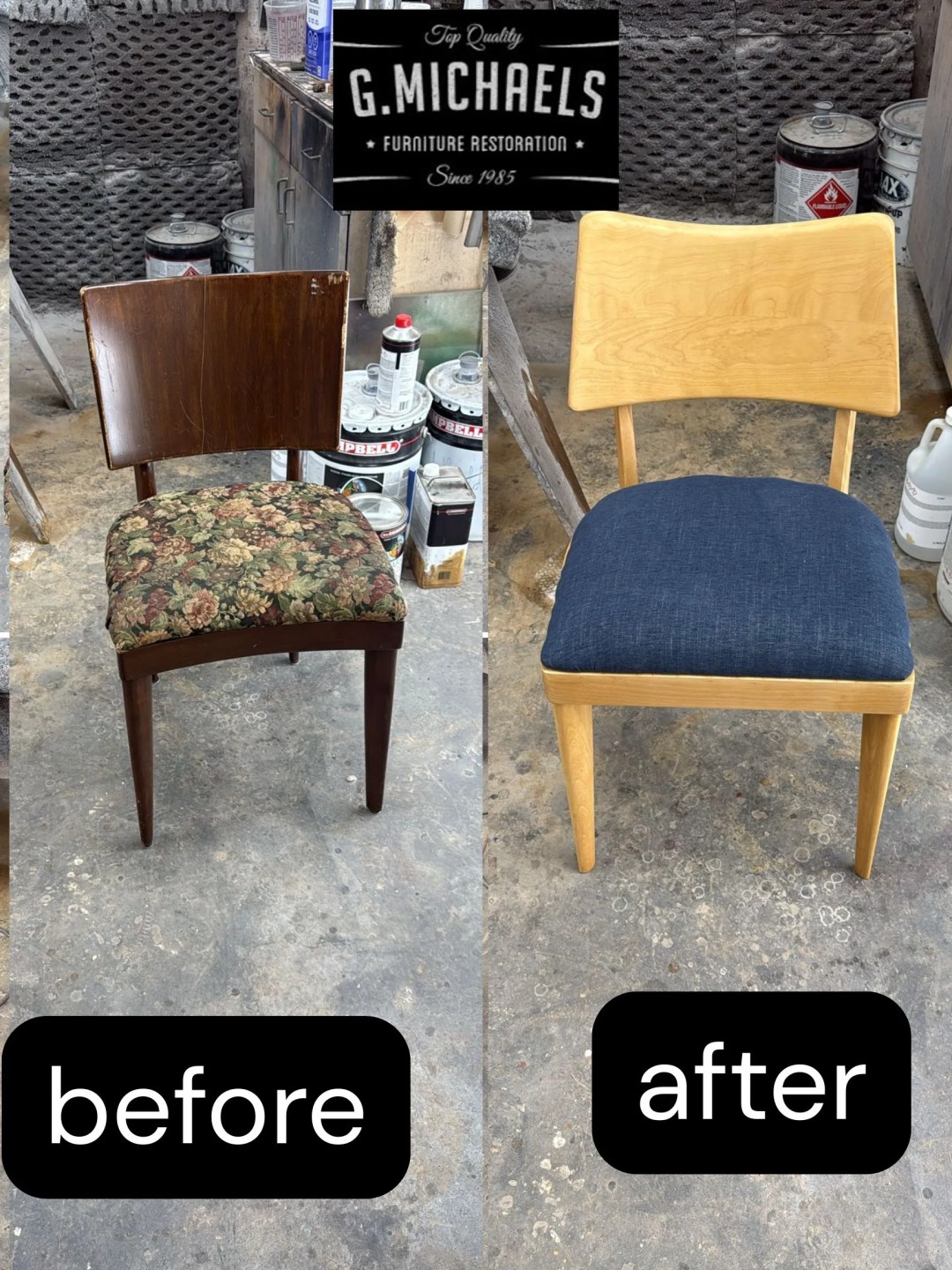
This set of Heywood-Wakefield chairs arrived at our shop in exactly that condition. Underneath a heavy, non-original dark stain and dated floral upholstery was exactly what you would hope to find: solid birch frames in good structural condition, with the clean sculptural lines that make Heywood-Wakefield one of the most recognizable and collectible American furniture brands of the twentieth century.
Getting them back meant doing the work in reverse. Strip what should not be there. Reveal what was always there. Finish it the right way. And give the upholstery an update that respects the design language of the piece without simply copying what came before.
Project Overview
This project included:
- Full stripping of non-original dark stain from all wood surfaces
- Surface preparation and sanding appropriate to Heywood-Wakefield birch construction
- Full refinish to restore the warm, natural blonde tone characteristic of original factory finish
- Removal of original floral fabric and padding
- Custom reupholstery in a clean, modern blue fabric suited to the mid-century aesthetic
About Heywood-Wakefield
Heywood-Wakefield was an American furniture manufacturer with roots stretching back to the nineteenth century. The company became synonymous with mid-century modern design during the late 1930s through the 1960s, producing furniture in solid birch with the blonde and wheat finish tones that defined the look of postwar American interiors. The design sensibility was clean, low, and functional, influenced by Scandinavian modernism but with a distinctly American character.
The result was furniture that was built to last and designed to be beautiful, which is exactly why so much of it is still around and still worth restoring properly. Heywood-Wakefield pieces hold their value when their original character is preserved. The worst thing that can happen to one of these chairs is not age or wear. It is a well-intentioned refinish that buries the blonde grain under dark stain or covers the wood entirely in paint.
The Denver Art Museum’s Architecture and Design collection includes mid-century American furniture among its holdings and documents the broader design movement that produced pieces like these, providing useful context for anyone interested in the period and its lasting influence on American design.
Stripping the Non-Original Finish
The first and most important step on this project was removing what did not belong.
The dark stain applied to these chairs at some point in their history was not a factory finish. Heywood-Wakefield’s signature aesthetic was built around light, warm, blonde birch, and the original finish systems the company used were designed to enhance that natural tone rather than mask it. A dark stain does the opposite: it obscures the grain character that makes birch distinctive and flattens the visual quality that collectors and design enthusiasts specifically seek out in these pieces.
Stripping a Heywood-Wakefield piece requires care. The birch construction is consistent and well-suited to stripping, but the preparation process has to be thorough enough to remove the non-original finish completely while remaining controlled enough to preserve the surface character of the wood beneath. Any residual stain left in the grain will read through the new finish and create an uneven tone that no amount of additional color work will fully correct.
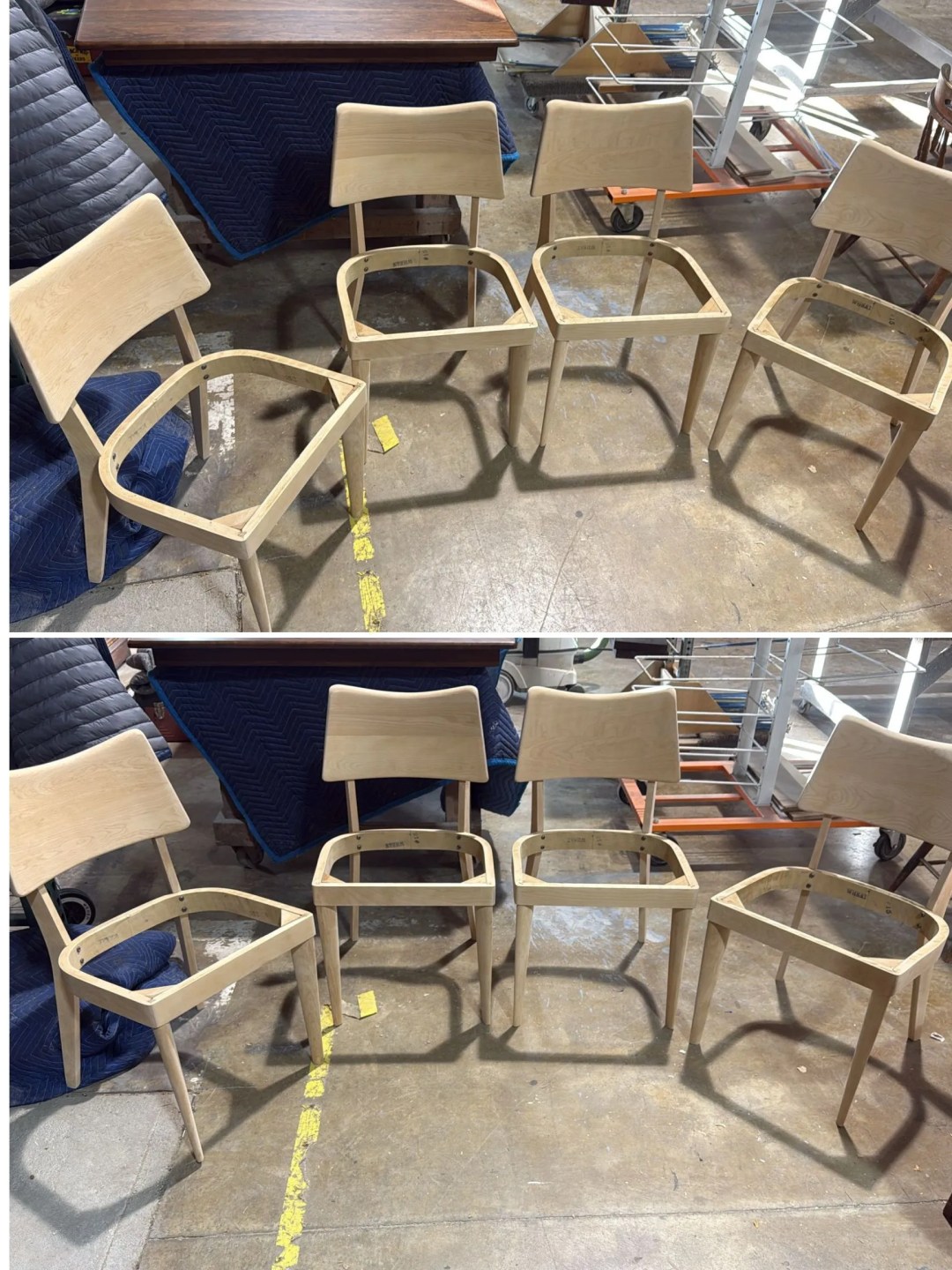
Our furniture stripping process on vintage pieces like these treats complete removal of the previous finish as a prerequisite, not an approximation. The birch surfaces on these chairs were stripped to clean, bare wood before any refinishing work began.
Surface Preparation
With the non-original finish removed, all wood surfaces were sanded through a progression appropriate to birch. Birch is a fine-grained hardwood that responds well to careful preparation and holds finish evenly when the surface is properly developed before any color or topcoat is applied.
The chair frames were worked systematically, including the curved back rails, the seat frames, and the leg elements, to ensure that the prepared surface was consistent across every component. On chairs that will be viewed and handled from all angles, surface inconsistency in the preparation stage becomes visible in the finished piece.
Refinishing to Original Blonde
The refinishing process on Heywood-Wakefield requires matching a tone that is at once simple and specific. The original factory blonde is warm without being orange, consistent without being flat, and light without reading as bleached or washed out. It is a finish that works with the natural character of birch rather than imposing a color over it.
We built the tone through a toning process across all surfaces, evaluating consistency across each chair and across the set as a whole. A set of chairs that varies in tone from one piece to the next is immediately visible in a room, even when the individual pieces look acceptable on their own. The goal was a result that reads as a unified set with the correct Heywood-Wakefield character restored throughout.
A protective topcoat was applied at the appropriate sheen level for the period: low enough to be consistent with mid-century American design sensibility, durable enough to hold up to regular use. This is the same approach we take across all of our antique furniture restoration projects where matching original finish character is the primary objective.
Custom Reupholstery
The original floral fabric on these chairs was removed along with the underlying padding. Reupholstering a Heywood-Wakefield chair is an opportunity to update the piece for current use without compromising its design integrity, and the fabric choice matters significantly.
We selected a clean, modern blue fabric that complements the warm blonde tone of the refinished birch without competing with the wood or introducing a pattern that would conflict with the geometric simplicity of the chair design. The result is an upholstery choice that feels current while remaining consistent with the spare, considered aesthetic of the mid-century modern period.
The installation was fitted and finished to a standard appropriate to the quality of the frames beneath it. On a chair with exposed wood elements and clean sight lines, the quality of the upholstery execution is fully visible. There is nowhere for poor workmanship to hide on a piece like this.
For more on our approach to wood surface work prior to reupholstery projects, see our furniture refinishing service page.
The Finished Set
The completed chairs present with clean, warm blonde birch frames and fresh blue upholstery throughout. The non-original dark stain is gone. The grain character of the birch is visible and consistent across the set. The custom fabric reads as intentional and period-appropriate. The overall result is a set of Heywood-Wakefield chairs that look like what they have always been: well-designed, well-built American mid-century modern furniture that deserved better than a dark stain and dated fabric.
Do You Have a Heywood-Wakefield or Mid-Century Modern Piece That Needs Restoration?
If you have a Heywood-Wakefield chair, dresser, credenza, dining set, or other piece that has been refinished in the wrong color, painted over, or upholstered with fabric that does not fit the piece, send us photos and we will give you an honest assessment of what is involved in bringing it back.
The same applies to other mid-century American furniture brands: Drexel, Lane, Broyhill Brasilia, and similar lines all have specific finish and construction characteristics worth understanding before any restoration work begins. Do not paint over these pieces. Do not stain them darker. Restore them correctly and they will outlast anything you can buy new today.
Send photos to shop@gmrestores.com or call us at 970-493-8737. We serve Fort Collins, Loveland, Windsor, and the greater Denver metro area from our shop at 113 Hickory Street, Fort Collins, Colorado 80524.
Frequently Asked Questions: Heywood-Wakefield and Mid-Century Modern Chair Restoration in Fort Collins
Can Heywood-Wakefield furniture be restored if it has been stained a dark color?
Yes, in most cases. Non-original dark stain can be stripped from Heywood-Wakefield birch frames through a careful stripping and surface preparation process. The key is complete removal of the non-original finish before any refinishing work begins. Residual stain left in the grain will show through a new finish and affect the final color, so the stripping process has to be thorough rather than approximate. Once the surface is clean and properly prepared, the original blonde tone can be restored through toning and a period-appropriate topcoat. The condition of the underlying birch determines how closely the finished result matches the original factory character, but in most cases the wood beneath a dark stain is in good condition and responds well to refinishing.
How do I know if my mid-century modern furniture is worth restoring in Fort Collins?
The most reliable indicator is the construction quality of the piece itself. Mid-century American furniture brands like Heywood-Wakefield, Drexel, Lane, and Broyhill used solid wood and quality veneers throughout their lines, and that underlying construction holds up well over decades. If the frame is structurally sound and the piece has design integrity, it is almost always worth restoring rather than replacing. A quick way to assess this is to bring or send us photos: we will give you an honest evaluation of the piece’s condition and the scope of work required, and we will tell you directly if the restoration cost is not proportionate to the value of the result. Free estimates are available on all projects.
What is the difference between furniture refinishing and furniture restoration for vintage chairs?
Refinishing refers specifically to the surface finish work: stripping the old finish, preparing the wood, and applying a new finish system. Restoration is a broader term that can include refinishing but also covers structural repairs, missing component fabrication, color matching to original factory finish, and upholstery work. For a Heywood-Wakefield chair in the condition of this set, the project involved both: refinishing the wood surfaces back to the original blonde tone and replacing the upholstery with fabric appropriate to the piece. A restorer who understands both the finish character and the construction of a specific brand or period will consistently produce better results than a general refinisher working from a standard process.
Does reupholstering a mid-century modern chair reduce its value?
Not necessarily, and in many cases appropriate reupholstery increases both the usability and the appeal of the piece. The factors that matter most are fabric choice and quality of execution. A fabric that is consistent with the design sensibility of the period and the color character of the refinished wood, installed cleanly and correctly, preserves the integrity of the piece. What does reduce value is inappropriate fabric choices, poor installation quality, or upholstery that conflicts with the visual language of the original design. On collectible pieces like Heywood-Wakefield, a well-chosen, well-executed reupholstery paired with a correct refinish is a net positive for both the piece and the owner.
Where can I get Heywood-Wakefield chairs or mid-century modern furniture restored near Fort Collins or Denver?
Michaels Restoration has been handling antique and vintage furniture restoration in Fort Collins since 1985, serving clients throughout the greater Denver metro area including Boulder, Loveland, Lakewood, and Aurora. We have specific experience with Heywood-Wakefield and other mid-century American furniture brands, including the stripping, refinishing, and reupholstery work involved in returning these pieces to their original character. We offer free estimates, pickup and delivery throughout our service area, and a 100% satisfaction guarantee. Send photos to shop@gmrestores.com or call 970-493-8737 to get started.
Located in the historic city of Fort Collins, Colorado. G. Michael’s is an esteemed furniture repair and antique furniture restoration wood shop.