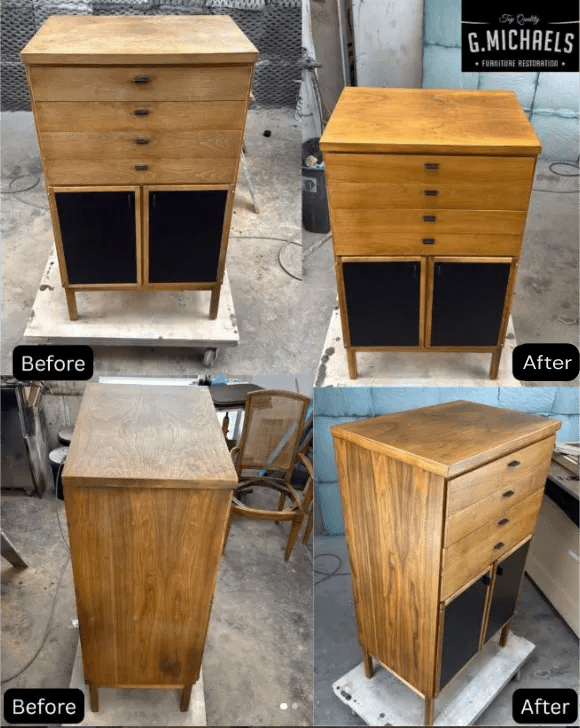
Mid-Century Modern Walnut Cabinet Restoration in Fort Collins: Veneer Refinishing and Finish Revival
Walnut does not need help being beautiful. What it needs is for the finish sitting on top of it to stop getting in the way. To achieve this we did a full mid-century walnut cabinet restoration.
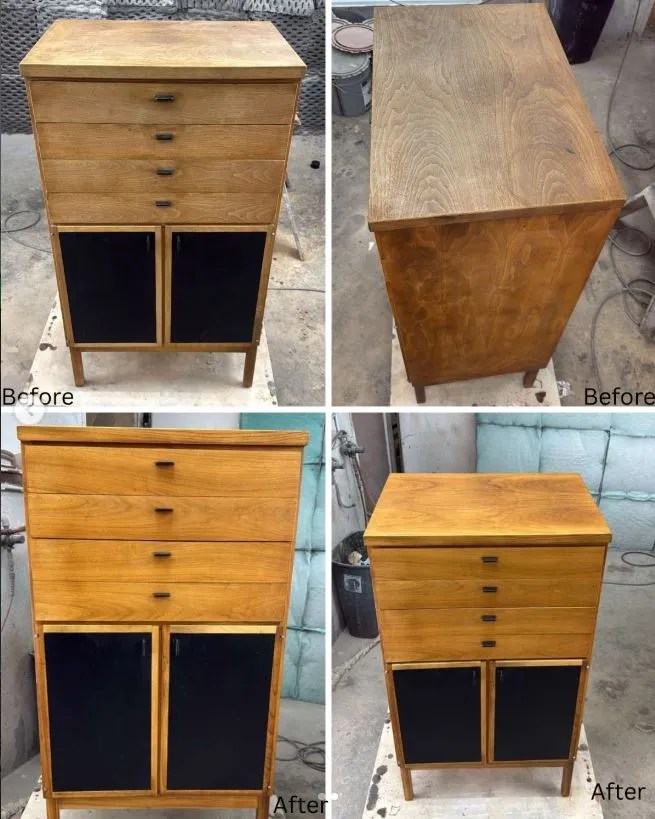
This mid-century modern cabinet arrived at our Fort Collins shop with a finish that had gone past tired and into genuinely cloudy. The warmth that makes walnut veneer worth having in a room was completely buried. The rich, dark grain movement that defines the wood was flattened under a surface that had oxidized, dulled, and lost whatever depth it once had. The two-tone design of the piece, warm walnut carcass paired with striking black accent doors, is one of the defining visual moves of mid-century American furniture design, and in the condition this cabinet arrived, neither element was doing what it was supposed to do.
Stripping it back and refinishing it correctly took the piece from something that looked worn out to something that looks like it belongs in a showroom. The walnut looks like walnut again. The black doors pop the way they were designed to. The whole thing reads as a cohesive, intentional design object rather than a piece past its prime.
Project Overview
This project included:
- Full stripping of the existing cloudy, degraded finish from all wood surfaces
- Careful surface preparation appropriate to walnut veneer construction
- Full refinish to restore deep, warm, natural walnut tone throughout
- Restoration of sharp visual contrast between walnut carcass and black accent doors
- Protective topcoat applied across all surfaces at period-appropriate sheen level
The Piece: What Makes This Cabinet Worth Restoring
Before getting into the process, it is worth spending a moment on what this cabinet actually is and why restoring it correctly matters.
The design is classic mid-century American. A tall, upright case with four drawers across the upper section and a two-door cabinet below, all sitting on tapered legs that lift the piece off the floor and give it the visual lightness characteristic of the period. The drawer pulls are low-profile, horizontal bar pulls in dark metal, flush with the drawer faces and minimal by design. The cabinet doors are finished in flat black, creating a deliberate two-tone effect that draws the eye and gives the piece a graphic quality that was very much intentional in the design vocabulary of the era.
The carcass and drawer faces are walnut veneer over a solid substrate. Walnut was a favored material for mid-century American furniture because its natural figure, with its swirling dark grain against warm brown field tones, provides visual complexity without requiring decorative carving or applied ornament. The design does the work, and the wood provides the character.
Walnut veneer requires a restorer who understands what they are working with. The veneer layer is thin, and the surface preparation process has to be controlled carefully to clean and level the surface without cutting through to the substrate beneath. A restorer who treats veneer like solid wood will ruin it. Fort Collins has a genuine appreciation for mid-century design, and the Poudre Landmarks Foundation, whose mission is to preserve, restore, protect, and interpret the architectural and cultural heritage of the Fort Collins area, has featured mid-century modern homes on its annual Historic Homes Tour Colorado Attorney General, reflecting the broader community recognition of the period’s lasting design value. That same respect for the era is what drives us to restore pieces like this one rather than cover them up or replace them with something new.
Stripping the Degraded Furniture Finish
The first step was removing what was there.
A finish that has oxidized and clouded to the degree this one had is not a candidate for a topcoat refresh. Applying new finish over a degraded existing finish traps the problem rather than solving it. The result looks better briefly and then fails again, often in a shorter timeframe than the original because the new finish is bonding to a compromised surface rather than clean wood. The only correct approach is full removal.
All wood surfaces were stripped to bare wood. The wood stripping process on walnut veneer is slower and more deliberate than on solid wood because the material being worked is thinner and less forgiving of error. The goal is a clean, uniformly stripped surface ready for preparation and refinishing, without any thinning or damage to the veneer layer.
The black accent doors were assessed and treated separately. The condition and construction of those panels determined whether they needed stripping and repainting or surface preparation and topcoat work to restore their finish.
Our furniture stripping approach on veneer pieces treats the preparation stage as the most critical phase of the entire project. Everything that follows depends on the surface condition at the end of it.
Surface Preparation on Walnut Veneer
With the old finish removed, all walnut veneer surfaces were sanded through a controlled sequence appropriate to the material. The objective at this stage is a surface that is clean, flat, and consistent across every panel, ready to accept finish evenly without blotching or tonal variation.
Walnut veneer can present uneven porosity across a single panel due to the grain movement and figure variation that makes the wood visually interesting in the first place. Areas of tight straight grain and areas of swirling figure can respond differently to stain or toner if the surface preparation is not done correctly. Getting the preparation right means the finish goes on evenly and the grain character reads through the surface as a unified whole rather than as a patchwork of differently toned areas.
The drawer faces were worked individually off the carcass where possible, and the case panels were prepared in place with attention to the transitions at corners and edges where veneer is most vulnerable.
Refinishing: Bringing Walnut Back to Life
The refinishing phase focused on restoring the deep, warm natural tone of the walnut veneer without imposing a color that obscures the wood’s own character.
Walnut’s natural range runs from warm golden brown in the lighter sapwood areas to deep chocolate brown in the heartwood, with dark grain lines weaving through both. A well-executed refinish on walnut does not make the wood look uniformly dark or uniformly light. It makes the full range of the wood’s natural tonal variation visible and clear, protected under a finish that has enough depth and clarity to let the figure read through it.
We built the finish in stages, evaluating tone and consistency across all panels under multiple lighting conditions before applying the final topcoat. The drawer faces, case sides, top panel, and leg elements were all brought into tonal alignment. On a piece with this much visible surface from normal viewing angles, a color discrepancy between the top and the sides, or between adjacent drawer faces, is immediately visible and undermines the whole result.
This careful, panel-by-panel approach is a consistent part of our antique furniture restoration and vintage refinishing process on pieces where the original material quality is worth honoring rather than obscuring.
Restoring the Black Accent Door Contrast
The two black accent doors are not decorative additions. They are structural to the design intent of the piece. The two-tone walnut-and-black combination is one of the defining aesthetic moves of mid-century American furniture, and it works precisely because the contrast is sharp and clean. Faded black that reads as dark grey does not create contrast. It creates visual ambiguity that makes the whole piece look tired.
The accent doors were restored to a clean, consistent flat black finish that holds a crisp boundary against the warm walnut carcass around them. The result is the contrast the designer intended: warm organic grain on one side of that line, flat graphic black on the other.
The Finished Wood Cabinet
The completed piece presents as what it was always meant to be: a well-designed, well-made example of mid-century American furniture with visual character that mass-produced modern furniture simply cannot replicate.
The walnut surfaces are clean, warm, and deep in tone. The grain figure reads clearly through the finish. The black accent doors hold their ground against the walnut with a sharp, confident contrast. The drawer pulls and tapered legs complete a design that looks as considered today as it did when it was first made.
For more on our approach to surface work on vintage and antique pieces, see our furniture refinishing service page.
Have a Mid-Century Modern Cabinet, Dresser, or Credenza That Needs Restoration?
Mid-century walnut veneer furniture is worth restoring correctly. The materials are better than most of what is produced today, the designs have held up for sixty-plus years, and a proper refinish will add another generation of life to a piece that was built to last.
If you have a mid-century modern cabinet, credenza, dresser, or dining piece with a degraded or cloudy finish, send us photos at shop@gmrestores.com and we will give you an honest assessment of the scope of work and what the result can look like.
We serve Fort Collins, Loveland, Windsor, and the greater Denver metro area from our shop at 113 Hickory Street, Fort Collins, Colorado 80524. Call us at 970-493-8737.
Frequently Asked Questions: Mid-Century Modern Furniture Restoration in Fort Collins
Can walnut veneer furniture be refinished without damaging the veneer?
Yes, when the work is done by a restorer who understands veneer construction. The key difference between refinishing solid wood and refinishing walnut veneer is the thickness of the material being worked. Veneer layers are thin, and the stripping and sanding process has to be controlled precisely to remove the old finish without cutting into or through the veneer beneath it. A restorer who approaches veneer the same way they would approach solid wood will damage the surface. At G. Michaels Restoration we work with walnut veneer regularly and treat the preparation stage as the most critical phase of any veneer refinishing project. When done correctly, the results are excellent and the veneer is fully preserved.
Is it worth restoring mid-century modern furniture in Fort Collins or should I just buy new?
In most cases, restoring a genuine mid-century modern piece is both more cost-effective and more satisfying than buying new. Mid-century American furniture was built with solid wood frames, quality veneer, and joinery that holds up over decades. The design quality of pieces from this period, including the materials, proportions, and visual character, is not something that mass-produced modern furniture replicates. A proper refinish restores the piece to showroom condition for a fraction of what comparable quality costs new, and you end up with something that has real material and design value rather than a reproduction. Send us photos for a free estimate and we can tell you specifically what your piece needs.
How do I know if my vintage cabinet has walnut veneer or solid walnut?
The most reliable way is to look at the edges and the back panels of the piece. Solid walnut will show end grain at the edges of panels, and the grain pattern will be consistent through the thickness of the piece. Veneered construction typically shows a different wood species or a plywood substrate at cut edges, and the back panels are often a less expensive secondary wood. The grain figure on a veneered face can look more consistent and symmetrical than solid wood because veneer sheets are cut sequentially and often book-matched. If you are uncertain, bring or send us photos and we can usually identify the construction from what we see.
What is the best way to clean and maintain a mid-century modern walnut cabinet at home in Fort Collins?
For day-to-day maintenance, dust walnut surfaces with a soft, dry or very slightly damp cloth, working with the grain. Avoid silicone-based spray polishes, which build up over time and complicate future refinishing work. A light application of a quality paste wax once or twice a year provides good surface protection on a refinished piece without the buildup issues associated with spray products. Keep walnut furniture out of direct sunlight, which causes the wood to fade and lose the warm tonal range that makes it distinctive. Colorado’s dry climate can cause wood movement in older pieces, so maintaining reasonable interior humidity, particularly during dry winter months, helps prevent checking and joint loosening over time.
Where can I get mid-century modern furniture restored near Fort Collins or Denver?
Michaels Restoration has been handling antique and vintage furniture restoration in Fort Collins since 1985, serving clients across the greater Denver metro area. We have specific experience with mid-century American furniture, including walnut veneer refinishing, two-tone finish restoration, and the surface preparation work that veneer construction requires. We offer free estimates on all projects, pickup and delivery throughout our service area, and a 100% satisfaction guarantee. Send photos to shop@gmrestores.com or call us at 970-493-8737 to get started. Our shop is located at 113 Hickory Street, Fort Collins, Colorado 80524.
Located in the historic city of Fort Collins, Colorado. G. Michael’s is an esteemed furniture repair and antique furniture restoration wood shop.