Antique Carved Table Restoration: Custom Walnut Top Fabrication and Professional Finish in Fort Collins
Some pieces arrive at our shop with a problem that no amount of refinishing can solve. This was one of them, so we did full antique carved table restoration to bring it back to its old glory.
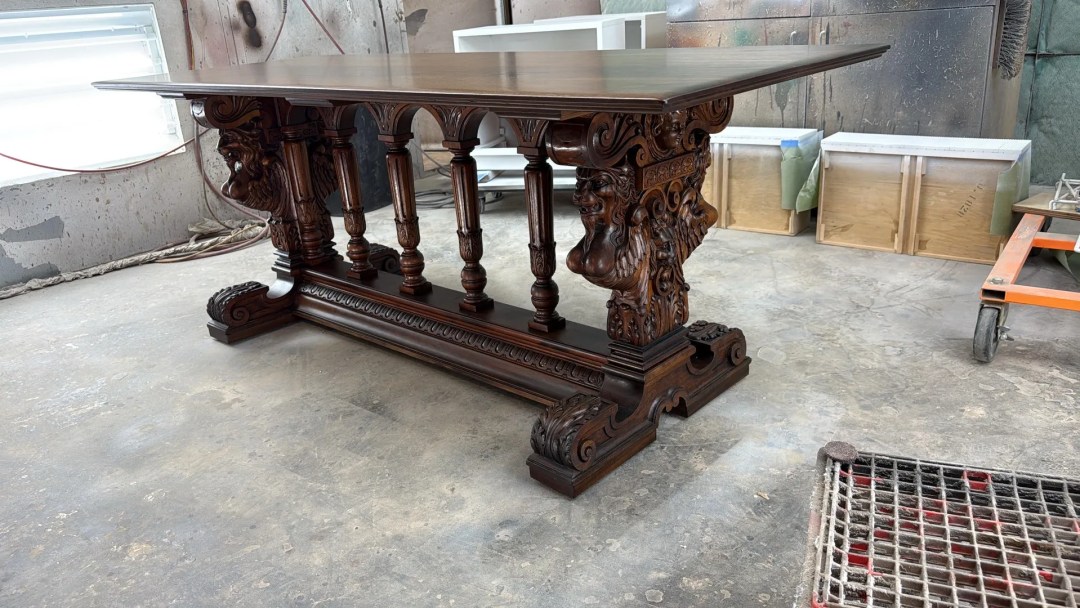
A client brought us an antique table base that stopped everyone in the shop the moment it came through the door. Lion head corbels at the corners. Grotesque face carvings on the end pedestals. Acanthus leaf motifs at the bracket feet. Turned and fluted spindles running along the gallery beneath the apron. Egg-and-dart molding carved into the apron rail itself. Elaborate scrollwork threading through the entire structure from top to bottom.
The craftsmanship was extraordinary. The problem was simple: there was no top.
Without a surface, the piece was incomplete and non-functional, no matter how remarkable the base. Our job was to build what was missing and finish it in a way that honored what was already there.
Project Overview
This project included:
- Full assessment of the carved antique base and existing finish condition
- Custom solid walnut top fabricated in-house to scale
- Edge profile and overhang proportion fitting to the carved apron
- ML Campbell conversion varnish finish applied to the new walnut top
- Finish maintenance and toning on the base to ensure cohesion throughout
The Base: Understanding What We Were Working With
Before any fabrication work began, we spent time with the base. Understanding a piece this detailed is not optional. It informs every decision that follows, from the wood species chosen for the new top, to the stain tone, to the sheen level of the finish, to the edge profile on the new panel.
The base is a trestle-style structure supported by two carved pedestals connected by a stretcher rail. Each pedestal features lion head carvings at the upper corbels and grotesque face carvings on the outward-facing panels, with dense scrollwork and foliate carving filling the surrounding field. The bracket feet are carved with acanthus leaf detail and scroll terminations. A turned spindle gallery runs beneath the apron between the two pedestals, and the apron rail itself carries a continuous egg-and-dart molding carved in relief.
This is not decorative surface carving applied after the fact. It is structural carving integrated into the form of the piece, which means the carvings carry visual weight and presence from every angle. Any top placed on this base would need to hold its own visually while stepping back enough to let the carving remain the focal point of the design.
Choosing the Right Wood: Why Walnut
We selected solid walnut for the new top based on several factors specific to this piece.
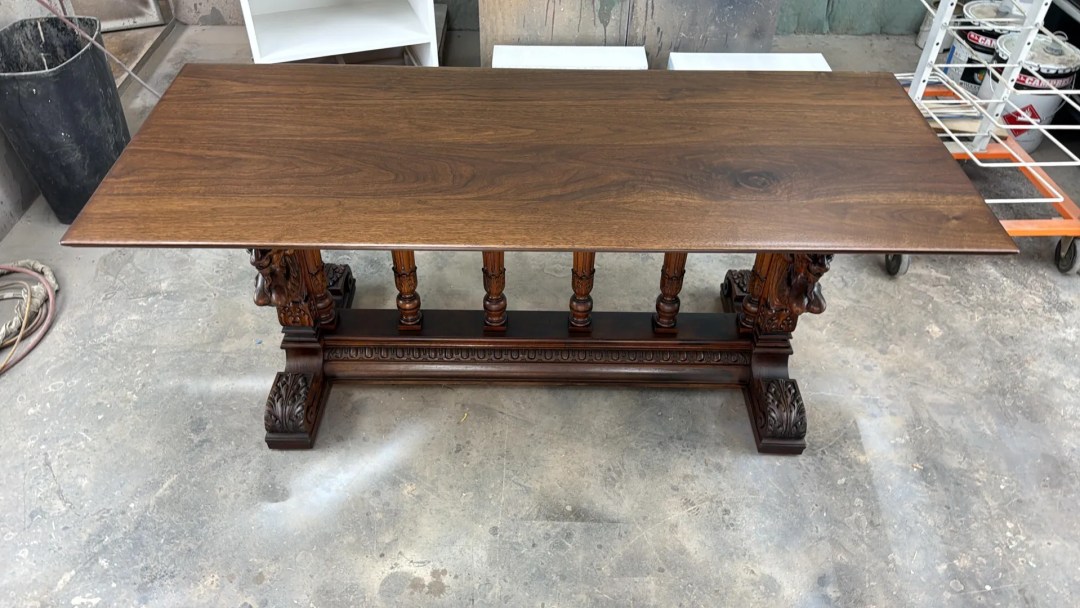
Tonally, walnut’s natural color range, a warm brown with darker streaking and grain movement, is compatible with the deep, dark-toned finish on the carved base. A pale wood like maple or ash would have created too much contrast and disrupted the visual weight of the piece. Walnut reads as a natural companion to a dark-stained hardwood base without requiring heavy pigmentation to close the gap.
Structurally, walnut is a dense, stable hardwood well suited to a large panel application like a dining or library table. It resists seasonal movement better than many alternatives and holds finish cleanly.
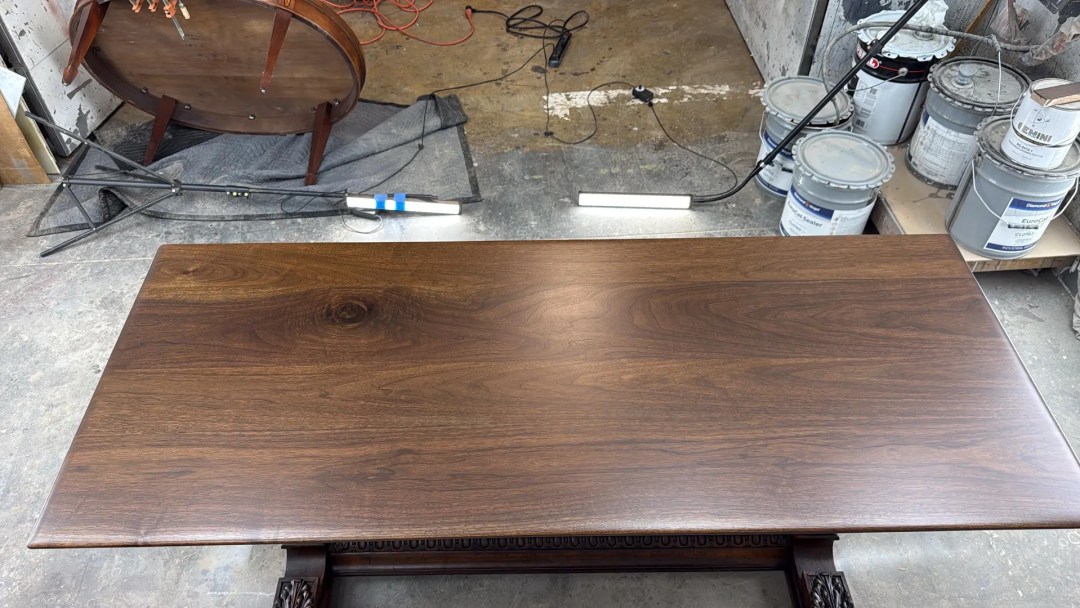
The grain figure in the panels we selected adds visual interest to a large flat surface without being busy. Walnut at this scale gives the eye something to move across, which matters when the top needs to hold its own next to carvings as detailed as those on the base below it.
Fabricating the Top
The panel was milled, jointed, and brought to final thickness in-house. Dimensions were determined by working directly from the base structure and evaluating proportion from multiple viewing angles. A top that is too narrow makes the base look heavy and bottom-loaded. A top that overhangs too generously obscures the carved apron detail below. Getting this proportion right is a judgment call that no formula replaces.
The edge profile was kept clean and simple, a rounded-over edge that softens the visual weight of the panel without adding decorative detail that would compete with the carved apron beneath it.
Fitting the top to the base required attention to the original structure. Antique pieces of this age do not always sit perfectly level or square. We worked to the actual condition of the base rather than assuming square, so the top would sit correctly without stress or shimmy. This is standard practice in our table refinishing and restoration work, where fitting to the real condition of a piece is just as important as the finish applied to it.
The Finish: ML Campbell Conversion Varnish
For the new walnut top, we applied ML Campbell conversion varnish.
Conversion varnish is a two-component professional finish system that crosslinks as it cures, producing a surface significantly harder and more chemically resistant than standard lacquer or oil-based finishes. It is the finish of choice for surfaces that will see regular contact, heat, and moisture exposure, which any dining or display table will encounter over time.
Beyond durability, ML Campbell conversion varnish is optically clear and non-yellowing, which matters on a wood like walnut where the natural warmth of the grain is a primary visual quality. A finish that yellows or clouds over time diminishes that warmth. This system does not.
The finish was applied to a level sheen appropriate to the period character of the piece. A high-gloss topcoat would have been out of place on an antique of this style and age. A flat finish would have looked unfinished on a surface of this quality. The final sheen falls between those extremes in a way that reads as polished and intentional without looking modern.
Bringing the Base Into Alignment
With the new top completed, we addressed the base finish to ensure the two halves of the piece would read as cohesive when assembled.
The existing finish on the carved base was cleaned, assessed, and toned where necessary to bring the color into alignment with the new walnut top. The goal was not to strip or significantly alter the base finish, which carried its own character and age, but to close any gaps in tone that would make the new top look visually disconnected from the original carving below. Our furniture stripping and surface preparation process only goes as far as the piece requires, and on a base like this one, restraint was the right call.
The Finished Piece
The completed table sits as a single cohesive object. The carved base remains the visual centerpiece. The new walnut top, with its natural grain movement and clean professional finish, provides the surface the piece always needed without competing with what is below it.
The result is a fully functional, complete antique table that can be used and enjoyed rather than stored in pieces waiting for a solution.
Services Included in This Project
- Custom solid walnut top fabrication from raw stock
- Proportion and edge profile fitting to the antique base
- ML Campbell conversion varnish finish system
- Base finish cleaning, toning, and color alignment
- Full antique furniture restoration assessment and project management
Have a Piece with Missing Components or a Damaged Finish?
This is one of the most common situations we encounter. A piece that is structurally incomplete, a top that was lost, a drawer that was removed, a door that was replaced with the wrong material. In most cases, what is missing can be built. In most cases, what remains is worth saving.
If you have an antique or heirloom with damage, missing parts, or a finish that has worn past the point of simple refinishing, send us photos at shop@gmrestores.com and we will give you an honest assessment of what is possible and what it will take.
We handle furniture repair, custom fabrication, and professional finishing for clients throughout Fort Collins, Loveland, Windsor, and the greater Denver area. Our approach is the same on every project: no shortcuts, no cover-ups, and a result built to last. Fort Collins has a deep tradition of caring for its historic objects and built environment, a commitment reflected in the City’s Historic Preservation program. That same mindset is what drives us to restore pieces like this one rather than replace them.
Located at 113 Hickory Street, Fort Collins, Colorado 80524. Reach us at shop@gmrestores.com or 970-493-8737.
Located in the historic city of Fort Collins, Colorado. G. Michael’s is an esteemed furniture repair and antique furniture restoration wood shop.