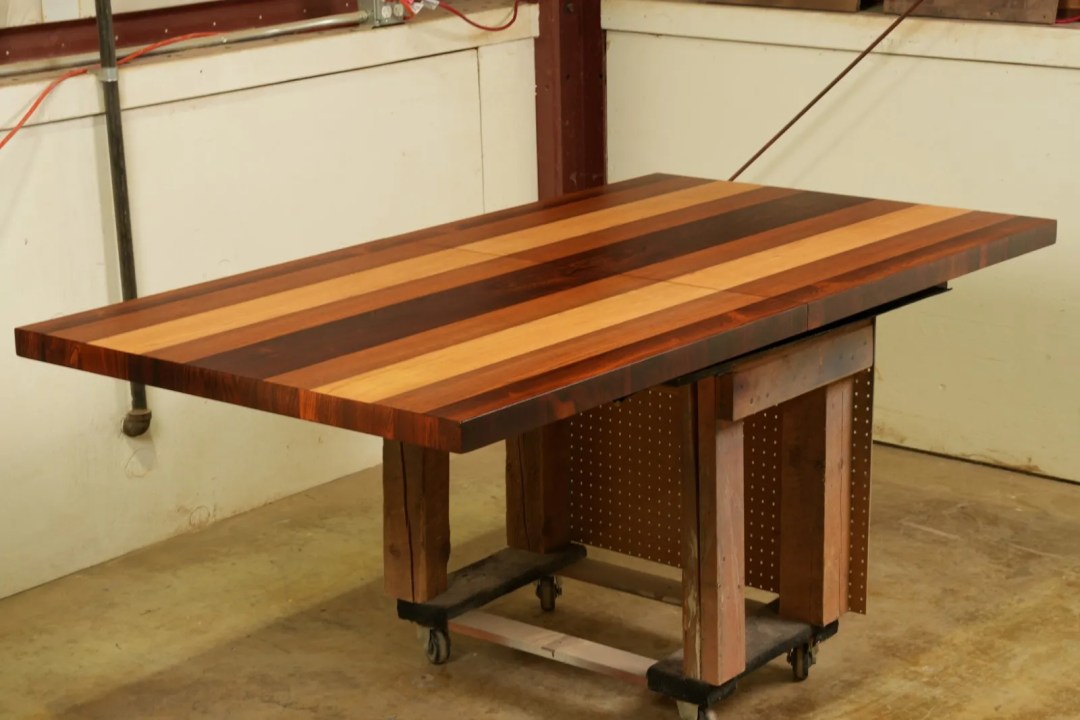
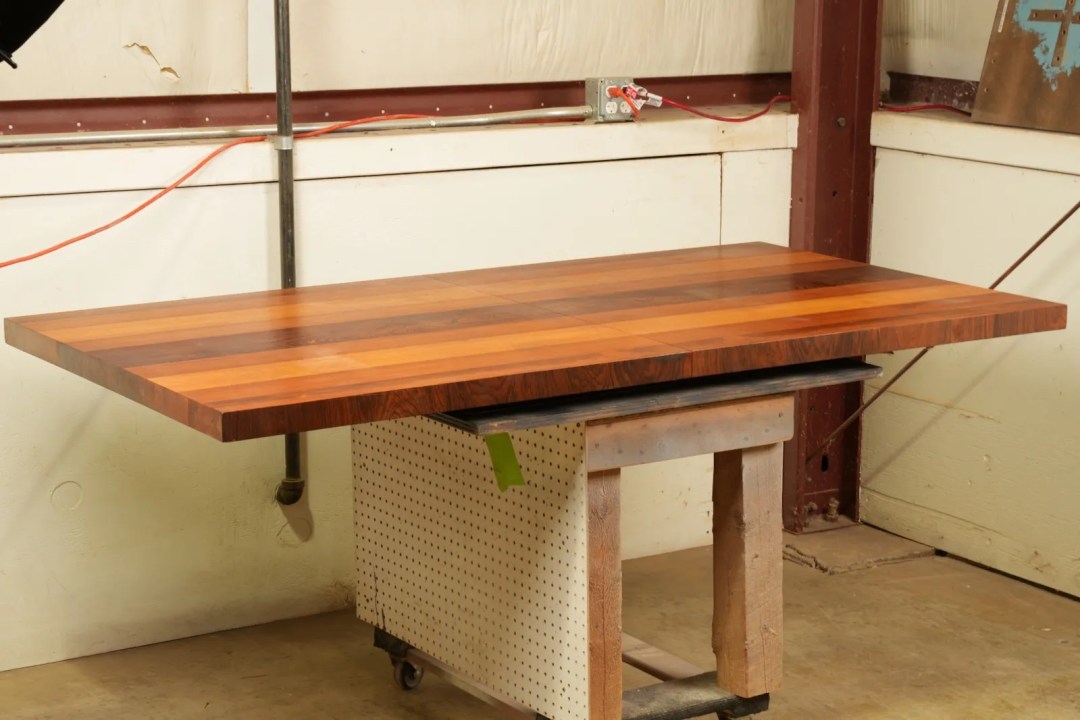
Wood Dining Table Restoration in Fort Collins - Before
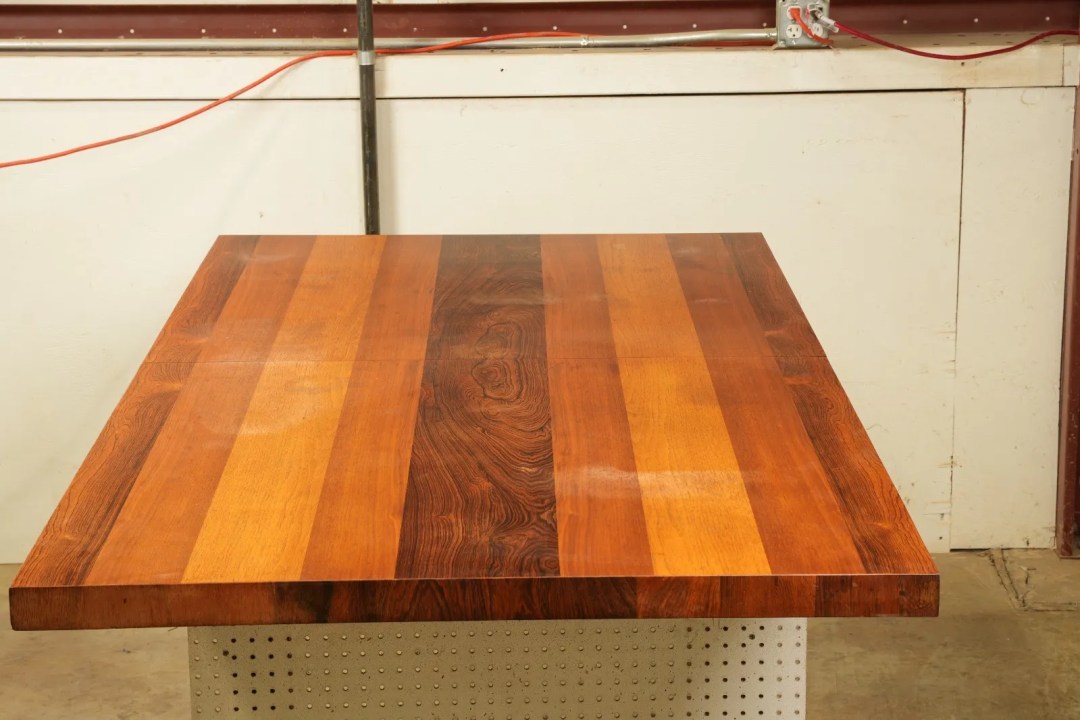
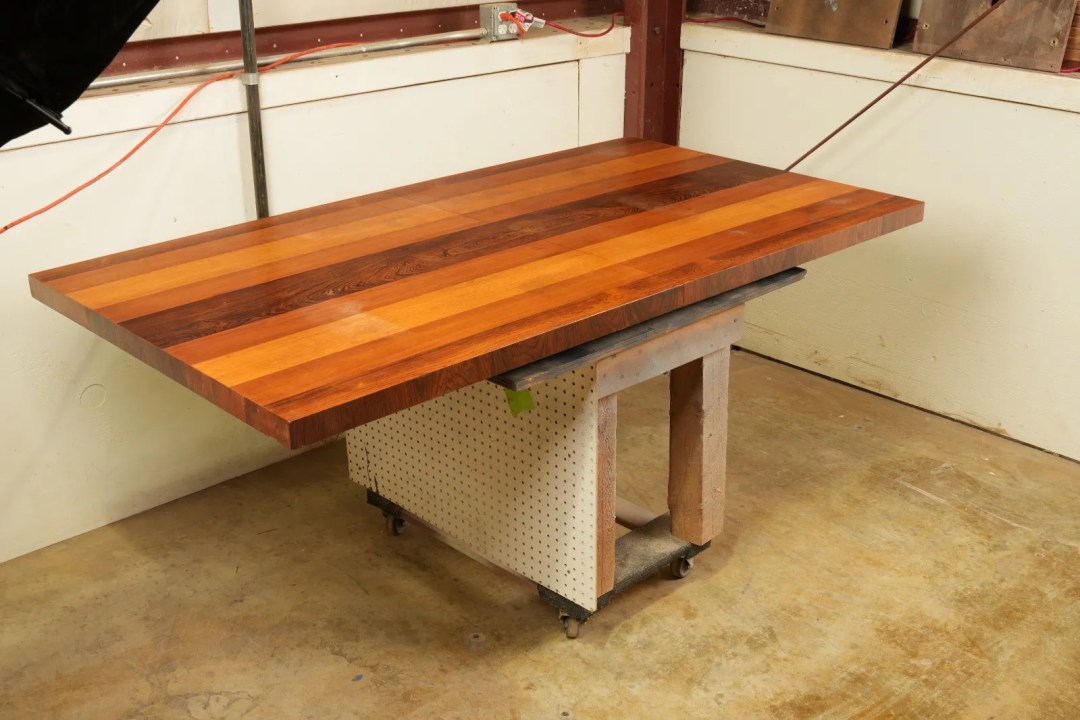
Wood Dining Table Restoration in Fort Collins - After

Multi-Species Butcher Block Dining Table Refinishing in Fort Collins: When the Wood Is the Art

There are tables that need a good finish to look right, and then there are tables where the wood itself is so visually striking that the finish either does it justice or the whole thing falls short. There is no middle ground on a piece like this.

This multi-species butcher block dining table came through our Fort Collins shop for a full top refinish, and from the moment it was in the shop it was clear this was not a standard job. The top is constructed from alternating strips of different wood species, edge-glued into a wide, substantial panel with the grain of each species running lengthwise across the table. Looking at the before photos, even in the condition it arrived in, the pattern created by those species transitions is genuinely arresting. Dark dramatic grain sitting directly against warm amber tones, then back to dark, then light again, across the full width of the top. The kind of visual movement that takes a moment to fully register.

Our job was to make sure the refinished surface let all of that read exactly as it should.

Block Dining Table Restoration Project - Before

Project Overview


This project focused on the table top surface:

  • Full assessment of the existing finish condition and surface quality across the multi-species top
  • Complete surface preparation accounting for the variable porosity and absorption characteristics of multiple wood species within a single panel
  • Clear finish system developed and applied to enhance and protect the natural color and grain of each species without imposing a unified color tone
  • Finish consistency confirmed across all species transitions, knot figures, and grain variation throughout the top
  • Final inspection under multiple lighting conditions before delivery

The Table Top: What Makes Multi-Species Construction So Visually Significant

Before the process, the material deserves its own attention.

Looking carefully at the images, the top appears to incorporate at least two distinct wood species in the alternating strip construction. The darker strips show the tightly packed, swirling grain pattern characteristic of a dense tropical hardwood, with figure that spirals and interlocks across the face of each board in a way that is genuinely difficult to look away from. The lighter strips between them show the straighter, more open grain of a domestic hardwood in the cherry or elm family range, with a warm amber tone that provides visual relief between the more intense darker species.

The combination is not accidental. Whoever built this table made deliberate choices about which species to pair and how wide to make each strip relative to the others. The result is a top that functions as a piece of visual design as much as a dining surface. The species transition lines running across the full width of the table create a rhythm that the eye follows from one end to the other, and the contrast between the grain characters of the different species gives the surface a depth and complexity that a single-species top cannot produce.

Butcher block construction of this type, where solid wood strips are edge-glued with the face grain up, produces a panel that is dimensionally stable, structurally substantial, and visually honest about its construction. Every glue line is visible. Every species transition is on display. There is nowhere to hide in a top like this, which means the surface preparation and finish have to be right or the quality of the material works against you rather than for you.

The Denver Art Museum’s design collection has documented how American studio furniture makers of the late twentieth century embraced multi-species construction as a form of material honesty, letting the wood’s own visual character carry design weight that would otherwise require applied ornament. This table sits within that tradition whether or not it was made with that intention.

The Challenge: Finishing Multiple Wood Species in a Single Panel

A multi-species top is a more demanding finishing problem than a single-species surface, and the reasons are practical rather than theoretical.

Different wood species have different surface porosity, different natural oil content, and different rates of absorption for both stain and clear finish materials. A finish applied uniformly across a mixed-species panel will not develop uniformly, because the material it is going onto is not uniform. Species with higher natural oil content resist finish adhesion. Species with more open grain absorb finish more deeply in the grain lines than the surrounding field, creating a visual effect that can either enhance the grain or produce a blotchy result depending on the preparation and the finish system chosen.

Getting a consistent, even finish across a multi-species panel requires surface preparation that accounts for these differences and a finish system applied in a way that allows each species to read with its own character while producing a unified, even sheen across the complete surface.

The goal on this table was not to impose a stain color that would unify the species. That approach would reduce the contrast that makes the top visually interesting. The goal was a clear or very lightly enhancing finish that would protect the surface and bring each species’ natural color and grain fully forward without suppressing the differences between them. That outcome requires the preparation work to be right from the beginning, because a clear finish on inadequately prepared mixed-species wood will show every inconsistency in the surface condition as clearly as it shows the grain.

This kind of technically demanding surface work on figured and mixed-species tops is part of what our table refinishing and restoration process is built to handle.

Surface Preparation: Getting Every Species Ready at the Same Time

With a multi-species panel, surface preparation is not a single process applied uniformly. It is a series of decisions made about the specific conditions of each section of the surface and how those sections interact with each other.

The existing finish was assessed across the full top for adhesion, wear patterns, and any surface damage that would need to be addressed before refinishing could begin. The wear pattern on a dining table top is rarely uniform: the center of the table and the areas where people sit see more contact and more moisture exposure than the edges and corners, and the condition of the finish in those areas is typically worse than the surrounding surface.

Surface preparation proceeded in stages, with sanding grits selected to address the condition of the existing finish without cutting through the surface variation in the denser, harder tropical species strips or leaving the softer lighter species strips undercut relative to their neighbors. Getting the full panel to an even, consistent surface plane across species of different hardness is one of the more exacting parts of multi-species finishing work, and it is the work that determines whether the finished surface reads as flat and unified or whether the species transitions produce subtle ridge lines in the topography of the surface.

The Finish: Letting Every Species Speak for Itself

The finish system on this table was selected to enhance and protect the natural color of each species without imposing a unified tone that would reduce the contrast between them.

Looking at the after photographs, the finish brings out significant depth in both species groupings. The dark strips show the full complexity of the grain figure, with the interlocking and swirling pattern visible clearly through the surface. The lighter strips show warm, clear amber tones with their own grain character fully present. The species transitions read as clean and defined rather than blurred or unified by the finish. The overall surface has the depth and warmth that comes from a well-built finish on quality solid wood.

Achieving that result on a mixed-species top requires building the finish in multiple stages and evaluating the developing surface under raking light at each stage to confirm that all species are reading correctly and that the sheen is developing evenly across the transitions. A finish that looks good on one species may look different on the adjacent strip depending on how each material is absorbing the topcoat material. Identifying and correcting those differences during the process rather than after the final coat is what produces a surface where the finish looks right across the complete top.

For our approach to finish systems on figured, exotic, and mixed-species surfaces, see our furniture refinishing and antique furniture restoration service pages.

The Finished Surface: What the Wood Deserves

The finished top shows every grain pattern, every species transition, every knot and figure that the construction put into the panel. The dark strips read with full grain depth and visual complexity. The lighter strips read warm and clear. The surface is even in sheen from edge to edge and consistent across every species boundary.

Tables like this one do not come around often. When they do, the finish either matches the quality of the material or it does not. This one does.

This table will go into a dining room in Fort Collins or somewhere in the greater Denver area and it will be the first thing anyone notices when they walk into the room. That is what wood this good, finished this correctly, does in a space.

Services Included in This Multi-Species Table Top Refinishing

Complete condition assessment of the existing finish across the full multi-species panel
Staged surface preparation accounting for differential hardness and porosity across species
Clear finish system developed and applied to enhance natural color and grain without unifying tone
Even sheen confirmed across all species transitions and grain variation
Final inspection under multiple lighting conditions before delivery

Have a Figured, Exotic, or Multi-Species Table That Needs Refinishing?

If you have a dining table with unusual wood, mixed species, heavy figuring, or any surface where the grain character of the material is the point, we would be glad to assess what the refinishing work involves. Tables like this require a different level of attention than a standard single-species refinish, and they respond to that attention with results that are genuinely worth seeing.

We serve clients throughout Fort Collins, including Old Town, Midtown, and the southeast neighborhoods, as well as Loveland, Windsor, Boulder, Longmont, Centennial, Lakewood, Denver, and the greater Denver metro area. Pickup and delivery are available throughout our service area.

Send photos to shop@gmrestores.com or call us at 970-493-8737. Free estimates on all projects.

113 Hickory Street, Fort Collins, Colorado 80524 | (970) 493-8737 | shop@gmrestores.com

Frequently Asked Questions: Multi-Species and Figured Table Top Refinishing in Fort Collins

Can a multi-species butcher block dining table top be refinished without losing the contrast between species?

Yes, and preserving that contrast is actually the central goal on a mixed-species refinish done correctly. The approach is to use a clear or very lightly enhancing finish system rather than a stain color that would reduce the natural tone differences between species. The preparation work has to account for the different porosity and absorption characteristics of each species so the finish develops evenly across the transitions. When the process is done correctly, the finished surface enhances the natural contrast between species rather than suppressing it.

Why is finishing a mixed-species wood top harder than finishing a single-species surface?

Different wood species have different surface porosity, natural oil content, and finish absorption rates. A finish applied uniformly across a mixed-species panel will not develop uniformly, because the material varies from strip to strip. Species with higher oil content resist finish adhesion differently than more porous species. Harder species may sand differently than softer adjacent strips, creating subtle surface plane differences that show in the finished surface. Addressing all of these variables during surface preparation and finish application requires more attention and more evaluation at each stage than a standard single-species refinish.

What finish is best for a butcher block or multi-species dining table top used daily?

For a dining table in active use, the finish needs to provide meaningful protection against moisture, heat, and daily contact while remaining clear enough to let the natural grain and species contrast read fully through it. The specific product selection depends on the species involved, the client’s maintenance preferences, and how the table will be used. We discuss finish options at the point of assessment and explain the tradeoffs between different systems so the client can make an informed choice. A properly selected and applied finish on a multi-species top should protect the surface effectively while keeping the visual character of the wood fully present.

Do you refinish exotic and figured wood dining tables in the Denver area?

Yes. We serve clients throughout the greater Denver metro area from our Fort Collins shop, including Boulder, Longmont, Centennial, Lakewood, Loveland, Windsor, Arvada, Aurora, and Denver proper. Free estimates are available on all projects and we offer pickup and delivery throughout our service area. Send photos to shop@gmrestores.com or call 970-493-8737.

Located in the historic city of Fort Collins, Colorado, G. Michaels Restoration is an experienced furniture repair and antique furniture restoration shop serving Fort Collins, Loveland, Windsor, Boulder, Longmont, Centennial, Lakewood, Denver, and the greater Denver metro area.

113 Hickory Street, Fort Collins, Colorado 80524 | (970) 493-8737 | shop@gmrestores.com

Block Wood Dining Table - Before Refinishing
Block Dining Table Restoration in Fort Collins - After Restoration

Located in the historic city of Fort Collins, Colorado. G. Michael’s is an esteemed furniture repair and antique furniture restoration wood shop.

Furniture repair & restoration expert

Antique Furniture Restoration

Check how we restored this wonderful piece of antique furniture to its new glory. If you would like to have your valuable piece of furniture restored, simply contact us! We cover Fort Collins and all Denver metro.

Antique Furniture Restoration

Check how we restored this wonderful piece of antique furniture to its new glory. If you would like to have your valuable piece of furniture restored, simply contact us! We cover Fort Collins and all Denver metro.

Antique Furniture Restoration

Check how we restored this wonderful piece of antique furniture to its new glory. If you would like to have your valuable piece of furniture restored, simply contact us! We cover Fort Collins and all Denver metro.

Antique Furniture Restoration

Check how we restored this wonderful piece of antique furniture to its new glory. If you would like to have your valuable piece of furniture restored, simply contact us! We cover Fort Collins and all Denver metro.

Antique Furniture Restoration

Check how we restored this wonderful piece of antique furniture to its new glory. If you would like to have your valuable piece of furniture restored, simply contact us! We cover Fort Collins and all Denver metro.

Antique Furniture Restoration

Check how we restored this wonderful piece of antique furniture to its new glory. If you would like to have your valuable piece of furniture restored, simply contact us! We cover Fort Collins and all Denver metro.

Antique Furniture Restoration

Check how we restored this wonderful piece of antique furniture to its new glory. If you would like to have your valuable piece of furniture restored, simply contact us! We cover Fort Collins and all Denver metro.

Antique Furniture Restoration

Check how we restored this wonderful piece of antique furniture to its new glory. If you would like to have your valuable piece of furniture restored, simply contact us! We cover Fort Collins and all Denver metro.

Antique Furniture Restoration

Check how we restored this wonderful piece of antique furniture to its new glory. If you would like to have your valuable piece of furniture restored, simply contact us! We cover Fort Collins and all Denver metro.

Antique Furniture Restoration

Check how we restored this wonderful piece of antique furniture to its new glory. If you would like to have your valuable piece of furniture restored, simply contact us! We cover Fort Collins and all Denver metro.

Antique Furniture Restoration

Check how we restored this wonderful piece of antique furniture to its new glory. If you would like to have your valuable piece of furniture restored, simply contact us! We cover Fort Collins and all Denver metro.

Antique Furniture Restoration

Check how we restored this wonderful piece of antique furniture to its new glory. If you would like to have your valuable piece of furniture restored, simply contact us! We cover Fort Collins and all Denver metro.

Antique Furniture Restoration

Check how we restored this wonderful piece of antique furniture to its new glory. If you would like to have your valuable piece of furniture restored, simply contact us! We cover Fort Collins and all Denver metro.

Antique Furniture Restoration

Check how we restored this wonderful piece of antique furniture to its new glory. If you would like to have your valuable piece of furniture restored, simply contact us! We cover Fort Collins and all Denver metro.

Antique Furniture Restoration

Check how we restored this wonderful piece of antique furniture to its new glory. If you would like to have your valuable piece of furniture restored, simply contact us! We cover Fort Collins and all Denver metro.

Antique Furniture Restoration

Check how we restored this wonderful piece of antique furniture to its new glory. If you would like to have your valuable piece of furniture restored, simply contact us! We cover Fort Collins and all Denver metro.

Antique Furniture Restoration

Check how we restored this wonderful piece of antique furniture to its new glory. If you would like to have your valuable piece of furniture restored, simply contact us! We cover Fort Collins and all Denver metro.

Antique Furniture Restoration

Check how we restored this wonderful piece of antique furniture to its new glory. If you would like to have your valuable piece of furniture restored, simply contact us! We cover Fort Collins and all Denver metro.

Antique Furniture Restoration

Check how we restored this wonderful piece of antique furniture to its new glory. If you would like to have your valuable piece of furniture restored, simply contact us! We cover Fort Collins and all Denver metro.

Inquires:

  • Office
    shop@gmrestores.com
  • (970) 493-8737
  • Estimate
    shop@gmrestores.com
Address:
113 Hickory Street
Fort Collins, Colorado 80524


Hours:
8a – 5p M-F

Portfolio