Oval Mahogany Table Lip Repair: Moving Damage Restoration in Fort Collins
Moving companies that are not careful keep us busy.
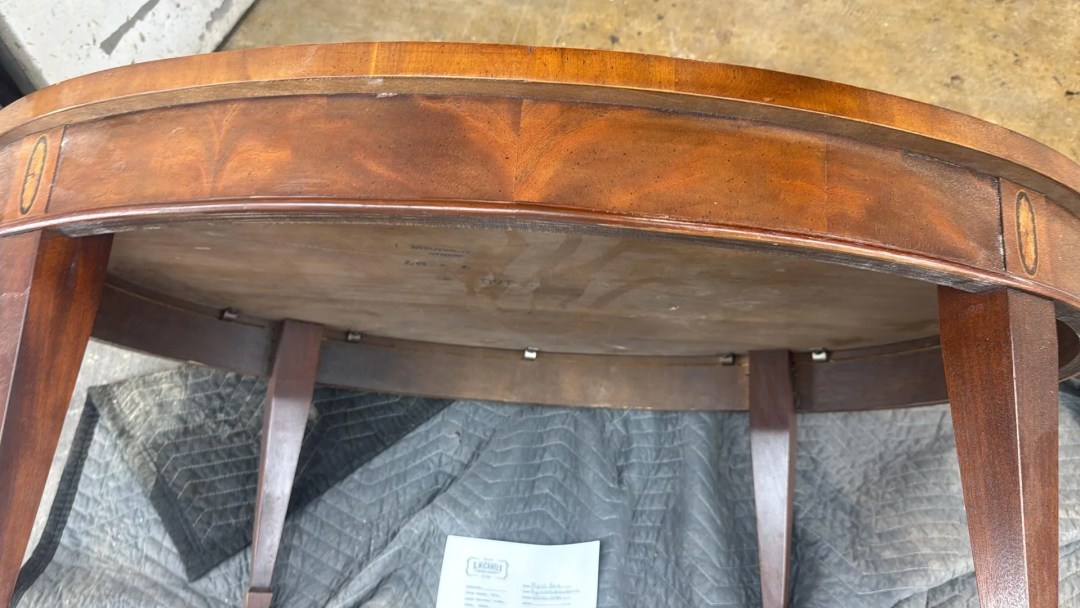
A client came to us after their movers broke the lip trim clean off an oval mahogany dining table during a move. The damage was straightforward in the sense that it was a clean separation, but the piece that came off never made it back to the client. The moving company could not produce it. So there was nothing to reglue, nothing to touch up. The trim was simply gone.
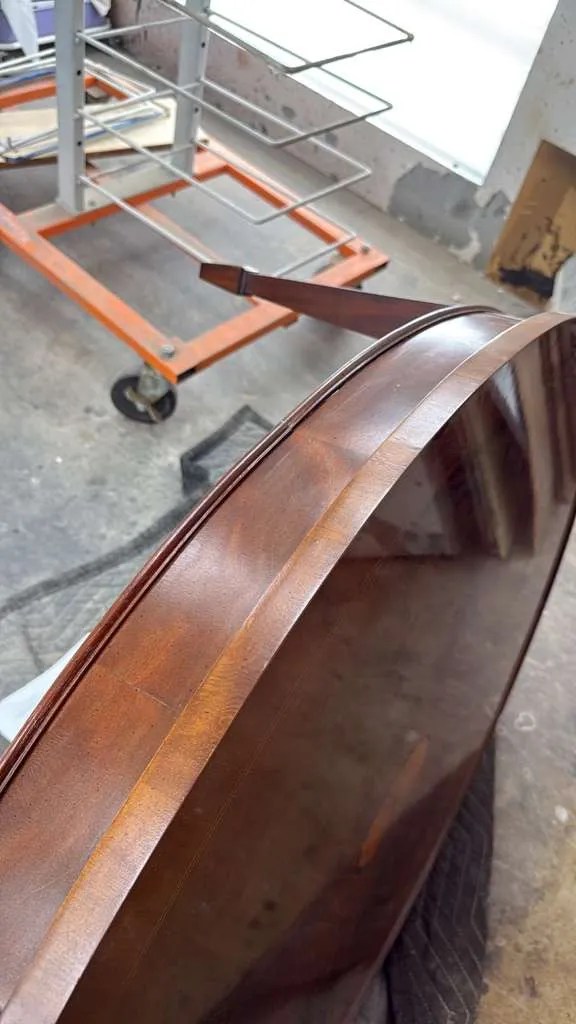
What made this repair genuinely challenging was the table itself. This is a beautifully detailed piece, with banded inlay running the entire perimeter of the top and the curved edge below it. Multiple wood tones, multiple grain directions, and a high-sheen finish all converging at the exact spot where the damage occurred. There was no room for approximation on the color match or the finish blend. Either it disappears completely or it does not.
It disappears completely.
Project Overview
Mahogany table lip repair included:
- Assessment of the damaged edge and remaining original lip profile
- Mold creation from the intact original trim to capture the exact profile
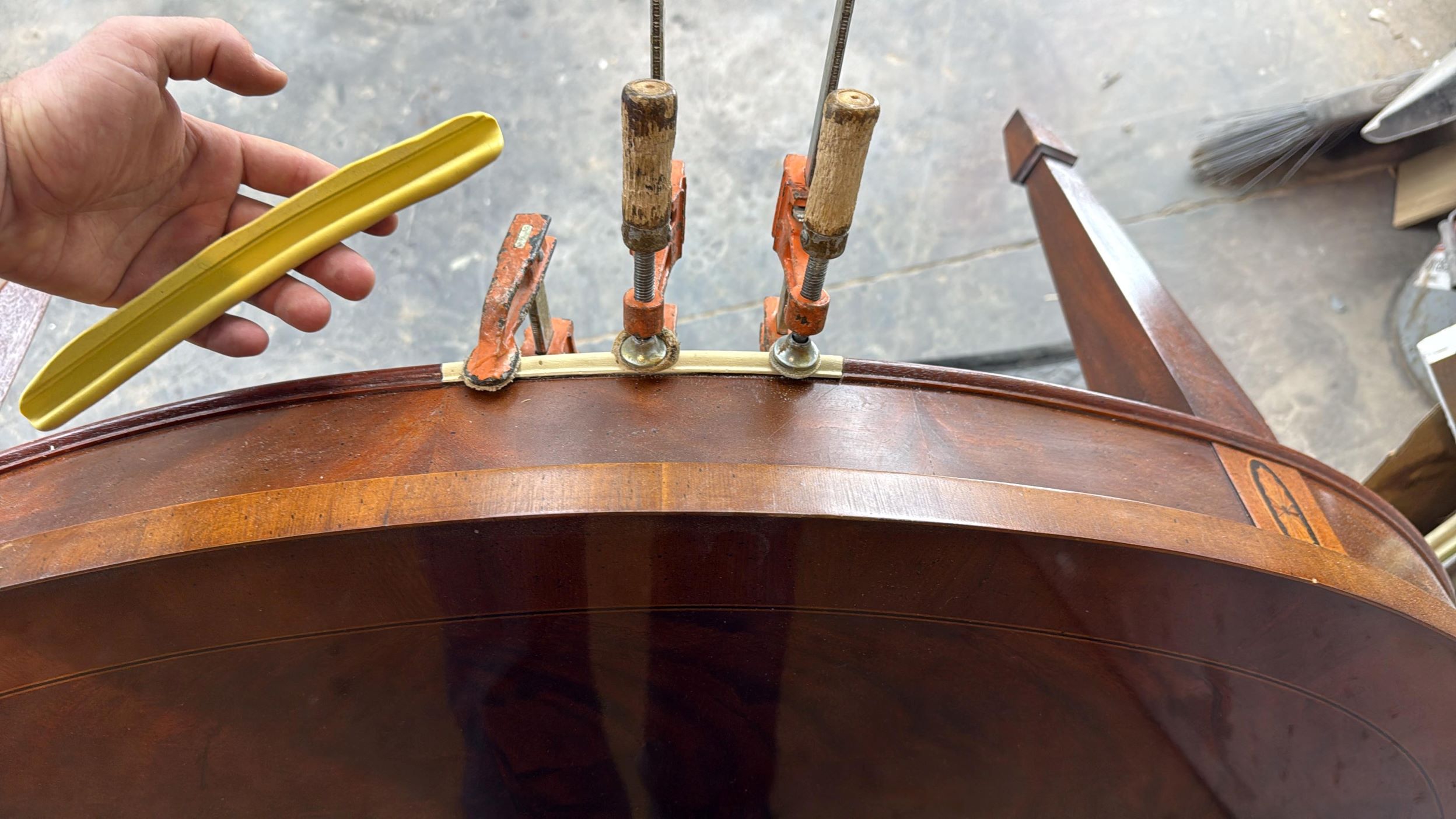
- Custom fabrication of a replacement lip section from scratch
- Multi-tone stain matching to the banded inlay and surrounding mahogany surfaces
- Finish blending across the repair area to integrate seamlessly with the existing surface
The Table: What We Were Working With
The piece is an oval dining table in mahogany with a curved apron and tapered legs. The top features banded inlay laid in along the perimeter, a decorative element that runs the full circumference and creates a layered tonal border between the field of the top and the edge treatment. The curved lip trim below the top edge follows the oval profile of the table and was a distinct milled component, not a simple flat strip.
This kind of edge detail is not something you find at a lumber yard. It is a shaped profile milled specifically for the piece, curved to follow the oval, and finished as part of the table’s original surface system. When it is gone, it has to be recreated entirely from what remains.
Creating the Mold
Before any fabrication work began, we created a mold from the intact sections of the original lip trim. This is the only reliable method for reproducing a shaped profile accurately when the damaged section is missing. Measuring and eyeballing a curved profile from a flat drawing introduces error at every step. Working from a physical mold of the original means the replacement is shaped from the actual geometry of the piece rather than an approximation of it.
The mold captured the full cross-section of the trim profile, including the curve, the transition at the top edge, and the bottom return. The replacement piece was then fabricated to that profile and curved to follow the oval of the table.
Fabricating the Replacement
With the mold established, we fabricated the replacement lip section from raw stock. The material had to be selected for grain consistency with the surrounding original surfaces, since the banded inlay and the mahogany field running up to the repair zone would make any obvious grain mismatch visible in the finished piece.
The fabricated section was fitted to the table, tested for profile alignment against the adjacent original trim on both sides of the repair zone, and adjusted until the transition from original to new was clean and continuous. On a curved edge, every small deviation in profile reads. The fitting process on a repair like this is slower than the fabrication itself.
Our furniture repair process on pieces like this always treats the fitting stage as non-negotiable. A replacement piece that is close in profile but not exact will telegraph through every finish coat applied over it.
The Color Matching Challenge
This is where the banded inlay made everything harder.
Standard mahogany color matching on a uniform surface is already demanding work. On this table restoration, the repair zone sat adjacent to a banded border made up of multiple wood species and tones laid in as a decorative inlay. The stain had to read correctly against all of them simultaneously: the warm reddish-brown of the mahogany field, the lighter inlay band, the darker accent line within it, and the curved trim surface itself.
We built the color in multiple toning passes, evaluating against the adjacent surfaces under different lighting conditions at each stage. The goal was not to match any single reference tone but to land in the range where the eye moves across the repair zone without registering a break. The banded inlay actually works in the restorer’s favor in one respect: the visual complexity of the edge detail draws the eye away from any single surface and makes a well-executed blend easier to read as continuous.
For more on our approach to color work and surface refinishing, visit our refinishing services page.
Blending the Finish
Once the color was correct, the final step was blending the finish across the repair zone so that the sheen level, surface texture, and reflective quality of the new section matched the surrounding original finish.
This is the step most repairs fail at. A color match that is accurate in matte still fails if the sheen of the repaired area sits at a different level than what surrounds it. On a high-gloss or semi-gloss surface like this one, sheen variation reads clearly even when color is correct. The finish has to be built up and leveled in the repair zone, then feathered into the surrounding original surface so the transition becomes invisible under raking light.
The table was photographed from multiple angles and under different lighting before we considered the finish work complete.
The Finished Result
The lip trim is back. The profile is correct. The color integrates with the banded inlay. The finish blends across the repair zone without a visible transition line.
From a normal viewing distance and from close inspection, there is no readable indication that the table was ever damaged. That is the standard we hold ourselves to on antique furniture restoration and moving damage repair work.
A Note on Moving Damage
This is not an unusual situation. Moving companies damage furniture regularly, and high-value or antique pieces are especially vulnerable because their components, profiles, and finish systems cannot simply be ordered as replacement parts. When a mover breaks something off a piece like this, the options are either to live with the damage or find a shop that can recreate what is missing.
If a moving company has damaged your furniture and has not made it right, the Colorado Attorney General’s Office maintains a Consumer Protection program that includes a Consumer Mediation service for disputes between Colorado residents and businesses. It is worth knowing that resource exists before writing the damage off.
In the meantime, if the piece itself can be repaired, send us a photo and we will tell you honestly what is possible.
Have Moving Damage or a Missing Component?
If a move left your furniture broken, chipped, or missing a section that cannot be sourced as a replacement, we can assess what it will take to bring it back. We fabricate what is missing, match the existing finish, and blend the repair so it does not read as a repair.
Send photos to shop@gmrestores.com or call us at 970-493-8737. We serve Fort Collins, Loveland, Windsor, and the greater Denver area from our shop at 113 Hickory Street, Fort Collins, Colorado 80524.
Located in the historic city of Fort Collins, Colorado. G. Michael’s is an esteemed furniture repair and antique furniture restoration wood shop.