Heywood-Wakefield Children’s School Desk and Chair Set Restoration in Fort Collins: Wood Refinishing, Metal Sandblasting, and a Two-Material Result
Not every restoration project that comes through our Fort Collins shop involves antique furniture or period cabinetry. Some of the most satisfying work we do is on pieces that were built for hard daily use, took it for decades, and are still structurally sound enough to be worth bringing back properly.
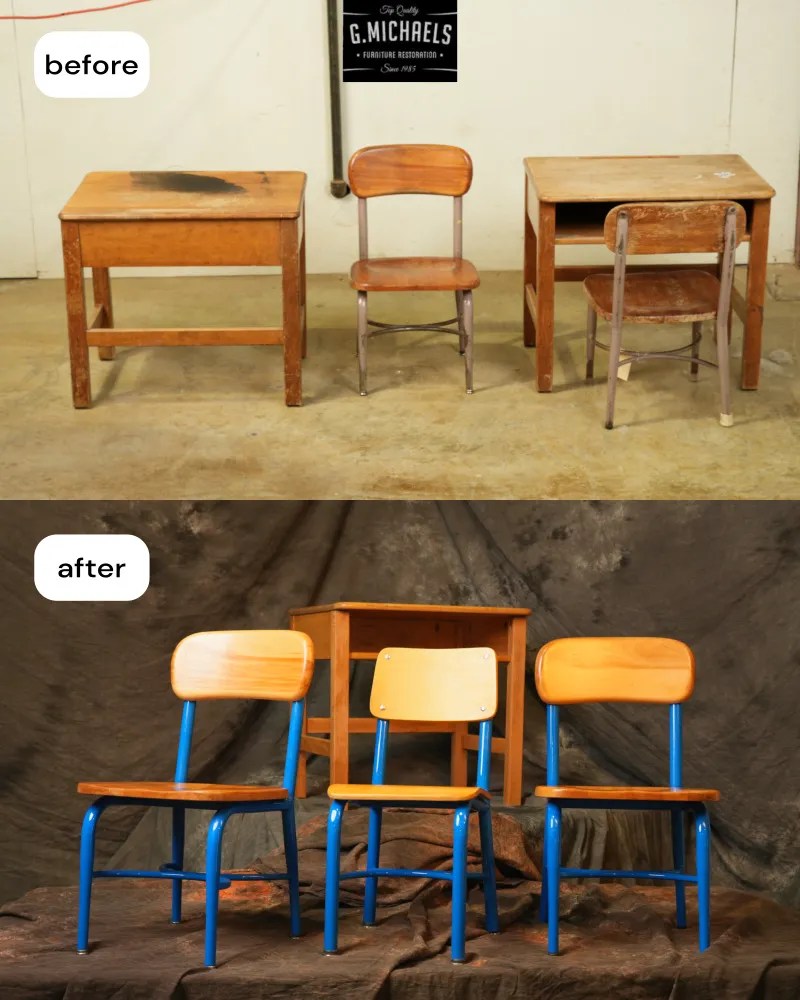
This set of vintage Heywood-Wakefield children’s school desks and chairs was exactly that kind of project. Three chairs with tubular metal frames and wood seats and backs. Two small school desks in solid birch with the characteristic warm honey tone that Heywood-Wakefield production furniture is known for. The set arrived showing the accumulated wear of long institutional use: surface wear across the wood tops and seats, a prominent ink stain on one desktop that had penetrated well past the finish layer into the wood fibers, mismatched and peeling paint on the metal chair legs in two different colors suggesting at least one prior refinishing attempt, and missing chrome caps on the leg tips.
Each of those problems had a specific correct solution, and none of them were the same process. Wood and metal require completely different approaches, and doing both correctly on a mixed-material set requires the range of in-house capability to handle each trade without compromise.
.
Project Overview
This project covered both the wood and metal components of the complete set:
- Ink stain treatment on the affected desktop using oxalic acid wash to draw staining from the wood fibers, followed by sanding and surface preparation
- Full wood refinishing on all desk surfaces and chair seats and backs using 2K polyurethane, a two-component finish selected for durability under heavy use
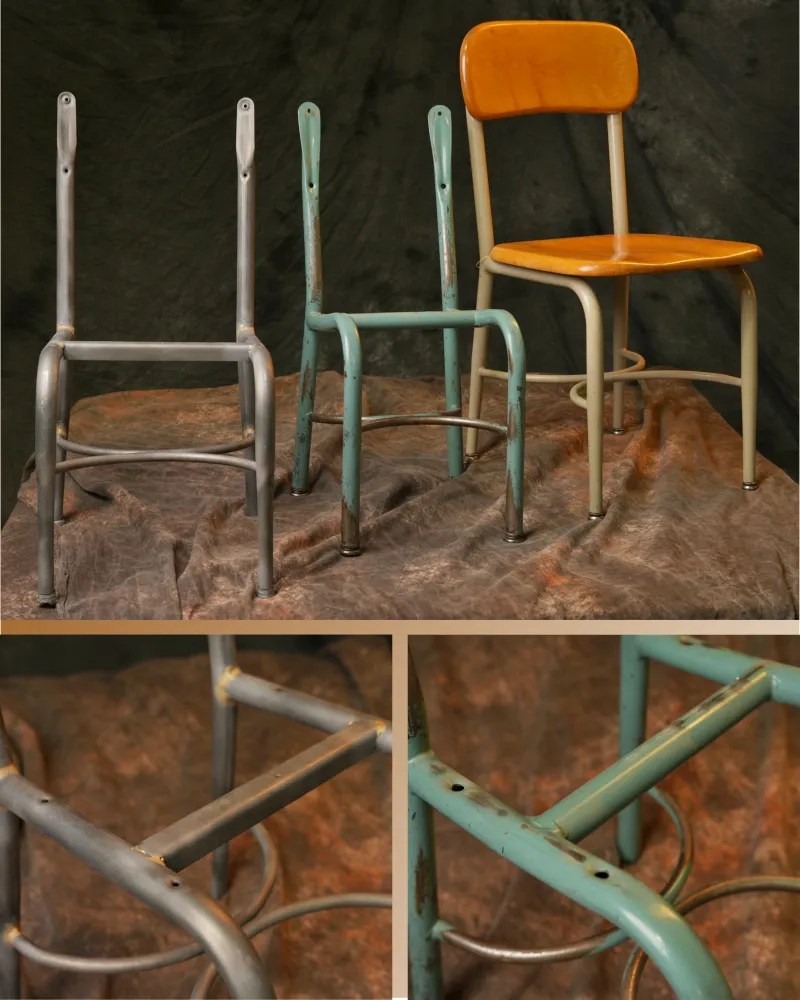
- Metal chair leg frames stripped of existing mismatched paint and sandblasted back to clean substrate throughout
- Missing and damaged chrome tip plugs repaired and replaced on the chair legs
- Metal frames refinished in automotive-grade paint for durability, consistent color, and a hard-wearing finish across the complete set
- Final inspection of the assembled set confirming consistent finish quality across all wood and metal components
The Set: What Heywood-Wakefield School Furniture Actually Is
Heywood-Wakefield produced children’s school furniture alongside their better-known residential lines, and the construction quality applied to institutional pieces was consistent with what made their residential furniture so durable. The birch used in the desk and chair components is solid, not veneered, with the tight grain and even color that makes Heywood-Wakefield birch furniture recognizable to anyone familiar with the brand. The tubular steel frames on the chairs are welded and formed in the simple, practical geometry that defined institutional furniture design from the 1940s through the 1960s: round tube stock bent to shape, welded at the joints, with rubber or chrome tip plugs at the foot ends.
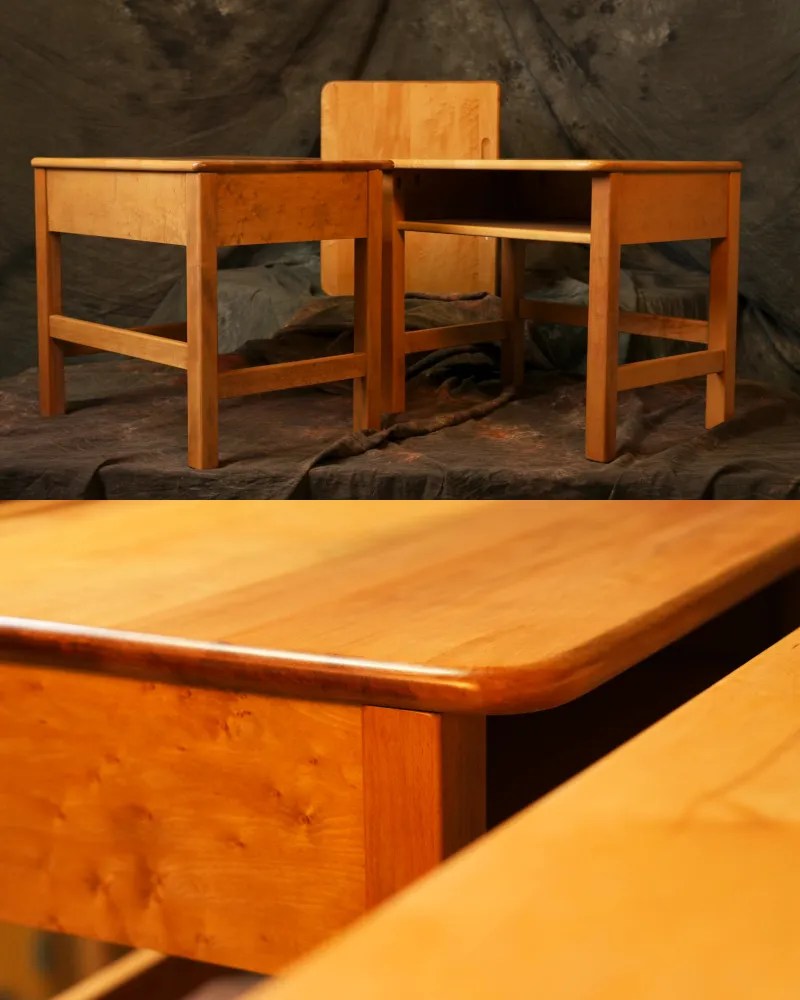
Looking at the detail photographs of the restored desk surfaces, the grain on the birch top panels shows the characteristic Heywood-Wakefield quality even at this utilitarian scale. The rounded edge profile on the desk tops is smooth and even, the corners are properly radiused, and the construction throughout reflects the same attention to detail that made this brand’s residential furniture collectible.
The before photographs tell a more complicated story. The wood surfaces had accumulated the surface wear typical of institutional use, with the finish worn through in the areas of heaviest contact and the grain raised and roughened in those zones. The ink stain on one desktop, visible as a dark patch in the before image, had penetrated past the finish into the wood itself. And the chair legs, which should have presented as a matched set, were in two different paint colors suggesting that at least some of the chairs had been partially repainted at some point during their institutional life without matching the existing color on the others.
The Heywood-Wakefield Company’s production history is well documented by collectors and design historians as a significant chapter in American mid-century furniture manufacturing. The Fort Collins Museum of Discovery has documented the mid-century period as a formative era for Colorado communities including those along the Front Range, where institutional and school furniture from manufacturers like Heywood-Wakefield equipped the classrooms and public buildings of growing postwar Colorado towns. A set like this one carries that history in its construction.
The Ink Stain: Why It Required Its Own Treatment Before Anything Else
The ink stain on the affected desktop was the most technically specific problem in this project, and it had to be addressed before any standard surface preparation or refinishing could begin.
Ink staining that has penetrated past the finish layer into the wood fibers cannot be sanded out without removing more wood than is acceptable on a thin desktop surface. Sanding aggressively enough to remove penetrated ink staining would alter the surface profile of the desk top and create a visible low spot or depression relative to the surrounding surface. The correct approach for penetrated ink staining in wood is chemical treatment using oxalic acid, which works by bleaching the oxidized compounds that produce the dark staining without removing wood fiber in the process.
The oxalic acid wash was applied to the affected area of the desktop and allowed to work into the stained wood, drawing the pigment compounds out of the fibers over the treatment period. After the treatment was neutralized and the surface dried completely, the result was evaluated: the staining had been reduced to the point where standard surface preparation and finish could complete the correction without the stain showing through the new finish.
This kind of targeted chemical treatment before refinishing is the approach that produces an invisible result. Skipping it and hoping the new finish will cover the stain produces a result where the stain remains visible through the surface, particularly under raking light, and darkens further as the finish ages over the staining beneath it.
Wood Refinishing: 2K Polyurethane for Furniture Built to Be Used
With the ink stain addressed and all wood surfaces prepared, the refinishing process on the desks and chair seats and backs proceeded using a 2K polyurethane finish system.
2K polyurethane, a two-component finish that catalyzes to a cross-linked polymer film rather than simply drying through solvent evaporation, was the correct finish choice for this application. The wood surfaces on a children’s school desk and chair set will see contact, moisture, cleaning products, and occasional impact in ordinary use. A single-component finish, however carefully applied, does not have the surface hardness or chemical resistance that a 2K system provides. A properly catalyzed 2K polyurethane finish will hold up to institutional-level use significantly longer than a standard consumer finish, which is exactly what this set required.
The finish was developed in the warm honey tone consistent with Heywood-Wakefield’s original finish character on birch furniture, allowing the natural grain and figure of the birch to read clearly through the surface while providing the protective qualities that the intended use demands. The detail photographs of the finished desk surfaces show the result: a smooth, even surface with the warm grain of the birch fully visible, the rounded edge profile finished consistently, and a sheen level that reads as appropriate to the period and character of the pieces without looking artificially glossy.
For our full approach to furniture refinishing on mixed-material pieces and furniture intended for heavy use, see our service page.
Metal Restoration: Sandblasting, Plug Replacement, and Automotive-Grade Paint
The tubular steel chair frames presented a different set of problems and required a completely different process from the wood work.
The existing paint on the chair frames was mismatched across the set, with some chairs carrying what appeared to be an original institutional color and others showing a different paint applied at some point during their working life. Neither color was in good condition, with peeling, chipping, and wear at every high-contact area. Getting a consistent result across all three chair frames meant stripping everything back to clean metal substrate before any new finish was applied.
The frames were stripped of all existing paint and then sandblasted to remove any remaining surface contamination, rust, or residue from the previous coating systems. Sandblasting on tubular steel of this gauge produces a clean, slightly textured surface that provides excellent mechanical adhesion for the new finish without altering the profile or geometry of the tubing. The missing and damaged chrome tip plugs at the leg ends were repaired and replaced as part of this phase, so the completed chairs would present correctly at the feet rather than with the worn or absent plugs visible in the before photographs.
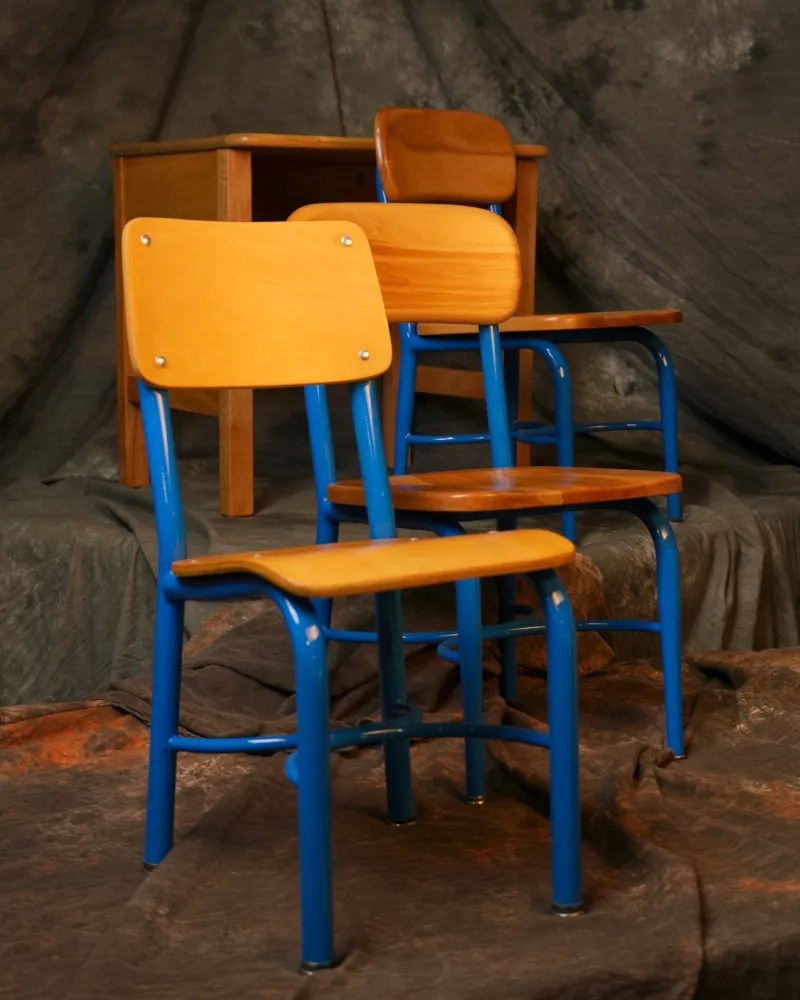
The refinishing color chosen for the metal frames was a bright, clean blue applied in automotive-grade paint. Automotive paint systems are specified for metal substrates for good reasons: they are formulated for adhesion to prepared metal, they cure to a harder and more chemically resistant film than standard architectural or furniture paints, and they provide a consistent, even color across the full surface of the frame including the curved and welded areas that can present adhesion challenges with lesser finish systems.
Against the warm honey birch of the restored wood components, the bright blue frames produce exactly the kind of energetic, period-appropriate contrast that makes this set visually interesting rather than merely functional. The combination reads as intentional, which is the standard any restoration should reach.
Why Mixed-Material Restoration Requires Broader Capability
It is worth being direct about what this project required in terms of shop capability, because not every furniture restoration shop is equipped to handle both sides of a mixed-material project correctly.
Wood refinishing and metal refinishing are distinct trades with different equipment, different chemical systems, different surface preparation methods, and different finish products. A wood finishing shop that is not set up for metal work will either send the metal components out to another shop, creating coordination and quality control challenges, or will apply a finish system to the metal that is not specified for metal substrate and will not perform correctly over time. A metal shop that is not set up for fine wood finishing will produce wood surfaces that do not meet the standard the material deserves.
Handling both trades in-house, as we did on this project, allows the quality standard to be consistent across every component of the set and allows the wood and metal work to be sequenced correctly relative to each other rather than independently. The result is a finished set where the wood surfaces and the metal frames look like they were restored together rather than separately.
For our full approach to wood furniture repair and multi-material restoration projects, see our service page.
The Finished Set: Warm Wood, Bright Frames, and Another Generation of Use
The completed set pairs the refinished warm birch surfaces of the desks and chair seats and backs with the bright blue automotive-painted tubular frames, and the combination works. The wood surfaces show clean grain under a finish that will hold up to real use. The metal frames are consistent in color across all three chairs and the desk bases, with no trace of the mismatched paint situation that the set arrived in.
These are children’s pieces designed to be used, sat in, written on, and lived with. The restoration returns them to that purpose with a quality of surface on both materials that the original institutional finish, now decades old, could no longer provide.
G. Michaels Restoration has been working from our Fort Collins shop since 1985, serving clients throughout Northern Colorado and the greater Denver metro area including Denver, Boulder, Longmont, Aurora, Arvada, and Evergreen. Pickup and delivery are available throughout our service area.
Services Included in This Heywood-Wakefield School Desk and Chair Restoration
- Oxalic acid ink stain treatment on affected desktop before surface preparation
- Full surface preparation on all wood components across desks and chair seats and backs
- 2K polyurethane finish system applied to all wood surfaces for durability and protection
- Tubular metal chair frames stripped of all existing paint and sandblasted to clean substrate
- Missing and damaged chrome tip plugs repaired and replaced on chair leg ends
- Automotive-grade paint applied to all metal frames in consistent bright blue throughout
- Final inspection of complete assembled set under multiple lighting conditions
Have Vintage School Furniture, a Mixed-Material Set, or Institutional Pieces That Need Restoration?
If you have a Heywood-Wakefield school set, vintage institutional furniture, or any piece combining wood and metal components that needs both materials addressed properly, we handle the full scope in-house. No coordination between separate shops, no compromise on either material.
We serve clients throughout Fort Collins, including Old Town, Midtown, and the CSU area neighborhoods, as well as Loveland, Windsor, Boulder, Longmont, Aurora, Arvada, Evergreen, Denver, and the greater Denver metro area. Pickup and delivery are available throughout our service area.
Send photos to shop@gmrestores.com or call us at 970-493-8737. Free estimates on all projects.
113 Hickory Street, Fort Collins, Colorado 80524 | (970) 493-8737 | shop@gmrestores.com
Frequently Asked Questions: Vintage School Furniture and Mixed-Material Restoration in Fort Collins
Can ink stains that have penetrated into wood be removed without visible damage to the surface?
Yes, when the right approach is used. Ink staining that has penetrated past the finish layer into the wood fibers requires chemical treatment rather than mechanical removal. Oxalic acid, applied as a wash to the affected area and allowed to work into the stained wood, bleaches the oxidized compounds responsible for the dark staining without removing wood fiber. After neutralization and proper drying, the treated area is prepared and refinished as part of the standard surface restoration process. The result, when the treatment has been effective, is a surface where the staining is not visible through the new finish.
What is 2K polyurethane and why is it better for furniture that sees heavy use?
2K polyurethane is a two-component finish system that catalyzes to a cross-linked polymer film rather than simply drying through solvent evaporation. The cross-linked film produced by a properly catalyzed 2K system is significantly harder and more chemically resistant than a single-component finish, making it appropriate for furniture that will see contact, moisture, cleaning products, and occasional impact in regular use. For children’s furniture, school pieces, or any furniture intended for heavy use rather than display, 2K polyurethane provides substantially better long-term performance than standard consumer finish systems.
Can tubular metal chair frames from vintage school furniture be fully restored?
Yes. Tubular steel frames that are structurally sound, with intact welds and no significant rust damage through the wall of the tube, can be stripped, sandblasted, and refinished to a condition that is better than the original coating in most cases. The sandblasting step removes all existing paint and surface contamination and produces a clean substrate with mechanical texture that provides excellent adhesion for the new finish. Automotive-grade paint systems applied over properly prepared tubular steel will provide a harder, more chemically resistant film than the original institutional paint, and will hold up to regular use significantly longer.
Do you restore vintage school furniture and Heywood-Wakefield pieces near Denver?
Yes. We serve clients throughout the greater Denver metro area from our Fort Collins shop, including Boulder, Longmont, Aurora, Arvada, Evergreen, Lakewood, Centennial, Loveland, Windsor, and Denver proper. Free estimates are available on all projects and we offer pickup and delivery throughout our service area. Send photos to shop@gmrestores.com or call 970-493-8737 to get started.
Located in the historic city of Fort Collins, Colorado, G. Michaels Restoration is an experienced furniture repair and antique furniture restoration shop serving Fort Collins, Loveland, Windsor, Boulder, Longmont, Aurora, Arvada, Evergreen, Denver, and the greater Denver metro area.
113 Hickory Street, Fort Collins, Colorado 80524 | (970) 493-8737 | shop@gmrestores.com
Located in the historic city of Fort Collins, Colorado. G. Michael’s is an esteemed furniture repair and antique furniture restoration wood shop.