Jensen Ipe Outdoor Furniture Restoration in Fort Collins: Hot Oxalic Acid, Structural Repair, and a Full Refinish on a Set Built to Last
Some outdoor furniture is designed to be disposable. Buy it, use it for a few seasons, replace it when it looks tired. The economics of that cycle are built into the price point and the materials from the start.
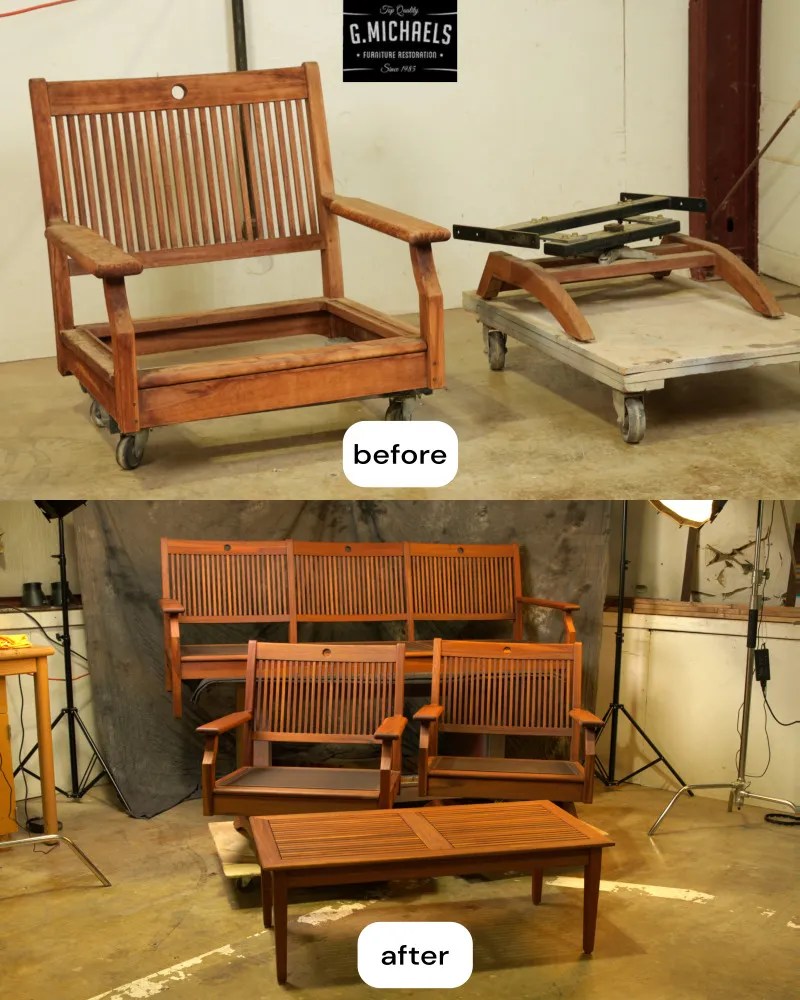
The Jensen outdoor set that came into our Fort Collins shop was not built that way. Two lounge chairs, a three-seat bench, and a coffee table, all constructed from ipe, one of the densest and most durable tropical hardwoods used in outdoor furniture anywhere. A set like this was never meant to be replaced. It was meant to be restored when the time came.
The time had come. Years of deep staining had worked their way into the surface of every piece. The frames had developed structural issues that needed attention before any surface work could proceed. The condition was exactly the kind that sends a lesser set to the landfill. For a Jensen ipe set, it was the beginning of a restoration process.
.
Project Overview
This project covered all four pieces in the complete set:
- Complete strip of all existing finish and surface contamination down to bare wood across both lounge chairs, the three-seat bench, and the coffee table
- Hot oxalic acid wash applied at 90°C / 190°F to address deep embedded staining across all ipe surfaces
- Structural frame repairs on components that had developed damage requiring attention before refinishing
- Full surface preparation following the oxalic treatment and repairs
- Refinishing that brings the natural ipe grain forward with a warm, even tone consistent across the complete set
- Final inspection confirming consistent finish quality across all four pieces before delivery
The Set and the Material: Why Ipe Furniture Is Worth This Investment
Ipe is in a different category from most outdoor furniture wood. Its density, which gives it a Janka hardness rating well above domestic species like oak and well above more common outdoor species like teak and cedar, is what makes it so effective as an outdoor material. It resists rot, insects, and moisture at a level that most alternatives cannot match, and it does so without the chemical preservative treatments that other species require to perform outdoors.
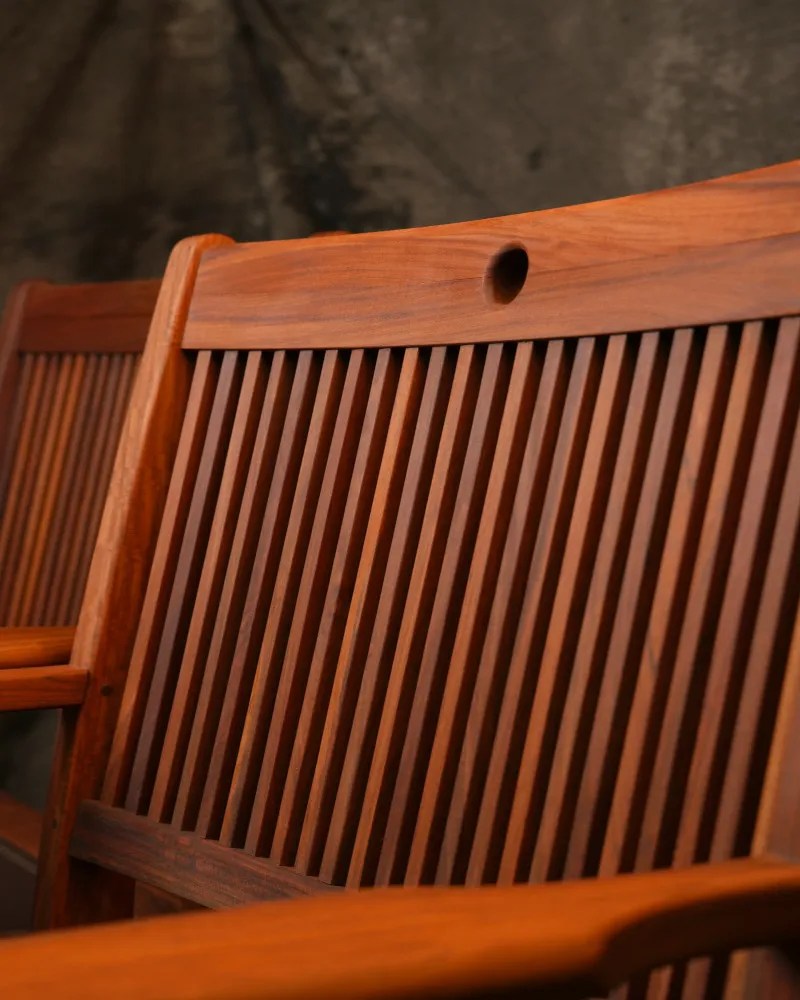
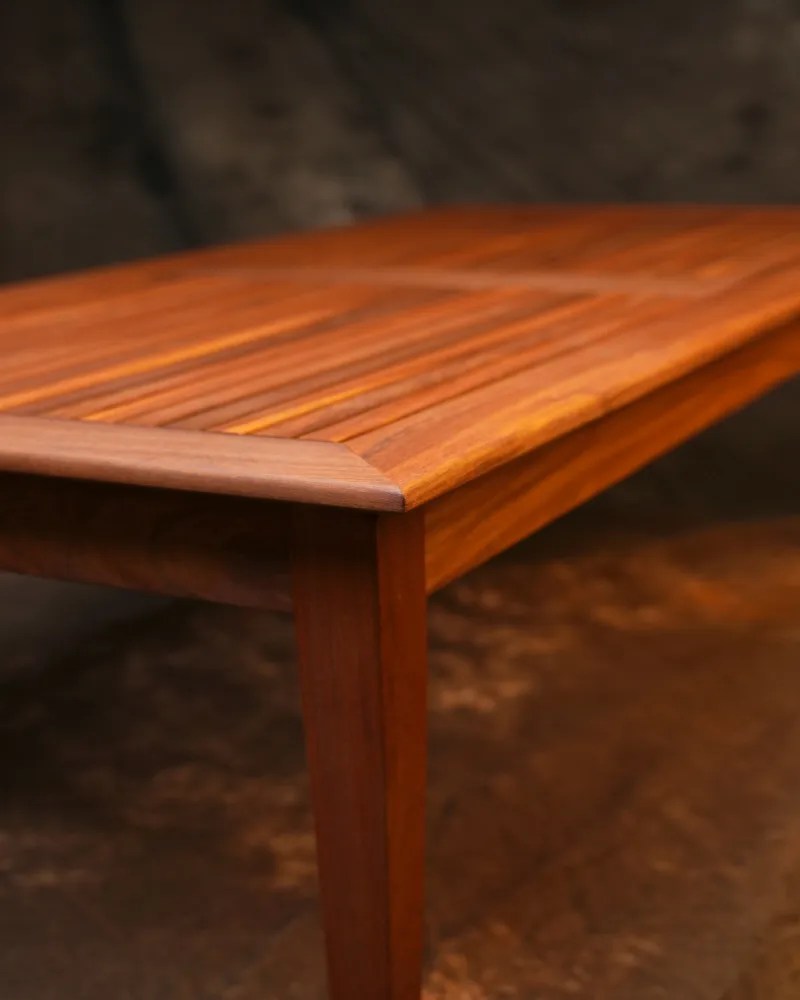
The Jensen brand has built a reputation for outdoor furniture that takes the material seriously. The construction visible in the photographs of this set, the tight slat spacing on the chair backs and bench, the mitered corner joinery on the coffee table frame, the clean tapered leg profiles, all reflect a manufacturer that understood what ipe can do when it is worked correctly and designed a product to take advantage of it.
Quality outdoor furniture built from ipe represents a real asset in a way that standard patio furniture does not. The replacement cost for a comparable new Jensen ipe set would be substantially higher than a professional restoration. For homeowners, interior designers, property managers, and hospitality clients who are managing outdoor spaces at a quality level, that math is worth understanding clearly: restoration at the right time costs a fraction of replacement at the same build quality, and the restored set performs at the same standard as a new one.
The City of Fort Collins sustainability and waste reduction initiatives, documented through the city’s environmental programs, align directly with this kind of restoration-over-replacement approach to durable goods. Keeping a quality ipe set in service through proper restoration rather than sending it to the landfill is the right outcome on multiple levels.
The Hot Oxalic Acid Protocol: Why Temperature Matters
The oxalic acid step in this project is worth explaining in detail, because it is one of the more technically specific aspects of the work and the one that most distinguishes a proper ipe restoration from an inadequate one.
Oxalic acid is the standard treatment for oxidized tannin staining in tropical hardwoods, and it works by chemically reducing the oxidized compounds that produce deep discoloration in the wood fibers. The principle is well established. What is less commonly understood or applied correctly is the role of temperature in how effectively the treatment works.
Oxalic acid applied at room temperature has a working strength that is adequate for light surface oxidation but insufficient for the kind of deep, embedded staining that develops in ipe after years of outdoor exposure without maintenance. The acid’s ability to penetrate the dense fiber of the wood and reach the oxidized compounds at depth is substantially increased at elevated temperature. Applied hot, at 90°C / 190°F, the oxalic acid works at its full potential against staining that a cold or room-temperature application would only partially address.
The practical difference is visible. On a dense tropical hardwood like ipe, the contrast between a hot oxalic treatment and a standard room-temperature application is not a subtle variation in shade. It is the difference between partially lightened staining and actual removal of the embedded compounds that produced the discoloration. That difference is visible across the room on a completed piece, which is exactly where quality control should be observable.
Most restoration shops either skip the oxalic treatment entirely, apply it at ambient temperature without understanding why the temperature matters, or have simply never encountered the hot protocol in their training or practice. On a project like this Jensen set with years of deep staining in dense tropical wood, skipping or underperforming this step means the staining remains visible through the new finish and the finished piece reads as restored rather than as looking right.
Structural Repairs: Surface Work Comes Second
The frame repairs on this set were a prerequisite for the refinishing work, not a separate optional service. Applying a quality finish to a piece with unaddressed structural issues produces a result that looks good temporarily and fails where the structure was compromised as the piece continues to move and flex in outdoor conditions.
The structural assessment on each piece determined which joints and frame elements had developed damage and what each repair required. Ipe’s density makes it an excellent outdoor material but also means it is less forgiving of joint failure than softer species: when an ipe joint fails, the repair has to be executed correctly and completely because the material will not accommodate movement or flex the way a softer wood might while a questionable repair holds temporarily.
Repairs were completed and confirmed stable before any surface preparation or finish work began. This is the correct sequence, and it is the only sequence that produces a finished piece where the structure and the surface are both at the standard the set was originally built to.
For our full approach to furniture repair on outdoor pieces and structural restoration prior to refinishing, see our service page.
Surface Preparation and Refinishing: Bringing the Grain Forward
With the oxalic treatment complete, neutralized, and dry, and the structural repairs confirmed, surface preparation proceeded across all four pieces of the set.
Ipe’s natural oils, which contribute significantly to its outdoor durability, also create specific challenges for finish adhesion. A finish applied to ipe surface that has not been properly prepared will not bond correctly and will fail prematurely regardless of the quality of the finish product itself. The preparation work after the oxalic treatment is what creates the surface condition that allows a quality finish to bond to ipe correctly.
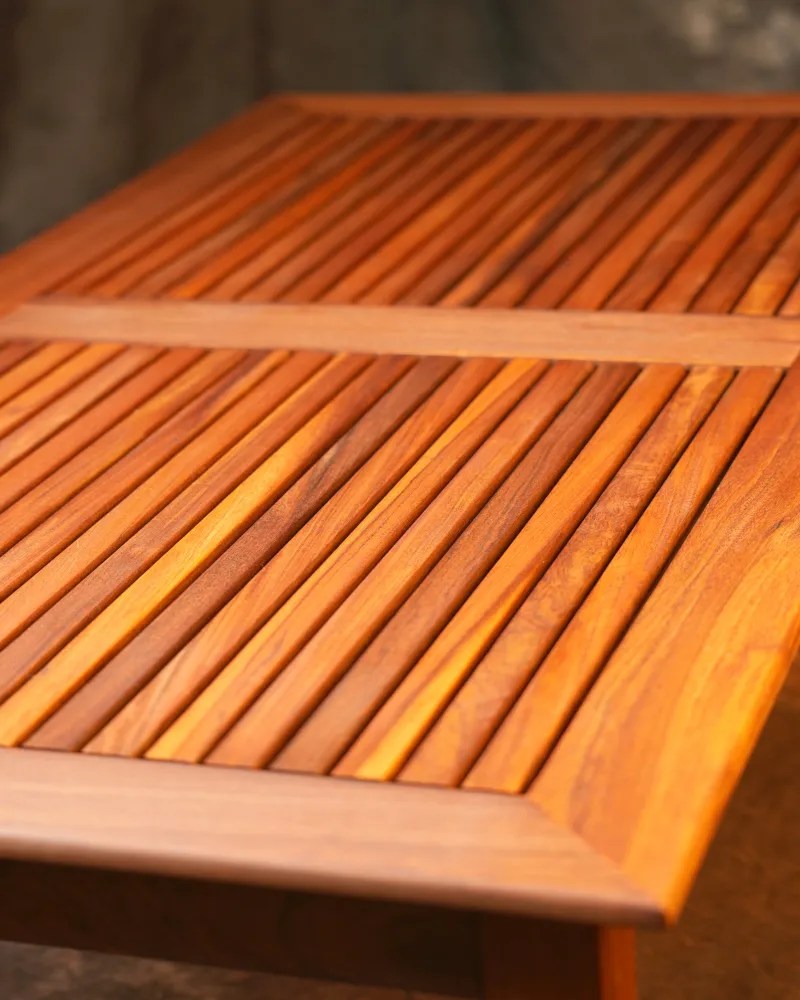
Sanding proceeded through appropriate grits on all surfaces of all four pieces, with particular attention to the slat faces and edges on the chair backs, bench back, and coffee table top. The gaps between slats are narrow enough that edge surfaces require deliberate technique rather than incidental coverage, and any slat edge that is inadequately prepared reads as a dark inconsistency in the finished surface when the piece is viewed from an angle.
The finish was developed to bring the natural ipe grain forward: a warm reddish-brown tone that reflects what properly maintained ipe looks like rather than imposing a color over the wood. Looking at the detail photographs of the finished armrest surface and the coffee table slats, the grain reads clearly through the finish with the color variation natural to ipe visible across each component. The surface looks like excellent tropical hardwood under a quality finish, which is what it is.
For our approach to furniture refinishing on outdoor and tropical hardwood pieces, see our service page.
The Business Case: Quality Furniture as a Maintained Asset
It is worth being direct about the economics of a project like this, because the calculation is relevant for a specific category of client and the numbers favor restoration clearly.
A Jensen ipe outdoor set at current replacement cost for new furniture of comparable build quality represents a significant investment. A professional restoration, even one involving structural repairs and the full hot oxalic protocol applied correctly, costs a fraction of that replacement figure. The restored set performs at the same standard as a new one. The ipe itself, which was the primary asset in the original purchase, is fully recovered and protected for subsequent seasons.
For interior designers specifying outdoor furniture for clients, property managers maintaining quality outdoor spaces at residential or commercial properties, and hospitality operators where outdoor furniture quality is part of the guest experience, this math matters at a practical level. Restoration on a maintenance schedule, rather than replacement when a set looks tired, is the approach that protects the investment and keeps the asset performing correctly.
- Michaels Restoration has been family-run in Fort Collins since 1985, serving Northern Colorado and the greater Denver metro area. We work with residential clients, designers, and commercial operators across the region on projects ranging from single-piece antique restoration to complete outdoor furniture set refinishing.
Services Included in This Jensen Ipe Outdoor Set Restoration
Complete strip of all existing finish to bare wood across both lounge chairs, three-seat bench, and coffee table
Hot oxalic acid wash applied at 90°C / 190°F for full working strength against embedded staining throughout
Structural frame repairs on damaged components before any surface work began
Full surface preparation accounting for ipe’s natural oil content and finish adhesion requirements
Warm reddish-brown finish developed and applied consistently across the complete four-piece set
Systematic finish application on all slat faces, edges, armrest surfaces, frame rails, and leg sections
Final inspection of the complete assembled set under multiple lighting conditions
Have a Quality Outdoor Furniture Set That Needs Professional Restoration?
If you have a Jensen, Gloster, or any quality ipe, teak, or tropical hardwood outdoor furniture set that has developed deep staining, structural issues, or surface failure from seasons without maintenance, we would be glad to assess what the restoration involves. The hot oxalic protocol, structural repair capability, and finish work appropriate to dense tropical hardwoods are all within our standard scope.
We serve clients throughout Fort Collins, including Old Town, Midtown, Fossil Creek, and the southeast neighborhoods, as well as Loveland, Windsor, Boulder, Longmont, Denver, and the greater Denver metro area. Pickup and delivery are available throughout our service area.
Send photos to shop@gmrestores.com or call us at 970-493-8737. Free estimates on all projects.
113 Hickory Street, Fort Collins, Colorado 80524 | (970) 493-8737 | shop@gmrestores.com
Frequently Asked Questions: Ipe Outdoor Furniture Restoration in Fort Collins
What is the hot oxalic acid protocol and why does temperature matter for ipe restoration?
Oxalic acid is the standard chemical treatment for oxidized tannin staining in tropical hardwoods, but its effectiveness against deep embedded staining in dense species like ipe depends significantly on the temperature at which it is applied. At room temperature, the acid’s ability to penetrate the dense fiber of ipe and reach oxidized compounds at depth is limited. Applied hot, at 90°C / 190°F, the treatment works at its full potential against staining that a cold application would only partially address. The practical difference on a piece with years of embedded staining is not subtle: hot oxalic treatment actually removes the compounds producing the discoloration, while room-temperature application partially lightens them. Most restoration shops skip this step entirely or apply it at ambient temperature without understanding why temperature matters.
Can structural damage on an ipe outdoor furniture frame be repaired before refinishing?
Yes, and structural repair is a prerequisite for refinishing rather than an optional add-on. Applying a quality finish to a piece with unaddressed structural issues produces a result that fails as the piece continues to move and flex in outdoor conditions. Ipe’s density means joint failures in this material require correct and complete repair rather than temporary fixes. We assess structural condition at the start of every outdoor furniture restoration project and complete any necessary repairs before surface preparation or finish work begins.
Is it worth restoring a quality ipe outdoor furniture set rather than replacing it?
For a quality set from a manufacturer like Jensen, the restoration math is clear. The replacement cost for new furniture of comparable build quality is substantially higher than a professional restoration, even one involving structural repairs and a full technical process. The restored set performs at the same standard as a new one, and the ipe itself, which represents the primary value in the original purchase, is fully recovered and protected. For designers, property managers, and hospitality clients managing outdoor furniture as a maintained asset, restoration on a schedule is the approach that makes economic sense.
Do you restore ipe and tropical hardwood outdoor furniture near Denver?
Yes. We serve clients throughout the greater Denver metro area from our Fort Collins shop, including Boulder, Longmont, Loveland, Windsor, Arvada, Lakewood, Aurora, Centennial, and Denver proper. Free estimates are available on all projects and we offer pickup and delivery throughout our service area. Send photos to shop@gmrestores.com or call 970-493-8737 to get started.
Located in the historic city of Fort Collins, Colorado, G. Michaels Restoration is an experienced furniture repair and antique furniture restoration shop serving Fort Collins, Loveland, Windsor, Boulder, Longmont, Denver, and the greater Denver metro area.
113 Hickory Street, Fort Collins, Colorado 80524 | (970) 493-8737 | shop@gmrestores.com
Located in the historic city of Fort Collins, Colorado. G. Michael’s is an esteemed furniture repair and antique furniture restoration wood shop.