Antique French Commode Restoration in Fort Collins - Before and After

French Marquetry Commode Restoration in Fort Collins: Gilt Brass, Marquetry Veneer, French Polish, and Marble

There is a category of restoration work where the scope is defined not by a single process but by the number of distinct disciplines a single piece requires. Most projects that come through our Fort Collins shop involve one primary trade: wood refinishing, structural repair, surface restoration. Occasionally a piece arrives that requires all of those things simultaneously, plus several others, each held to the same standard as the rest.

This Louis XVI style marquetry commode was that kind of project.

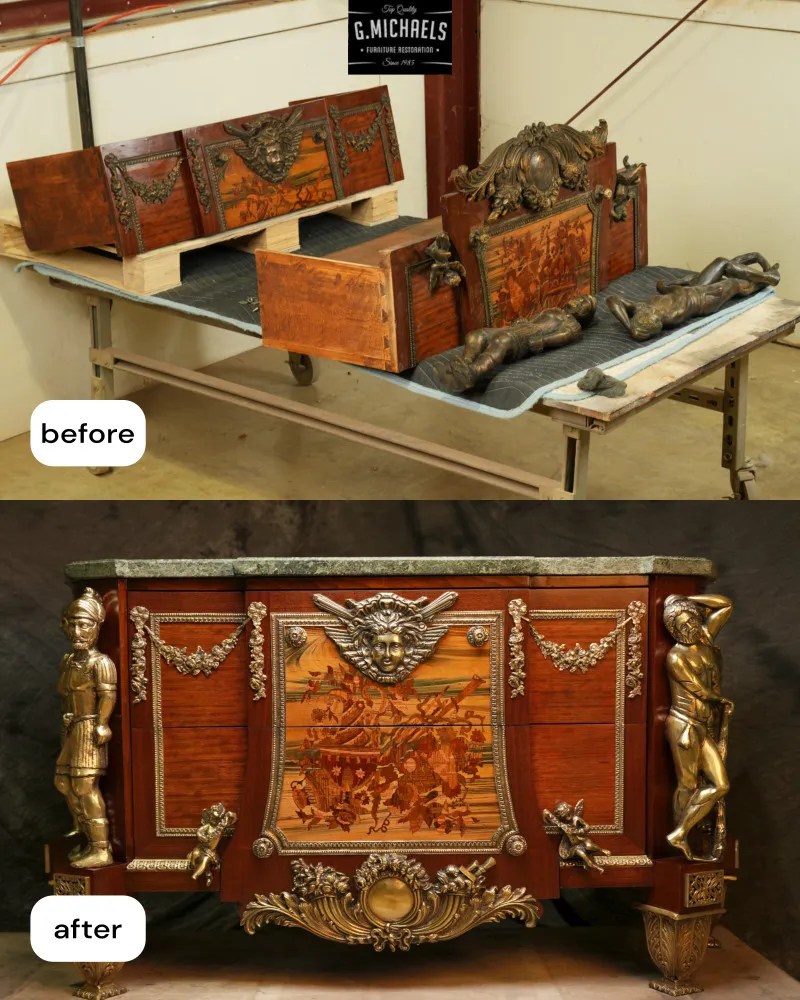
Looking at the before photograph, the piece arrived completely disassembled, its components laid out on a work surface: the drawer fronts with their complex marquetry inlay panels, the figural brass mounts stripped from the carcass and lying separately, the ornate cast brass corner figures detached and waiting. What the before image does not fully capture is the scope of what reassembling this piece correctly would require: four distinct materials, four distinct restoration disciplines, and a standard that had to be consistent across all of them before the piece could be brought back together as a coherent whole.

That is where the work began.

.

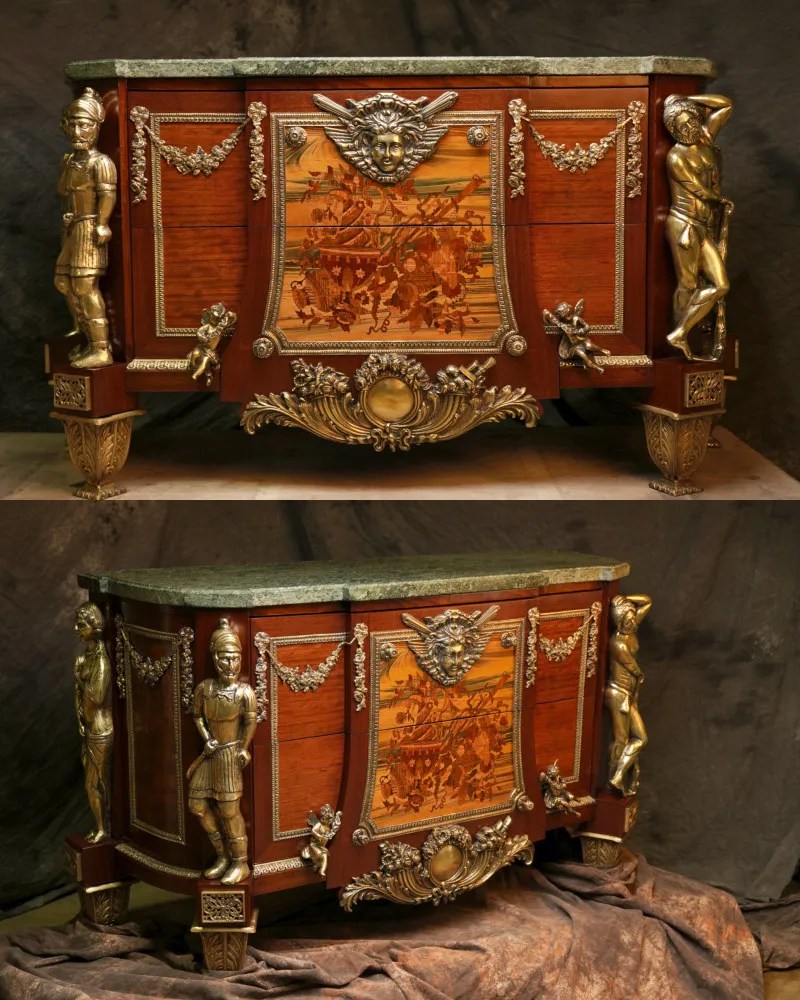
Restored Commode Gilt Bronze Fort Collins

Project Overview

This project involved complete disassembly followed by material-specific restoration across four distinct disciplines:

  • Complete disassembly of the commode, including both drawers and all brass mounts and figural elements removed individually
  • Brass restoration: all cast brass figures, corner mounts, cherub figures, garland swags, and decorative mounts stripped, cleaned, polished, and refinished with brass-specific lacquer
  • Wood and veneer restoration: marquetry drawer fronts repaired and refinished throughout, preserving inlaid pictorial compositions assembled from dozens of individual pieces of contrasting wood species
  • Base and surface restoration using traditional French polish applied by hand
  • Marble top polished and repaired
  • Full reassembly with all components correctly seated, fitted, and aligned

The Piece: What a Louis XVI Marquetry Commode Actually Is

Before the process, the piece deserves proper context, because the form and the history behind it matter for understanding what the restoration required.

The Louis XVI commode is one of the defining furniture forms of late eighteenth century French cabinetmaking. The style emerged during the reign of Louis XVI as a reaction against the curves and asymmetry of the preceding Rococo period, returning to straighter lines, classical architectural references, and a restrained ornamental vocabulary drawn from Greco-Roman antiquity. The commodes produced during this period and in subsequent revival production combined fine wood veneer and marquetry surfaces with elaborate gilt bronze mounts applied across the carcass, providing both decorative ornament and structural protection for the veneer at corners, edges, and drawer surrounds.

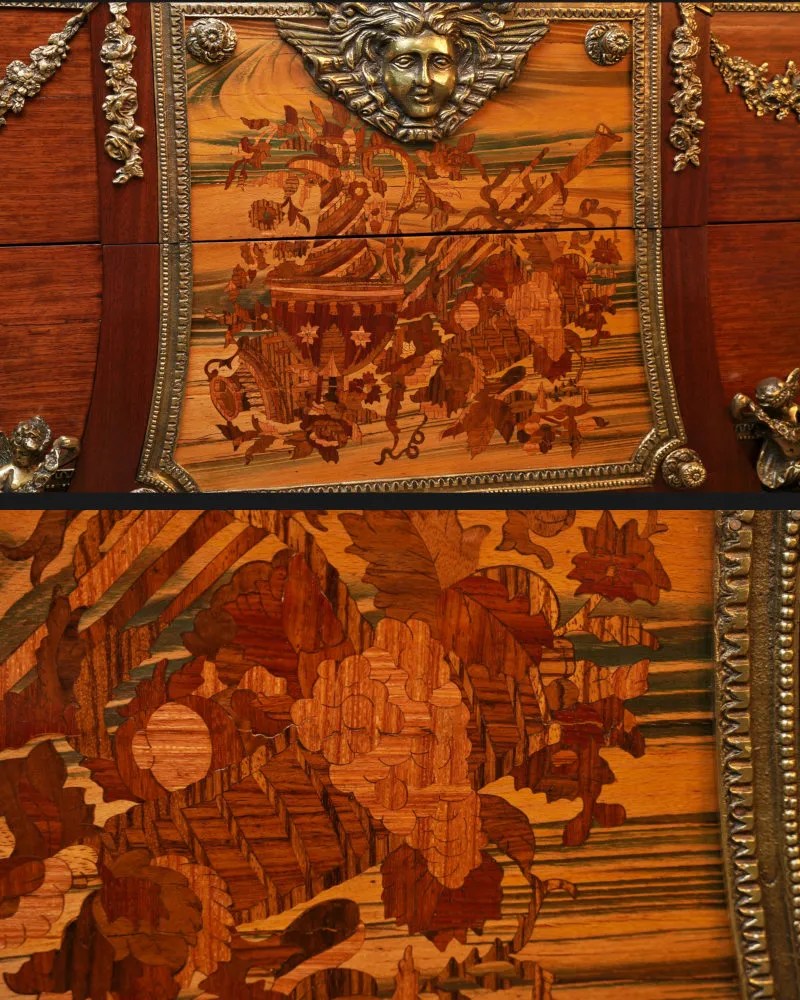
The marquetry work on this particular commode, visible in detail in the close-up photographs, is a pictorial composition assembled from dozens of individual pieces of wood veneer in contrasting species and tones. The technique, known as marquetry rather than parquetry because it depicts representational imagery rather than geometric pattern, requires cutting each individual veneer element to precise shape and fitting them together into the completed picture before the assembled panel is applied to the drawer front. The imagery visible across the two drawer fronts includes floral compositions, architectural elements, and decorative objects assembled in the manner characteristic of late eighteenth century French marquetry work.

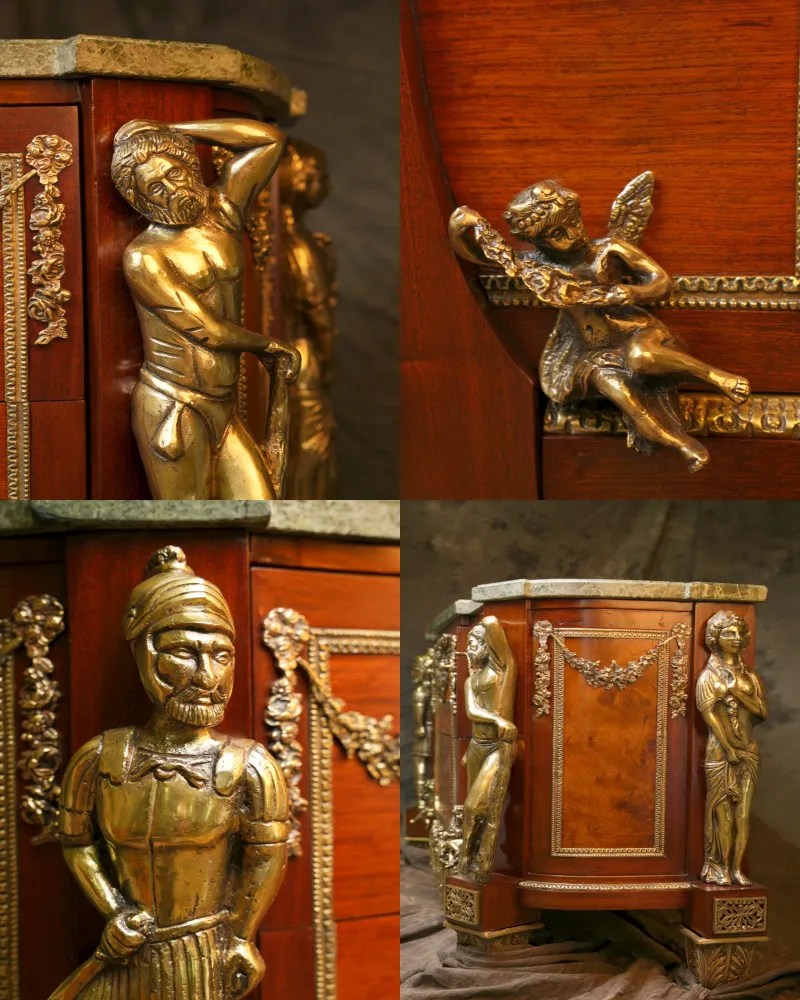
The figural brass mounts are the other major material component of the piece. The corner figures, visible clearly in the detail photographs, are full figural castings: a warrior figure in armor on one corner, a classical male figure on another, with cherub figures at the lower front and garland swags across the upper register. These are not stamped sheet metal decorations. They are cast brass figures with surface detail that required individual attention during the cleaning and refinishing process.

History Colorado’s collections include French and French-influenced decorative arts and furniture documenting the presence of European fine furniture traditions in Colorado interiors from the nineteenth century through the mid-twentieth. A commode of this quality and complexity represents the highest level of European cabinetmaking tradition, and restoring it correctly requires treating each material component with the discipline its own tradition demands.

Disassembly: Why Everything Had to Come Apart First

The decision to fully disassemble this piece before any restoration work began was not a choice made for convenience. It was the only approach that would allow each material to be treated correctly on its own terms.

Brass mounts on a piece like this cannot be properly cleaned, polished, and refinished while attached to a wood surface. The chemicals used in brass cleaning are not compatible with wood veneer or shellac-based finishes. The mechanical polishing required to bring the surface of cast brass figures back to the quality visible in the after photographs cannot be done precisely in the proximity of veneer without risk of damage to the wood surface. And the brass lacquer applied as a final protective coat over the refinished brass cannot be applied or cured correctly if the mounts are in place against a wood surface that is also undergoing its own finishing process.

The same logic applies in reverse for the wood and veneer work. Stripping and refinishing veneer surfaces adjacent to attached brass mounts creates risk of chemical contact with the metal and produces masking and edge problems that compromise the quality of the finish at every mount boundary. Working on the veneer and marquetry panels as individual components, completely separated from the brass and hardware, allows the surface preparation and finish application to proceed without any compromise.

Full disassembly is more work and more time than working on an assembled piece. It is also the only approach that produces a result where every material has been treated correctly and the finished piece reads as unified rather than as evidence of the compromises required to work around the constraints of an assembled piece.

Brass Restoration: Four Categories of Metal Work

The brass components on this commode break down into four distinct categories, each with different surface area, detail complexity, and finishing requirements.

The full figural corner mounts, the warrior and classical figures that stand at the corners of the carcass, are the most complex brass elements on the piece. They are cast figures with surface detail at the level of individual facial features, armor articulation, and textile rendering. Cleaning and polishing work on cast figures of this complexity requires hand work with appropriate tools at each level of detail, from the broad surface areas down to the recessed areas between individual cast elements, without losing the definition of the casting detail in the process. The cherub figures, smaller in scale, require the same level of attention at a finer scale.

The decorative mounts, including the garland swags, the Medusa-head central mount, the beaded molding that frames the drawer fronts, and the acanthus leaf decorations at the base, are flat or low-relief castings that present a different set of cleaning and polishing requirements. The goal on all of these elements is a surface that reads as consistently warm gold throughout the piece, with the casting detail clearly visible and the surface free of the tarnish, oxidation, and accumulated contamination that the before photographs showed across the brass components.

All brass components were finished with a lacquer formulated specifically for brass surfaces, which protects the polished finish from future oxidation while maintaining the clarity and warmth of the metal underneath. Against the refinished wood veneer and the green-veined marble top, the restored brass reads exactly as it should: warm, present, and clearly the work of skilled founders rather than decorative add-ons.

Veneer and Marquetry: Preserving What Cannot Be Replaced

The marquetry panels on the drawer fronts are the most technically delicate element of this restoration, and the one where the most care was required to get right.

Marquetry veneer assembled from dozens of individual species-specific pieces is not a uniform surface. Different species in the composition have different porosity, different hardness, different response to cleaning agents and finish materials. The boundaries between individual veneer pieces, where the knife cuts that defined each element were made, are potential failure points where old adhesive may have dried and lifted slightly, where the veneer edges may have separated, and where any new finish system has to bridge correctly rather than highlighting the transitions between elements.

The restoration of the marquetry panels required assessment of each panel at a detailed level before any treatment began: identifying areas where veneer had lifted or separated, determining the condition of the pictorial composition across both drawer fronts, and evaluating what the existing finish over the marquetry could tell about the history of the piece and any prior restoration work.

Repair work on lifted or separated marquetry is meticulous by nature. Each element that has separated from the substrate has to be carefully re-adhered with appropriate adhesive, clamped or weighted correctly to ensure full contact during cure, and then evaluated once the adhesive has set to confirm the repair is flush and stable before any surface work proceeds. Rushing this step produces visible repair lines in the finished surface wherever adhesion was incomplete.

Once the structural condition of the marquetry was addressed, the surface was refinished in a manner appropriate to the material: developing depth and clarity through the veneer composition without imposing a uniform color that would reduce the contrast between species that makes the pictorial composition readable.

Our antique furniture restoration process on marquetry and veneered surfaces is built around this kind of material-specific attention at every stage.

French Polish: The Traditional Finish System the Piece Deserves

The base and carcass surfaces of this commode were hand-finished using traditional French polish, a shellac-based finishing technique applied by hand using a pad in a process that builds the finish in very thin layers over multiple sessions.

French polish is the benchmark finish for European fine furniture from the eighteenth and nineteenth centuries, and the reason is not purely historical. The technique produces a surface depth and clarity that modern spray finishes cannot replicate: the finish appears to be part of the wood rather than a coating sitting on top of it, and the warmth and figure of the underlying veneer reads through it with a quality that is immediately distinguishable from any other finish system when seen in person.

It is also a slower and more demanding process than any modern alternative. Building the finish to the appropriate depth requires multiple sessions with drying time between them, constant evaluation of the developing surface under raking light, and hand correction of any imperfections that appear in the building coats before proceeding. There are no shortcuts that produce the same result.

The finished French polish surface on the carcass of this commode reads with the depth and warmth that the veneer and the piece’s period of origin deserve. Against the polished brass mounts and the green marble top, the wood surface holds its own as an equal element in the composition of the finished piece rather than serving as a background for the metalwork.

For our full approach to traditional French polish and period-appropriate finish systems on antique European furniture, see our furniture refinishing service page.

Marble: The Final Material

The verde antico marble top on this commode, with its characteristic green ground and white veining, was polished and repaired as part of the complete restoration scope.

Marble on period furniture accumulates surface scratching, etching from acidic contact, and dullness from years of use and cleaning with inappropriate products. Restoring the surface to a polished condition requires progressive work through abrasive sequences appropriate to the specific stone, finishing with polishing compounds that develop the natural reflectivity of the marble without leaving a surface coating that would change the character of the stone.

The restored marble sits correctly on the refinished carcass and reads as an integral part of the completed piece rather than as a separate element placed on top of it. The green tone of the marble connects to the warm tones of the veneer and the gold of the brass in a way that confirms the original selection was made with deliberate visual intent.

The Finished Commode: When Every Part Is Right

The finished commode, looking at the after photographs from the front and the angled view, reads as a coherent whole rather than as an assembly of individually restored components. The brass figures read consistently warm across all four corners and all decorative mounts. The marquetry drawer fronts show the pictorial composition clearly through a finish that develops the contrast between species without suppressing it. The French-polished carcass surfaces frame the drawer fronts and brass elements with appropriate warmth and depth. The marble sits correctly and reads as part of the piece.

This is what restoration at this level is supposed to produce: not evidence of the work that was done, but a piece that reads as if the work was always its condition.

  1. Michaels Restoration has been working on pieces of this complexity from our shop on Hickory Street in Fort Collins since 1985, serving clients throughout Northern Colorado and the greater Denver metro area including Denver, Boulder, Longmont, Aurora, Arvada, and Evergreen. Pieces like this one travel to us from across the region because the work they require is not common, and the standard they deserve is not negotiable.

Services Included in This Louis XVI Commode Restoration

Complete disassembly of all components before any restoration work began
Cast brass figural mounts, corner figures, cherubs, garlands, and decorative mounts stripped, cleaned, polished, and refinished with brass-specific lacquer
Marquetry veneer drawer fronts assessed, repaired, and refinished with material-appropriate technique
Base and carcass surfaces hand-finished using traditional French polish
Verde antico marble top polished and repaired
Full reassembly with all components correctly fitted, seated, and aligned
Final inspection under multiple lighting conditions before delivery

Have a Marquetry Piece, European Antique, or Museum-Quality Furniture Needing Restoration?

If you have a French commode, a marquetry cabinet, a piece with gilt bronze mounts, or any European antique where the restoration requires multiple distinct disciplines handled simultaneously, we would be glad to assess the scope and give you an honest evaluation of what the work involves.

We handle the full range of complex antique restoration from our Fort Collins shop, serving clients throughout Northern Colorado and the greater Denver metro area. Pickup and delivery are available throughout our service area for pieces of any size and complexity.

Send photos to shop@gmrestores.com or call us at 970-493-8737. Free estimates on all projects.

113 Hickory Street, Fort Collins, Colorado 80524 | (970) 493-8737 | shop@gmrestores.com

Frequently Asked Questions: French Marquetry Commode and European Antique Restoration in Fort Collins

What does restoring a Louis XVI commode with marquetry and brass mounts actually involve?

A piece with multiple distinct materials requires treating each material as a separate restoration discipline rather than applying a single process across the piece. The wood veneer and marquetry, the cast brass mounts, the shellac-based finish on the carcass, and any stone or marble elements all require different techniques, different materials, and different sequences of work. The practical implication is complete disassembly before restoration begins, so each component can be treated correctly on its own terms without the constraints or contamination risks that come from working on assembled mixed-material pieces. Reassembly is the final step after all components have been individually restored and confirmed.

Can marquetry veneer that has lifted or separated be repaired without replacing the inlay?

In most cases where the veneer elements are intact but have separated from the substrate, yes. Re-adhesion with appropriate period-compatible adhesive, properly applied and cured under controlled pressure, produces a repair that is structurally stable and visually invisible in the finished surface. The more complex cases involve missing veneer elements that have been lost entirely, which require sourcing or fabricating replacement veneer pieces in matching species and figure. Both types of repair require patience and precision rather than speed, and the quality of the result depends entirely on the care taken at each step of the process.

What is French polish and why is it used on period European furniture?

French polish is a shellac-based finish applied by hand using a pad in a process that builds the finish in very thin layers over multiple sessions. The technique was the standard finish for fine European furniture from the eighteenth century onward because it produces a surface depth and clarity that no other finish system replicates: the finish reads as integral to the wood rather than as a coating on top of it, and the warmth and figure of the underlying veneer comes through it with exceptional clarity. Modern spray finishes are faster and more durable in some respects but do not produce the visual quality that French polish achieves on period veneer. For furniture from the Louis XVI period and similar European traditions, French polish is the period-appropriate and visually correct choice.

Do you restore French antiques and European marquetry furniture near Denver?

Yes. We serve clients throughout the greater Denver metro area from our Fort Collins shop, including Denver, Boulder, Longmont, Aurora, Arvada, Evergreen, Lakewood, and Centennial. For significant or fragile pieces, we can discuss transport options at the point of assessment. Free estimates are available on all projects. Send photos to shop@gmrestores.com or call 970-493-8737.

Brass Details on French Commode - Details
Antique Furniture Inlay Details After Restoration

Located in the historic city of Fort Collins, Colorado. G. Michael’s is an esteemed furniture repair and antique furniture restoration wood shop.

Furniture repair & restoration expert

Danish Skovby SM-32 Dining Table

This Danish Skovby SM32 dining table arrived with a shattered base, broken extension mechanism, and a damaged cherry top after taking a tumble down eight stairs during a move. We rebuilt the pedestal base piece by piece, realigned the internal mechanism so it glides open like new, and fully refinished the cherry top. It might just look better than the day it left the factory in Denmark.

Antique Front Door Restoration

This 120-year-old front door in Old Town Fort Collins arrived with peeling finish, weathered wood, and a sticky lock. We took it through 12 to 15 steps: stripping, our 9-step wood prep, lock restoration, and a new mechanism. ML Campbell Poly 2K finish protects it for 20 to 30 years.

Solid Pine Closet Restoration

Built by our customer's grandfather, this 7 by 9 foot solid pine closet arrived covered in a bold Southwestern mural. We stripped every inch of paint, refinished it in a rich warm tone, and cleaned up the original hardware. Same bones, whole new soul.

Antique Oak Dresser Restoration

This antique oak piece arrived at our shop missing its entire bottom drawer, with the top drawers reduced to just front panels. We custom-built a new bottom drawer and fresh boxes for the upper panels, then hand-blended stains until the raw wood disappeared seamlessly into the original. A traditional French polish and high-end wax finish brought back that silky, antique glow.

Windsor Armchairs Restoration

These two Windsor armchairs came in with failing finish on the arms and spindles, the areas that take the most wear over the years. A thorough cleaning and careful touch-up brought the finish back to life across both chairs. Sometimes furniture doesn't need a full overhaul, just the right hands.

Table With Carved Base Restoration

This antique carved table base arrived covered in lion heads, grotesque faces, acanthus leaves, and ornate scrollwork. Beautiful craftsmanship, but no top. We fabricated a brand new solid walnut top to match its scale and presence, then finished it with ML Campbell conversion varnish for decades of protection. Old world base, new world craftsmanship.

Oval Mahogany Table Repair and Refinishing

A moving company broke the lip trim off this oval table and couldn't return the missing piece. We made a mold of the original profile, fabricated a new lip from scratch, then matched the stain and sheen against the table's banded inlay edge. Every grain direction and tone lined up: you'd never know it happened.

Heywood-Wakefield Dresser Restoration

This Heywood-Wakefield dresser arrived with a tired, scratched-up finish, especially across the top. We took it through a full refinish from top to bottom, restoring the warm, even blonde tone that makes this signature birch so iconic. Clean grain, smooth finish, exactly the way it left the factory.

Heywood-Wakefield Chairs

These vintage Heywood Wakefield chairs arrived hidden under a heavy dark stain and dated floral fabric. We carefully stripped the non-original finish, refinished the wood to reveal that famous blonde grain, and replaced the upholstery with a clean modern blue fabric. Iconic mid-century design, back to its original glory.

Mid-Century Cabinet Restoration

This mid-century walnut cabinet arrived with a faded, cloudy finish hiding the natural beauty of the wood. We stripped the old finish, then carefully sanded and refinished the walnut veneer to bring back its deep, warm tones. The sharp contrast with the black accent doors is back, exactly the way mid-century modern was meant to look.

Antique Dining Set Repair and Refinishing

This antique dining set came into the shop ready for a second life. The table leaves got a full refinish that brought out the natural grain, while the matching side chairs received a careful finish restoration without touching a single thread of the original needlepoint seats. The warmth is back in the wood, the history is still in the fabric, and the whole set looks ready for the next generation of dinners.

Mission Style Dining Table Restoration

This Mission-style trestle dining table came to us completely unfinished: bare, pale oak with beautiful natural grain and clean slat detailing on the base. We took it through a full staining and finishing process, building up a rich, deep warm tone that makes the oak grain absolutely sing. From raw wood to a table built to last generations.

Heywood-Wakefield Coffee Table Restoration

Heywood-Wakefield coffee table arrived needing a full restoration, from its sculpted splayed legs to the perfectly rounded top. We took it completely apart, stripped everything down to bare wood, and brought every surface back to life before the finish went on. That signature 1950s honey tone is back, exactly the way collectors love it.

French Oak Buffet Cabinet Repair and Refinishing

This antique French oak buffet cabinet arrived disassembled, with a split top, worn finish, and decades of grime hiding incredible hand carving: rosette medallions, egg-and-dart molding, turned columns, and ornate brass hardware. We repaired and refinished the top, then treated the whole piece to a rich, deep, smoky oak finish that unifies every surface while letting each carved detail pop. Pieces like this are irreplaceable, and this is exactly why we do what we do.

Queen Anne Style Dining Table

This Queen Anne style dining table came through our shop for a complete refinish, from the cabriole legs and pad feet to the scalloped apron and every curve in between. The whole piece was finished in a deep, rich dark brown tone that gives it exactly the presence it deserves. Smooth, even, and consistent from the top all the way down: the way it was always meant to look.

Ethan Allen Pine Desk

This Ethan Allen pine desk arrived buried under decades of dark stain and years of scratches. We stripped it back, brought out that warm honey pine grain, and gave it a clean professional finish that shows off every knot and ring. Same desk, same solid pine, completely different life.

Mid-Century Lounge Chairs Restoration

These mid-century lounge chairs left the shop with their curved scissor-style legs telling the whole story. We refinished the walnut frames to a warm, even tone that lets the grain and the sculptural shape do the talking, while our partners at Sparrow House of Design handled the bold tropical upholstery. Two shops, two trades, one result worth staring at.

Hexagonal Gun Cabinet Repair and Refinishing

This 1960s hexagonal gun cabinet arrived locked, scratched up, and fitted with original 1/16 inch glass fragile enough to shatter from a single touch. We picked the lock and had a brand new key cut by Red Rocks Locksmith, swapped the original glass for 3/16 tempered panels from Black's Glass, replaced the old fluorescent tubes with color-changing COB LED strips, relined the interior in fresh wool felt, and gave the whole piece a full pine refinish from top to base.

Multi-Species Dining Table Project

This multi-species butcher-block dining table came through our shop and the wood alone stopped everyone in their tracks.This multi-species butcher-block dining table came through our shop and the wood alone stopped everyone in their tracks. Alternating strips of dark and light species sit side by side, creating a pattern that looks almost like a piece of art as much as a table. A surface this dramatic deserves to be seen.

Antique Round Oak Pedestal Table

This antique round oak pedestal table just left the shop after a full refinish, and those carved claw-and-ball feet under the turned column base are something else. Quarter-sawn oak grain runs through the column and base, with strong ray patterns across the top, all finished in a rich deep brown that makes every carved detail pop. Antique tables like this deserve to be used, not stored.

Antique Furniture Restoration

Check how we restore wonderful pieces of antique furniture to its new glory. If you would like to have your valuable piece of furniture restored, simply contact us! We cover Fort Collins and all Denver metro from Downtown Denver, Boulder, Arvada, Lakewood, Evergreen and more.

Antique Oak Sideboard

This antique oak sideboard came to us with years of water damage across the entire top surface and a finish that had long since given up. We completed a full refinish in a warm reddish-brown tone that brought every surface back to life, and those bookmatched burl panels now show the depth and figure they were always hiding.

Old Dresser Stripped and Refinished

This antique dresser came to us buried under decades of dark grime and oxidized finish. We stripped the entire piece back to bare pale wood and rebuilt the finish with a warm natural tone that finally lets the grain, the turned legs, and the carved detail read the way they were always meant to

French Commode Restoration in Fort Collins

This Louis XVI marquetry commode needed four completely different restoration disciplines handled at once. Brass figures polished and lacquered, marquetry veneer repaired and refinished, carcass hand-finished in traditional French polish, marble top cleaned and restored. Everything brought back together as one piece.

Inquires:

  • Office
    shop@gmrestores.com
  • (970) 493-8737
  • Estimate
    shop@gmrestores.com
Address:
113 Hickory Street
Fort Collins, Colorado 80524


Hours:
8a – 5p M-F

Portfolio