
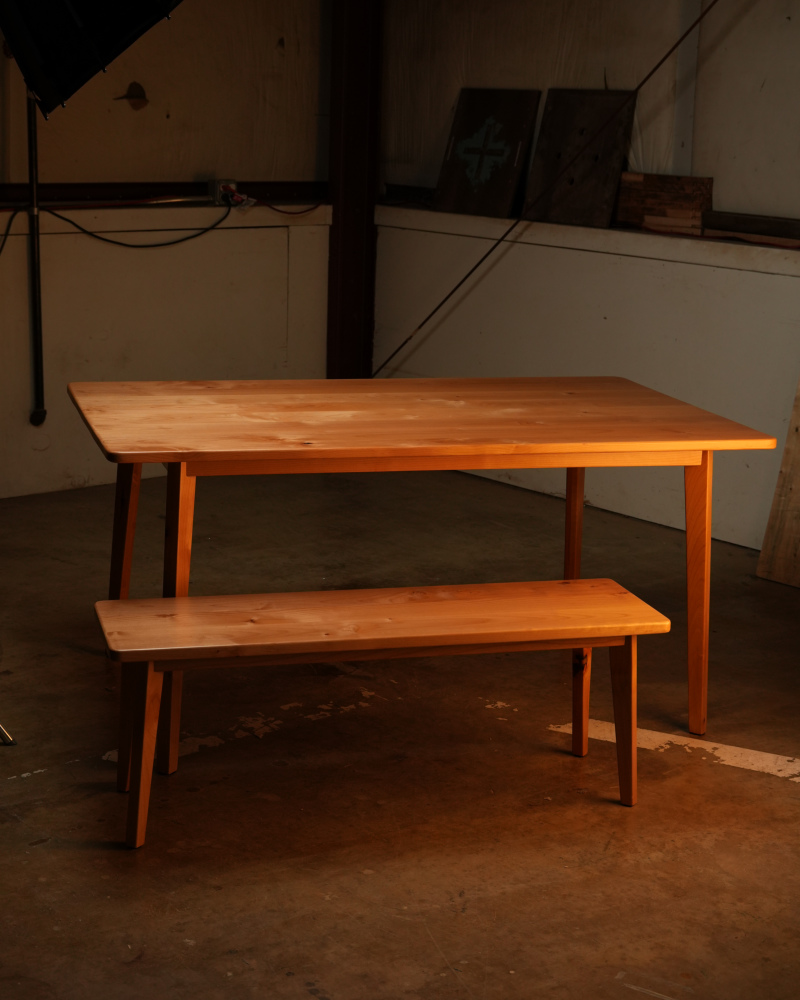
Not every piece that comes through our Fort Collins shop starts as a repair. This one started as two pencil sketches in a spiral notebook: a 64 by 38 inch dining table with gently splayed legs, and a 48 inch bench built to slide underneath it. A local family wanted seating that would handle daily breakfasts, homework sessions, and the occasional twelve-person Thanksgiving, all without looking like it came off a showroom floor.
This case study walks through how our team built that custom dining table and matching bench from rough lumber to final delivery. If you're weighing a made-to-order table against a mass-produced one, the details below will show you exactly what goes into the custom route, where the real difficulties sit, and how a shop that's been working wood since 1985 handles them.
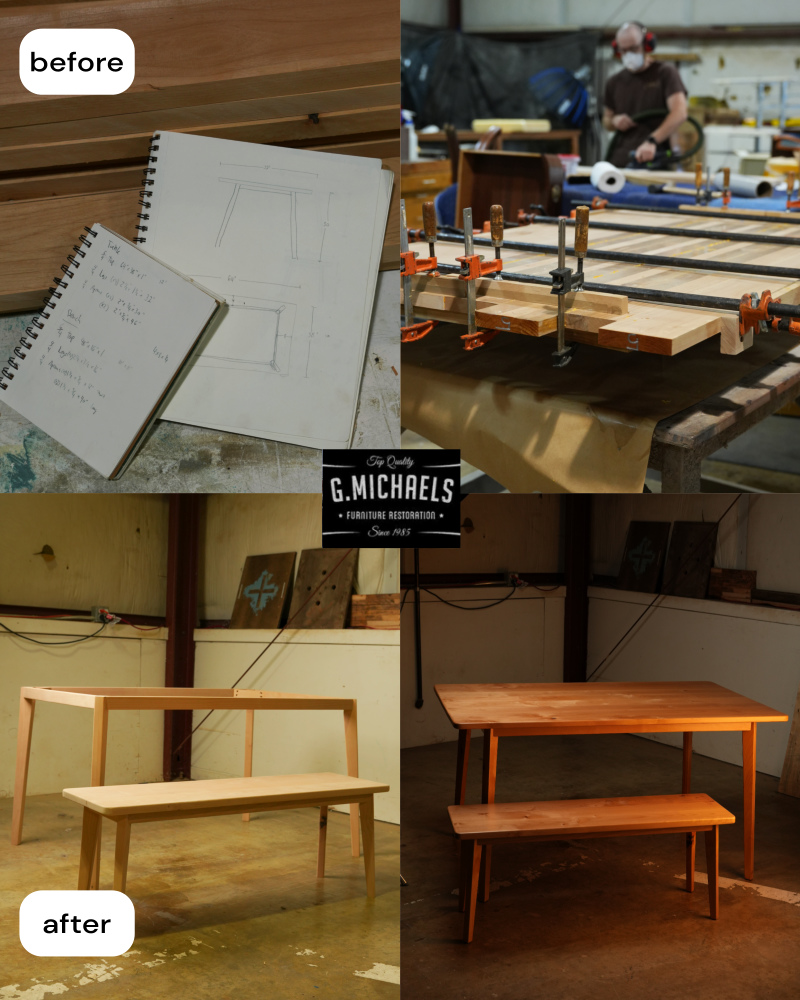
Project snapshot
What the client asked for
The family came to us with three requirements and a floor plan. Their dining nook measured just under eleven feet across, they wanted to seat six comfortably on normal days, and they didn't want chairs crowding one side of the room. A bench solved the third point: it tucks fully under the table when nobody's using it, which keeps the walkway behind it clear.
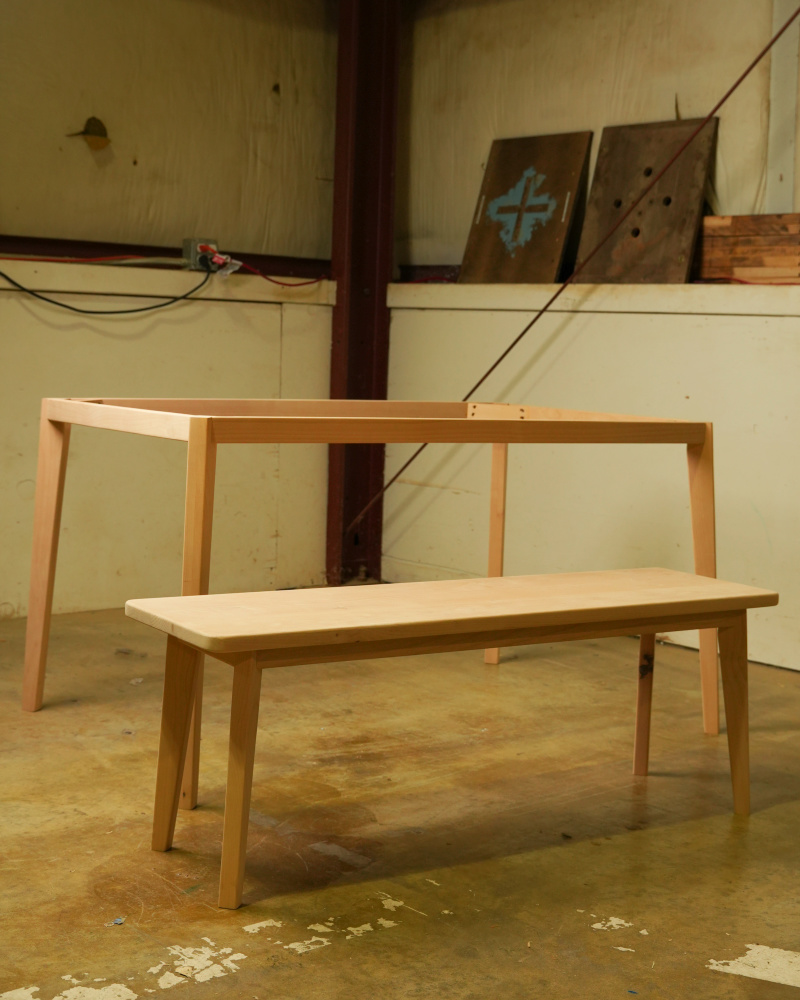
Style-wise, they asked for something between mid-century and Scandinavian. Clean lines, legs that angle outward slightly at the floor, no heavy aprons or turned details, and a finish light enough to show the grain. They also wanted the table and bench to read as one set, built from the same boards where possible, so the color and figure would match across both pieces.
Durability mattered too. Two kids, a dog, and a household that actually eats at the table every day rules out thin veneers and soft finishes. Everything had to be solid wood, with a sprayed topcoat that shrugs off water rings and crayon.
From sketchbook to cut list
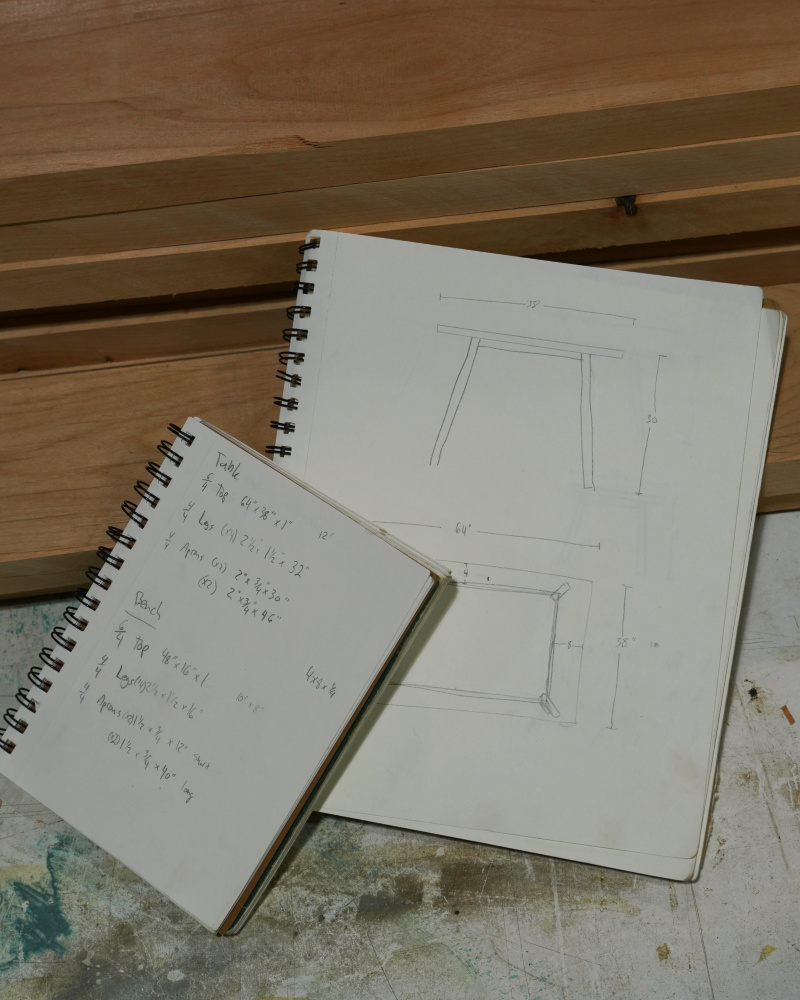
Every made-to-order dining table in our shop starts on paper. For this project, that meant a scaled drawing of the tabletop and leg stance, plus a full cut list worked out by hand: a 64 by 38 inch top at one inch thick, four legs at 2 1/2 by 1 1/2 by 32 inches before tapering, and aprons cut at 30 and 46 inches to form the frame beneath the top. The bench got its own sheet, with a 48 by 16 inch top and proportionally lighter legs and aprons so it wouldn't look chunky next to the table.
Drawing first isn't ceremony. The leg splay angle changes how far the feet land from the tabletop edge, and on a 38 inch wide top that geometry decides whether someone sitting at the end bangs their knee. We settled the angles on paper, confirmed knee clearance against standard seating heights, and only then pulled lumber.
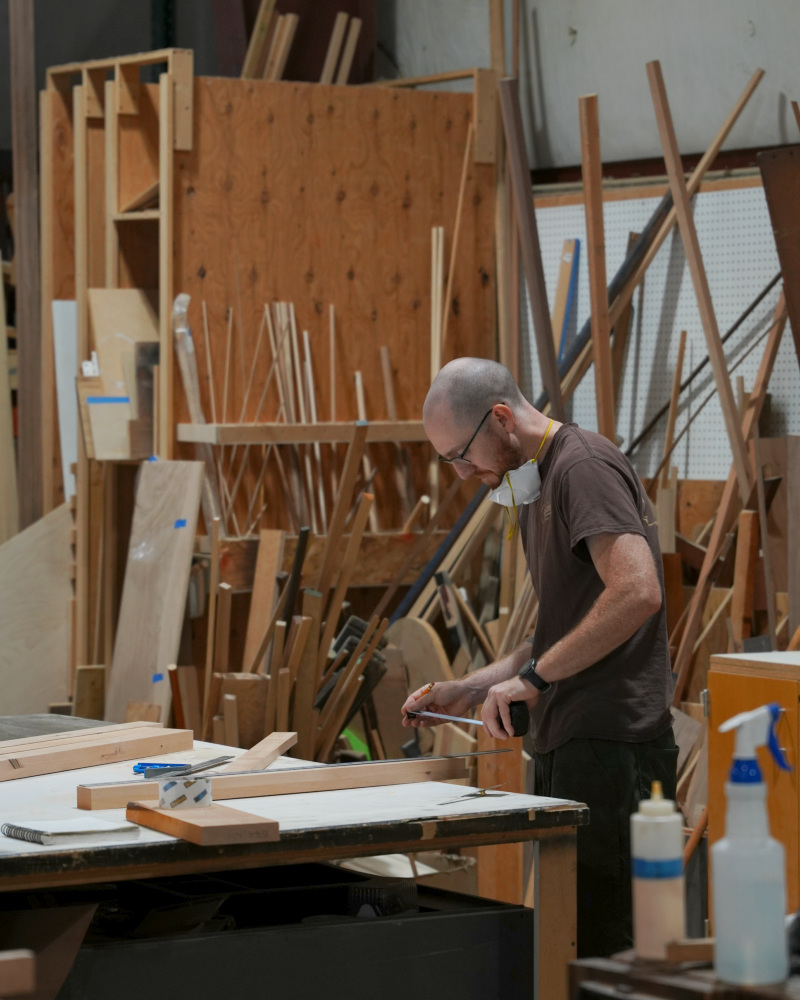
Board selection took most of a morning. Because the client wanted the table and bench to match, we laid out rough stock from the same batch and chose boards for color consistency and grain direction before a single cut. Boards with wild figure went to the center of the tabletop where they'd be seen; straighter, calmer grain went to the legs and aprons where stability matters more than looks.
The build: glue-up, shaping, and assembly
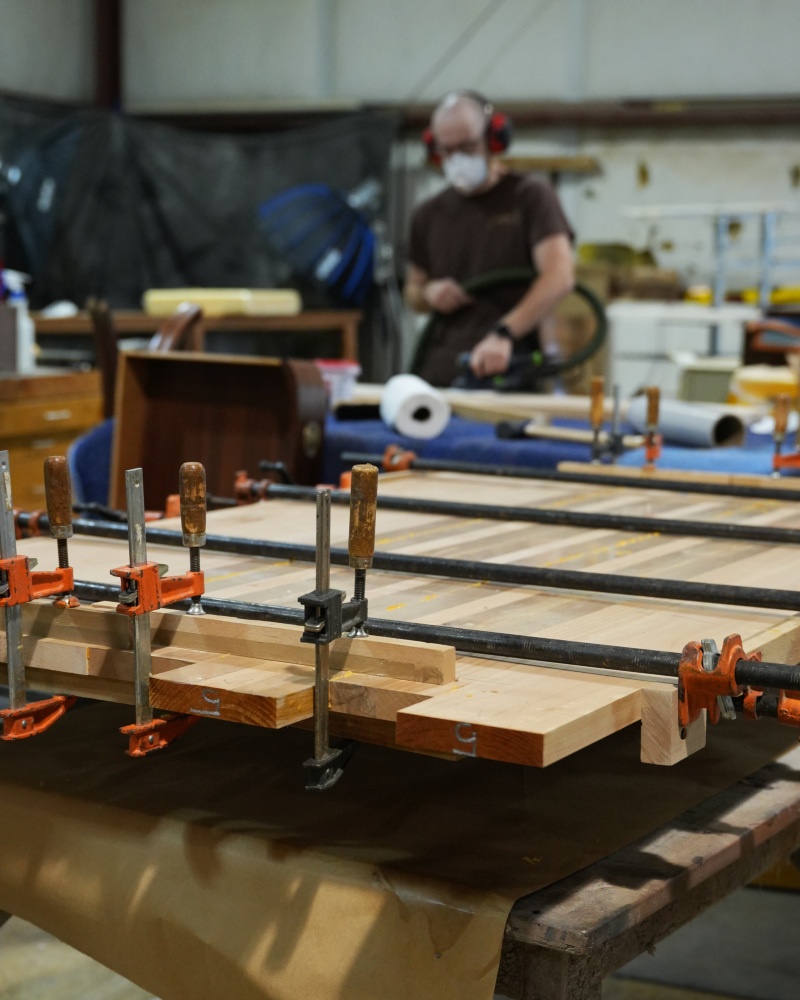
The tabletop came together as a panel glue-up: milled boards edge-jointed, glued, and pulled tight under a row of bar clamps alternating above and below the panel. Alternating clamp pressure is what keeps a wide panel from bowing while the glue cures. Once out of the clamps, the top was leveled, trimmed square, and sanded through progressively finer grits until the surface felt like glass under a bare palm.
Leg work happened at the bench. Each of the eight legs (four per piece) was tapered on two faces, then cut at a compound angle at the top so it meets the apron frame at the correct splay. Angled joinery like this is less forgiving than square joinery; a half degree of error at the top of a 32 inch leg puts the foot noticeably out of position at the floor. Our builders cut test joints in scrap first and checked the stance with a bevel gauge before committing the real stock.
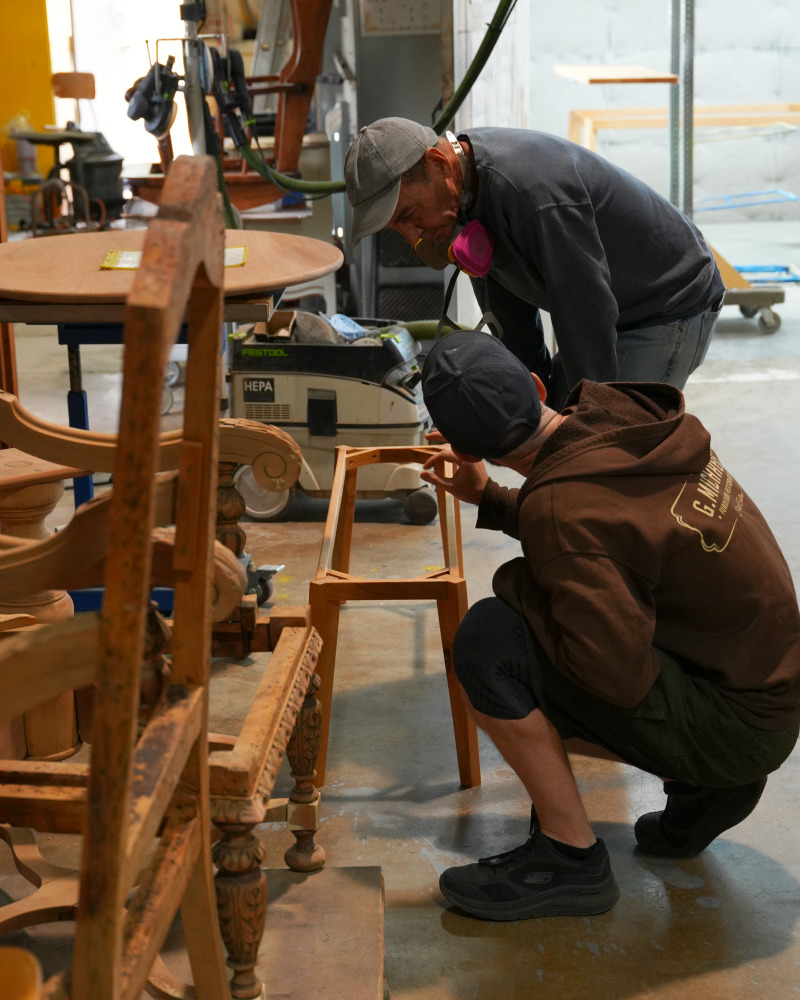
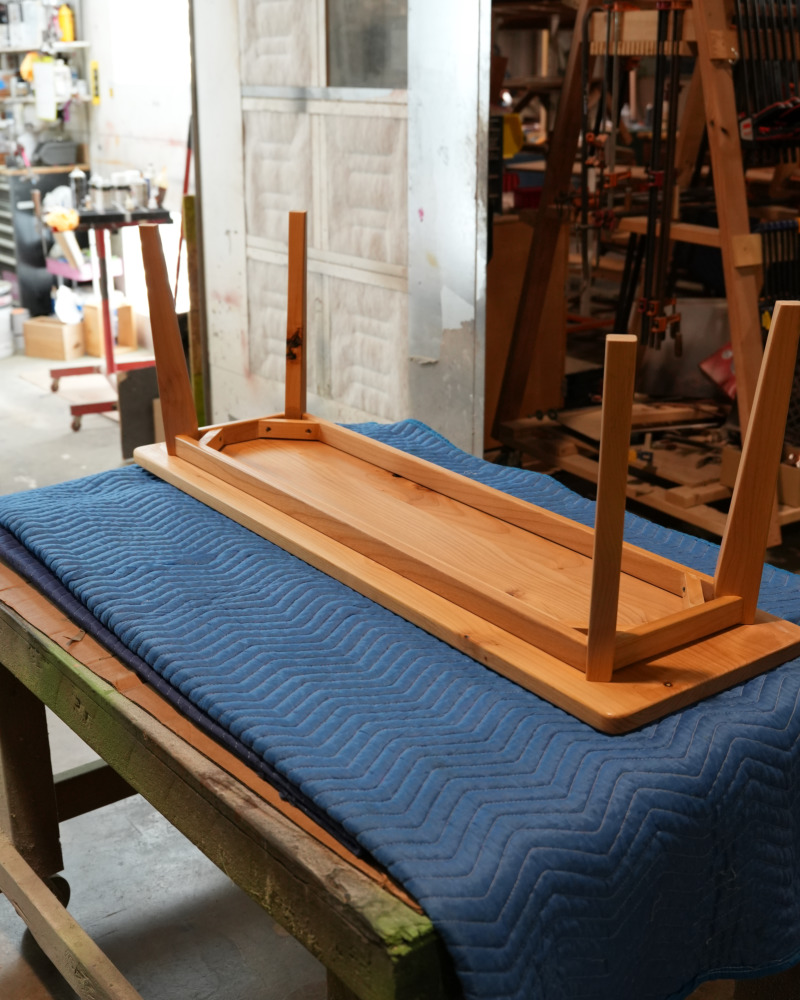
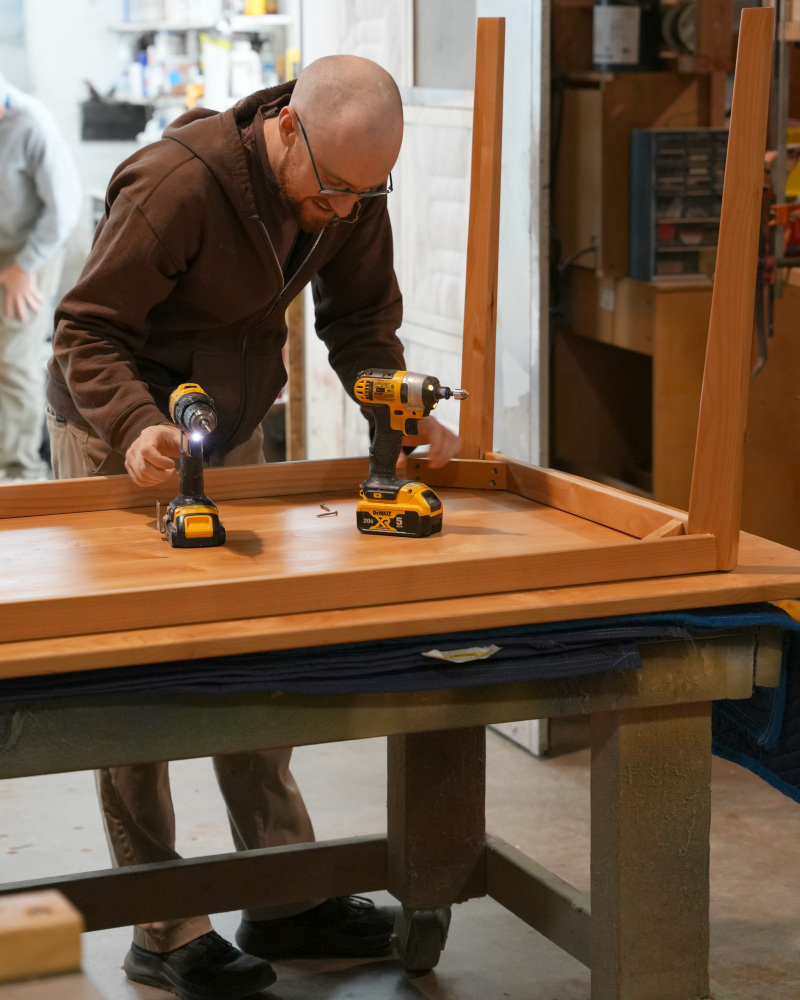
Assembly ran in stages. The apron frames were glued and clamped as units, the legs joined to them, and corner blocks added inside for rigidity. The tops went on last, fastened from below with screws through slotted holes rather than glue, a detail we'll come back to in the challenges section. Before finishing, the shop lead and a second craftsman went over both pieces together, checking every joint, easing every edge, and rocking the bench on a dead-flat surface to catch any wobble while it could still be corrected.
Three real challenges on this project, and how we solved them
1. Keeping a 38 inch panel flat in Colorado's dry air. Wood along the Front Range lives at roughly 20 to 35 percent relative humidity for much of the year, and a wide solid top will cup or crack if it can't move with the seasons. Two decisions handled this. First, the lumber acclimated in our shop for two weeks before milling, so it reached equilibrium with local conditions rather than the moisture level of wherever it was stored before. Second, the top was attached to the base through slotted screw holes instead of a rigid glue bond, which lets the panel expand and contract across its width without anything restraining it. A top that's bolted down tight looks fine in June and splits by February; this one won't.
2. Matching color across ten-plus boards and two pieces of furniture. Boards from the same species, even the same tree, can vary from pale cream to reddish brown. A table and bench that don't match read as mismatched furniture, not a set. The fix happened before the glue-up, not after: our finisher wetted each candidate board with solvent to preview its finished color, then the panels were arranged so tone shifts fall gradually across the width instead of jumping at a glue line. The bench top was glued up from boards pulled from the same sequence. No stain tricks were needed to fake consistency later.
3. Building a bench with splayed legs that doesn't rack. A bench takes worse abuse than a table. People drop onto it, slide along it, and tip it back on two legs, and splayed legs without a lower stretcher leave the joints doing all the work. Rather than add a stretcher (which the clients didn't want visually, and which becomes a shin magnet), we sized the leg-to-apron joints heavier than the bench's scale suggests and added glued corner blocks inside the apron frame. After assembly, one of our craftsmen did the unscientific but honest test: sat on the end, bounced, and twisted. Nothing moved.
Finishing in the spray booth
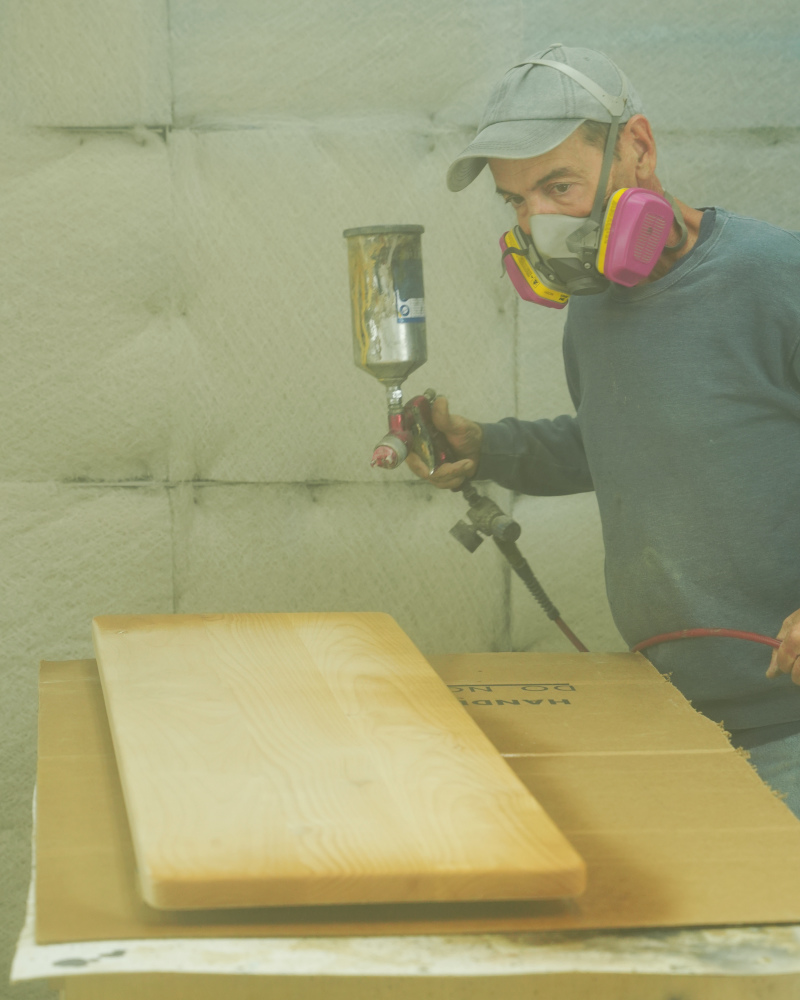
Both pieces were finished in our dedicated spray booth rather than brushed by hand. Spraying lays down a thinner, more even film than a brush can, with no lap marks and no bristle texture, and the booth's filtration keeps dust out of the wet surface. Our finisher applied a sealing coat first, scuff-sanded it once dry, then built up clear topcoats until the surface had the depth the clients wanted without looking like plastic.
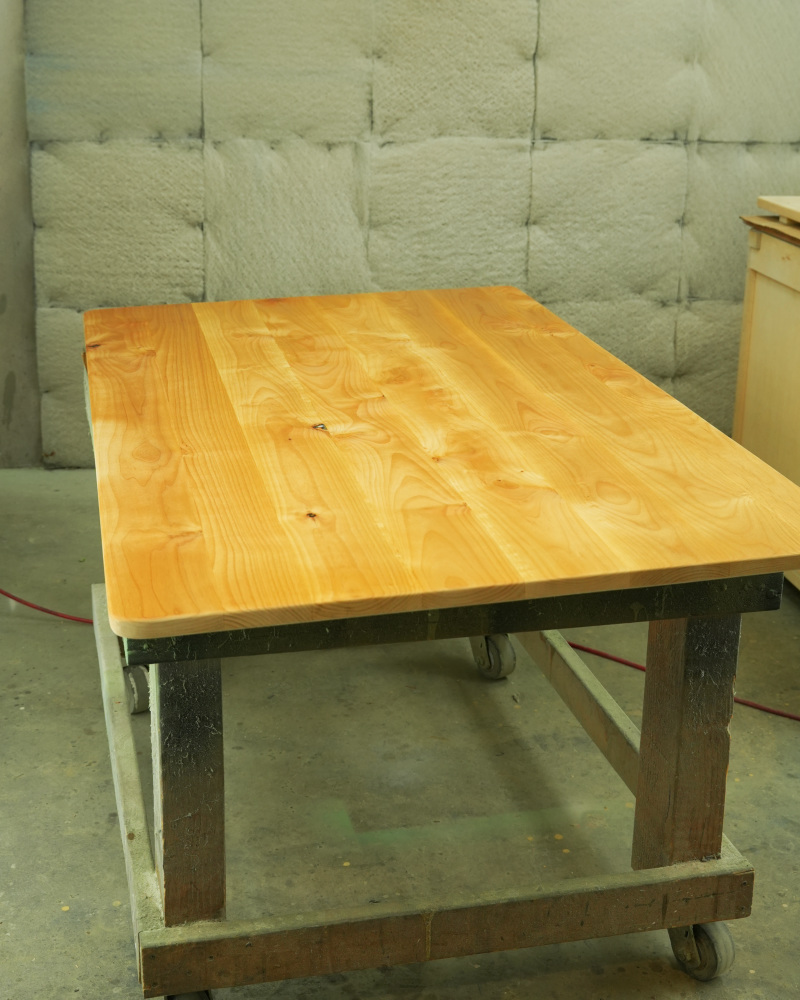
The color you see in the final photos is mostly the wood itself under a clear finish, warmed slightly so the table and bench glow rather than sit flat. A durable topcoat was the right call for this household: it resists water, handles hot plates within reason, and wipes clean. When it eventually wears decades from now, it can be refinished, which is the quiet advantage of solid wood over veneer. There's a full inch of material to work with.
Why families choose a made-to-order dining table
A custom solid wood dining table and bench costs more upfront than a flat-pack set, so it's fair to ask what that buys you. Based on what clients tell us after a few years of ownership, these are the points that hold up:
- Exact fit. The table is sized to your room and your seating count, not to a manufacturer's warehouse pallet. This project's 64 by 38 footprint exists because that's what the client's dining nook needed.
- Solid wood, full thickness. A one inch solid top can be sanded and refinished for generations. Veneered particleboard gets one life.
- Joinery built for your climate. Construction that accounts for Colorado's dry winters and seasonal swings, so the top stays flat and the joints stay tight.
- A matched set. Table and bench built from the same lumber batch, finished in the same booth, on the same day.
- Repairability. The shop that built it can fix it. A deep scratch or a dented edge is a service call, not a replacement purchase.
- One conversation, start to finish. You talk to the people cutting the wood, not a call center.
Custom-built vs. mass-produced: how the two actually compare
The honest trade-off sits in the last two rows. If you need a table this weekend at the lowest possible price, custom isn't the answer. If you want the last dining table you'll need to buy, it usually is.
Where we build and deliver
Our workshop sits in Fort Collins, and most commissions come from close by: Old Town families replacing a table that's hosted thirty years of dinners, Midtown households furnishing a remodel, and newer homes out along the Harmony corridor and in south Fort Collins where builder-grade furniture never quite fit the space. Loveland, Windsor, Timnath, and Greeley are all short drives for consultations and delivery.
We also build regularly for the Denver metro. Clients in Denver proper, Boulder, Longmont, Westminster, Arvada, Thornton, Lakewood, and Highlands Ranch commission pieces from us and either pick them up or schedule white-glove delivery. The drive from our shop to downtown Denver runs about an hour, which keeps site visits practical when a project calls for measuring a room before we draw anything.
Frequently asked questions
How long does a custom dining table with matching bench take to build?
Plan on several weeks from approved drawing to delivery. Lumber acclimation alone takes about two weeks, and finishing adds drying time between coats that can't be rushed. We give a specific timeline with every quote and stick to it.
What wood holds up best in Colorado's dry climate?
Stable, well-dried hardwoods handle the Front Range well when the construction allows for seasonal movement. Species matters less than preparation: lumber that's been properly kiln-dried and then acclimated to local humidity before milling behaves predictably. If you're curious about how Colorado's climate shapes its trees and wood supply, the Colorado State Forest Service, headquartered here in Fort Collins at CSU, publishes solid research on the state's forests and wood products.
Can you build a bench to match a table I already own?
Yes, and it's a common request alongside our furniture restoration work. We match the wood species, profile the legs and edges to echo the original, and blend the finish color by eye and test board. Bring the table in or send clear photos with measurements and we'll tell you honestly how close a match is achievable.
Do you deliver to the Denver metro area?
We do. Denver, Boulder, Westminster, Arvada, and the surrounding metro are all within our regular delivery range, and we place and level the piece in your room rather than leaving boxes at the curb.
How should I care for a sprayed clear finish?
Wipe spills when you see them, use a damp cloth with mild soap for cleaning, and skip silicone-based polishes, which complicate any future refinishing. Trivets under hot cookware are cheap insurance. That's the whole regimen.
Start your own table
The family from this case study now eats at a table built for their room, their routine, and their climate, and the bench disappears under it between meals exactly as drawn in that first sketch. If you've been measuring your own dining space and sketching on napkins, you're most of the way to a first conversation.
Contact G. Michael's Restoration or stop by the Fort Collins shop with your measurements, a photo of the room, and any inspiration pictures. We'll talk through wood options, sizing, and a realistic timeline, and you'll get a straight answer on cost before anything gets cut. Building furniture here since 1985 means the piece we make for you will outlast the trends, and probably the house.